Saint Fursey

An Irish monk crosses to a pagan kingdom
Fursey was born around 597, likely in Ireland, into a family with connections on both sides to figures already noted for their piety — later medieval genealogies link him to several other Irish saints, though how much of that lineage is reliable rather than retrospective embellishment is impossible to say for certain. What's better documented is his monastic formation in Ireland and his decision, sometime in the 630s, to leave for the kingdom of the East Angles in eastern England, part of a broader wave of Irish monks who spent the seventh century actively evangelizing across Britain and the Continent.
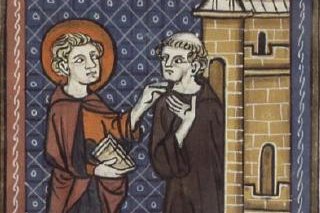
Richard de Montbaston and collaborators, manuscript miniature of Saint Fursey, Paris, 14th century — public domain.
He arrived at a useful moment. Sigebert, king of the East Angles, had spent time in exile in Francia, where he had been exposed to Christianity more thoroughly than was yet common among the Anglo-Saxon kingdoms, and welcomed Fursey's arrival as an opportunity to strengthen the faith's still-shallow roots in his territory. Sigebert granted Fursey land at a site called Cnobheresburg — generally identified by historians with the well-preserved Roman shore-fort at Burgh Castle in Norfolk — where Fursey founded a monastery that became an early and important center of Christian life in East Anglia.
The illness, and the vision that followed
It was during his time in East Anglia, according to Bede's account, that Fursey fell seriously ill and experienced the visionary episode for which he would become known across early medieval Christendom. Bede describes Fursey being taken out of his body during the illness and shown, by angelic guides, a series of increasingly intense scenes: choirs of angels and the voices of accusing demons contesting for the souls of the dead, and then a vast landscape of fire, which the angels explained to him was meant to test each soul according to what it had failed to burn away through repentance during its life — a purifying rather than simply punitive fire, in the account's own framing, though a genuinely terrifying one to witness.
The most vivid and specific detail in Bede's account describes a moment in the vision when a demon, in the midst of this fiery landscape, hurled a burning soul — someone Fursey had known in life, to whom he had shown some past kindness — directly at him, and the flame struck his shoulder and jaw. Bede reports, carefully, that he had this detail from a man who said he had known Fursey personally in life and had seen the resulting scar with his own eyes, a mark Fursey reportedly bore, visibly, for the rest of his life as a permanent physical trace of what he'd experienced in the trance. Bede's willingness to name his source and specify exactly how he came by the story is treated by historians as a genuine, careful citation, of a kind he doesn't extend to every anecdote in his history — a sign he considered Fursey's case unusually well attested for his time, even while the vision itself belongs to a genre of medieval religious experience that can't be independently verified.
Leaving England for Francia
However exactly the vision affected him, Fursey did not remain in England for the rest of his life. Sometime after Sigebert's death and amid growing political instability in East Anglia — including renewed threats from the pagan Mercian king Penda — Fursey left Cnobheresburg in the hands of his brothers and departed for Francia, on the Continent, apparently seeking a more settled environment to continue his monastic vocation. There he found favor with local Frankish nobility, who granted him land at Lagny, near modern Paris, where he founded a second monastery that, like his first, would go on to have a lasting institutional life well beyond his own lifetime.
Fursey's later years were spent partly in monastic administration and partly, by tradition, continuing to preach and share the substance of his earlier visions, which by this point had already begun circulating beyond his immediate community — a text describing them, the Visio Fursei, would go on to become one of the most widely copied and influential visionary accounts of the early medieval period, read and referenced for centuries afterward and cited by later writers, including Bede himself, as an important precedent for later medieval visions of heaven, purgatory, and hell.
Death near Péronne, and an enduring Irish pilgrimage site
Fursey died around 650 at a place called Mazerolles, near the town of Péronne in northern France, while traveling to visit relatives who had also emigrated to the Continent. His body was brought to Péronne itself and, according to tradition, was found some time later to be remarkably well preserved — a detail that early medieval Christians took as a further sign of sanctity, alongside the vision that had already established his reputation. Péronne subsequently developed into a significant pilgrimage destination, drawing enough Irish monks and pilgrims across the following centuries that it acquired the lasting nickname "Peronna Scottorum" — Péronne of the Irish — a title still cited by historians of the early medieval Irish presence on the Continent as evidence of how extensive and organized that presence had become.
A saint remembered for what he saw, not what he built
Unlike many founder-saints of the period, whose cults center on the institutions they left behind, Fursey's lasting reputation rests overwhelmingly on the content of a single illness-induced vision, transmitted through one of the most careful historians of the early Middle Ages. His feast is kept on January 16, and while veneration of him remains strongest in Ireland, in the part of Norfolk where Burgh Castle still stands, and around Péronne in France, his real historical significance lies less in geography than in influence: the Visio Fursei helped shape how medieval Christians across Western Europe pictured the fate of the soul after death, centuries before Dante gave the same basic architecture its most famous literary form.
Trivia
Who was Saint Fursey?
What visions did Saint Fursey experience?
Where did Fursey found his monasteries?
Why is the town of Péronne, France, connected to Fursey?
Is Bede considered a reliable source for Fursey's life?
You May Also Like
Related Reading