Saint Hildegard of Bingen

Visions kept private for decades
Hildegard reported experiencing visions from the time she was a small child, educated from a young age at the Benedictine cloister of Disibodenberg. But she didn't act on them publicly for decades. Only at 43 did she consult her confessor about what she had been seeing — a striking gap between the experience itself and any attempt to formalize or share it, suggesting a caution about her own visions that outlasted most of her adult life.
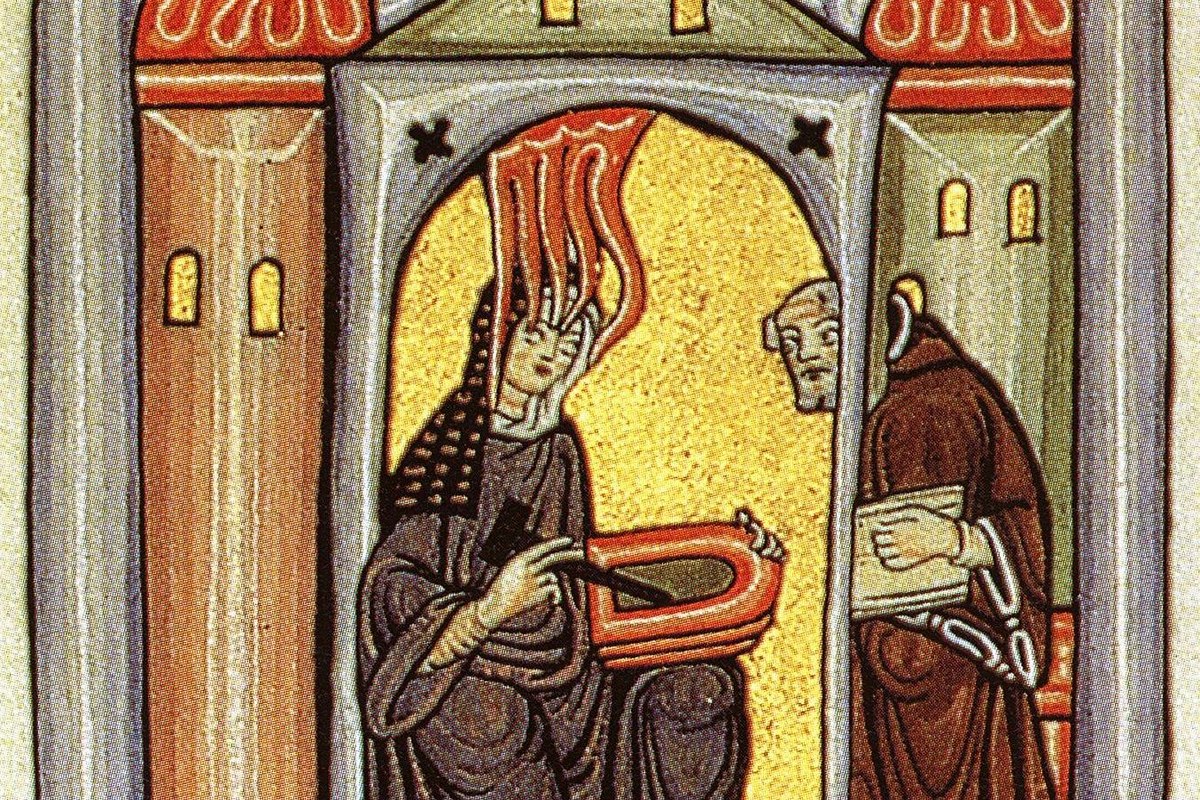
Illumination from the Rupertsberg Codex of Hildegard's "Liber Scivias," 12th century — public domain.
Confirmed by a Church investigation before a word was written
Her confessor reported the matter to the archbishop of Mainz, who convened a committee of theologians to examine whether Hildegard's visions were genuine. Only once that committee confirmed their authenticity was a monk assigned to help her begin recording them in writing. The resulting work, Scivias, took over a decade to complete (1141-1152) and consists of 26 visions treating themes as large as the nature of the Church, the relationship between God and humanity, and the path to redemption — a theological project undertaken only after formal institutional validation, not before.
From child oblate to abbess
Tradition holds that Hildegard's parents offered her to the Church as a tithe — the tenth child in a noble family, given over as an oblate around age eight — and placed her in the care of the anchoress Jutta of Sponheim, who lived a life of enclosure attached to the monastery of Disibodenberg. As other women joined Jutta's cell, it grew into a small Benedictine community, and when Jutta died in 1136, the nuns elected Hildegard, then in her late thirties, as their magistra, or superior. Records show this put her in charge of a religious community more than a decade before Scivias was even begun, and it was from this position of established, if still local, authority that she approached her confessor about the visions.
Not long after Scivias was completed, Hildegard sought and received permission to relocate her growing community away from Disibodenberg to a new site at Rupertsberg, near Bingen, over the objections of the monks who did not want to lose the prestige — and income — her community brought them. She later founded a second house across the Rhine at Eibingen. Both foundations were built and financially sustained under her direct administration, a level of practical, organizational authority unusual for an abbess of her period.
A preaching tour unusual for a woman of her time
In her sixties, Hildegard undertook several preaching tours through German lands, addressing clergy and laity in public settings — a role almost never granted to women in the twelfth-century Church. She also carried on an extensive correspondence with popes, bishops, abbots, and secular rulers, including Emperor Frederick Barbarossa, offering theological counsel and, on occasion, direct criticism of ecclesiastical corruption. Near the end of her life, her community faced a brief interdict — a suspension of the sacraments — after she permitted the burial of a man some clergy considered excommunicated; she defended the decision on the grounds that he had been reconciled to the Church before death, and the interdict was lifted only months before she died in 1179.
Viriditas and the iconography of a visionary healer
Hildegard's writings on medicine and nature are organized around a concept she called viriditas, or "greenness" — a life-giving vital force she saw running through creation and connecting bodily health to spiritual vitality. Two treatises, Physica and Causae et Curae, catalog plants, stones, and animals alongside remedies and explanations of disease, and this attention to viriditas has made her a recurring figure in devotional art tied to nature and healing. She's also the subject of a musical drama, Ordo Virtutim ("Play of the Virtues"), considered among the earliest surviving morality plays. In art, Hildegard is most often shown as she is on the Rupertsberg Codex illumination — seated with tongues of flame descending onto her head, a wax tablet in hand, and a scribe recording her words nearby, an image meant to convey that the visions came to her as illuminating fire rather than as something she composed on her own.
A canonization centuries in the making
Local veneration of Hildegard began soon after her death, and several attempts were made toward formal canonization in the centuries that followed, none of which reached completion. She was listed in the Roman Martyrology and venerated as a saint for centuries under the Church's older, pre-modern norms, even without a completed formal process. Pope Benedict XVI resolved this long-standing gap in 2012 through what is called "equivalent canonization" — a papal declaration extending existing widespread veneration and universal liturgical use of a person's cult, rather than a new judicial process with its usual miracles and postulators. Her feast day is celebrated on September 17, the date of her death.
A composer more prolific than any other medieval figure
Hildegard's talents didn't stop at theology. She was a gifted poet and composer, collecting 77 of her own lyric poems, each set to music she had composed herself, in a work titled Symphonia armonie celestium revelationum — "Symphony of the Harmony of Heavenly Revelations." More of her chant compositions survive today than those of any other composer from the medieval period, a body of musical work that exists alongside, rather than instead of, her visionary theology.
Science, medicine, and a rare kind of observation
Beyond music and mysticism, Hildegard also wrote treatises on medicine and natural history, noted by later scholars for a quality of careful, direct observation that was unusual for her era. That range — visionary theologian, composer, and natural scientist all at once — is part of why Pope Benedict XVI's 2012 declaration of her sainthood, followed later that same year by her recognition as a Doctor of the Church, felt less like a single achievement being honored and more like an entire, unusually varied body of work finally being recognized together. She remains one of only four women ever given that title.
Trivia
Why did Hildegard wait so long to record her visions?
What is Scivias?
What did Hildegard accomplish beyond theology?
When was Hildegard recognized as a Doctor of the Church?
What is viriditas?
Why did Hildegard's community face an interdict near the end of her life?
When is Hildegard's feast day?
Related Reading