The Angel in Zechariah's Night Visions

A prophet writing in the ruins of return
Zechariah begins his ministry at a specific, difficult moment in Israel's history. The Babylonian exile has ended, and Jewish families have started returning to Jerusalem — but the city they've come back to is a shadow of what it was, its Temple still in ruins, its walls broken, its people few and uncertain of what comes next. Zechariah's book opens not with a vision but with a call to honesty about the past: "The Lord was very angry with your ancestors," he reports, urging the people, "Return to me...and I will return to you" (Zechariah 1:2-3, NABRE), reminding them plainly that earlier generations ignored the same warning and paid for it.
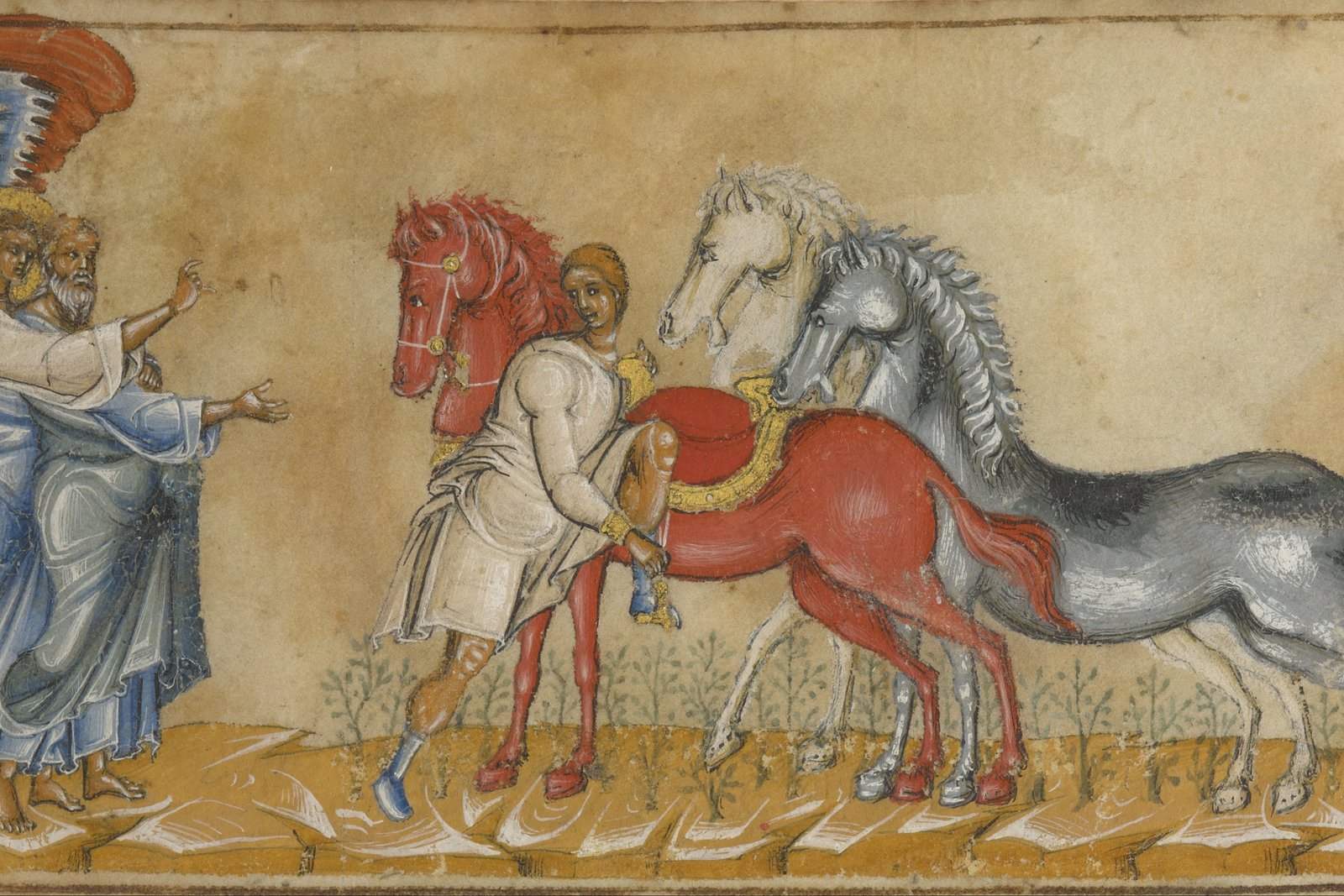
"The Vision of Zechariah," unknown illuminator, Sicily, about 1300, tempera and gold on parchment, Getty Center -- public domain.
It's against this backdrop of a fragile, half-rebuilt community that Zechariah begins receiving a series of night visions unlike almost anything else in the prophetic books — eight in total, densely symbolic, and populated by angelic figures who don't just deliver messages but actively guide the prophet through what he's seeing.
Patrol riders and an angel who explains
The first vision sets the pattern for what follows. "I looked out in the night, and there was a man mounted on a red horse standing in the shadows among myrtle trees; and behind him were red, sorrel, and white horses" (Zechariah 1:8, NABRE). Rather than trying to interpret the strange scene alone, Zechariah asks directly, "What are these, my lord?" and receives an answer from a figure the text introduces as "the angel who spoke with me" (Zechariah 1:9, NABRE) — a recurring guide who appears across several of these visions specifically to explain what the prophet is looking at.
The riders, it turns out, are patrols: "these are the ones whom the Lord has sent to patrol the earth," and their report back is almost eerily calm — "we have been patrolling the earth, and now the whole earth rests quietly" (Zechariah 1:10-11, NABRE). What follows is striking: the angel of the Lord himself responds to this report not with satisfaction but with something closer to grief, asking how much longer Jerusalem and Judah's cities will go without mercy after "these seventy years" of exile and anger (Zechariah 1:12, NABRE) — an angel interceding, in effect, on behalf of a struggling people.
A courtroom, an accuser, and a change of clothes
The third vision shifts entirely in tone and staging, moving from open fields and patrol riders to something closer to a courtroom. "He showed me Joshua the high priest standing before the angel of the Lord, while the adversary stood at his right side to accuse him" (Zechariah 3:1, NABRE). This Joshua is not the conquest-era commander who once knelt before the commander of the Lord's army outside Jericho centuries earlier — he's a contemporary of Zechariah, the high priest of the newly returned community, standing trial in a vision at the moment his people most needed their priesthood restored to legitimacy.
The Hebrew word rendered "the adversary" here — ha-satan — functions in this scene primarily as a title describing a legal role: an accuser positioned to prosecute, much as a prosecutor stands opposite a defendant in a courtroom. Whether this figure should be read as the same being later Christian tradition fully identifies as Satan the devil, or understood more narrowly as a heavenly prosecutorial office within this particular vision, is a genuine point where Scripture itself doesn't settle the question, and this article doesn't attempt to resolve it either.
What the angel of the Lord does next is unambiguous, regardless of how the adversary is identified: "May the Lord rebuke you, O adversary; may the Lord who has chosen Jerusalem rebuke you! Is this not a brand plucked from the fire?" (Zechariah 3:2, NABRE) — a direct rebuke, followed immediately by an act of restoration rather than a verdict argued point by point. Joshua stands "clad in filthy garments," a visual symbol of guilt, and the angel orders: "Remove his filthy garments," then tells Joshua directly, "Look, I have taken your guilt from you, and I am clothing you in stately robes" (Zechariah 3:3-4, NABRE). A clean turban follows. The accusation isn't refuted point by point in the text — it's simply overridden by an act of cleansing.
Explained beyond this one figure's suffering
What follows the change of clothing turns the vision from a single man's restoration into something with wider implications. The angel charges Joshua to walk faithfully in his priestly duties, and then extends the vision's meaning outward: "Hear, O Joshua, high priest! You and your associates who sit before you! For they are signs of things to come! I will surely bring my servant the Branch" (Zechariah 3:8, NABRE) — language later Jewish and Christian readers alike have connected to a coming messianic figure. The vision closes with an image of peace restored: "you will invite one another under your vines and fig trees" (Zechariah 3:10, NABRE), an idiom elsewhere in the Old Testament signaling security and rest after hardship.
A book built almost entirely on angelic guidance
What sets Zechariah's visions apart from many other prophetic books is how consistently angels function not just as messengers delivering a single line, but as ongoing interpreters — present across scene after scene, explaining, rebuking, and restoring in turn. The Catechism of the Catholic Church notes that Scripture records angels having "assisted the prophets" throughout salvation history among their many roles (CCC 332), and few Old Testament books demonstrate that assistance as visibly, or as strangely, as this one — a prophet in a broken, rebuilding city, guided night after night through visions he could never have made sense of alone.
Trivia
Who was the prophet Zechariah, and when did he write?
What is the 'angel who spoke with me' in Zechariah's visions?
Who accuses Joshua the high priest, and what happens to him?
Is 'the adversary' in Zechariah 3 the same as Satan the devil in later Christian tradition?
What do the different colored horses in the opening vision represent?
Related Reading