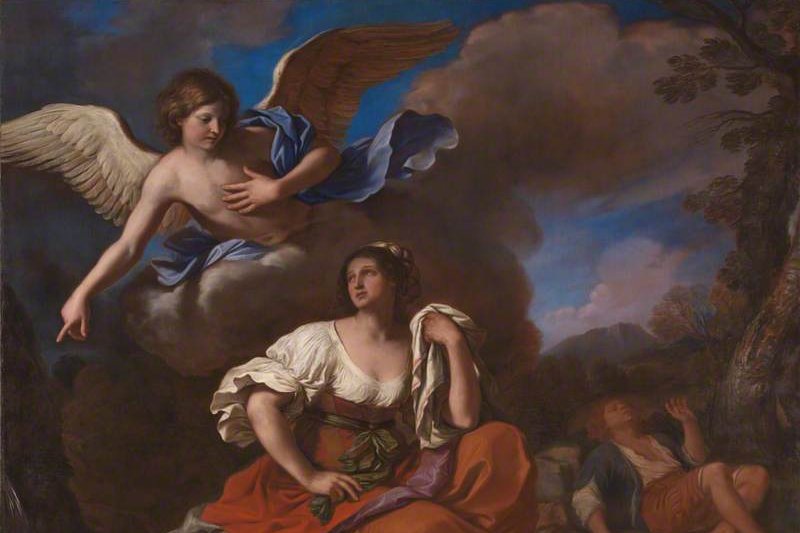
The Angelic Guide Who Measured Ezekiel's Temple

A vision that begins with a very specific date
Ezekiel is careful, almost unusually so among the prophets, about dating his visions precisely. This one, he tells us, comes "in the twenty-fifth year of our exile, at the beginning of the year, on the tenth day of the month, fourteen years after the city had been captured" (Ezekiel 40:1, NABRE) — a way of marking time that only makes sense to someone still counting the years since Jerusalem fell, still measuring his own life against a Temple that, by this point, has been rubble for over a decade.
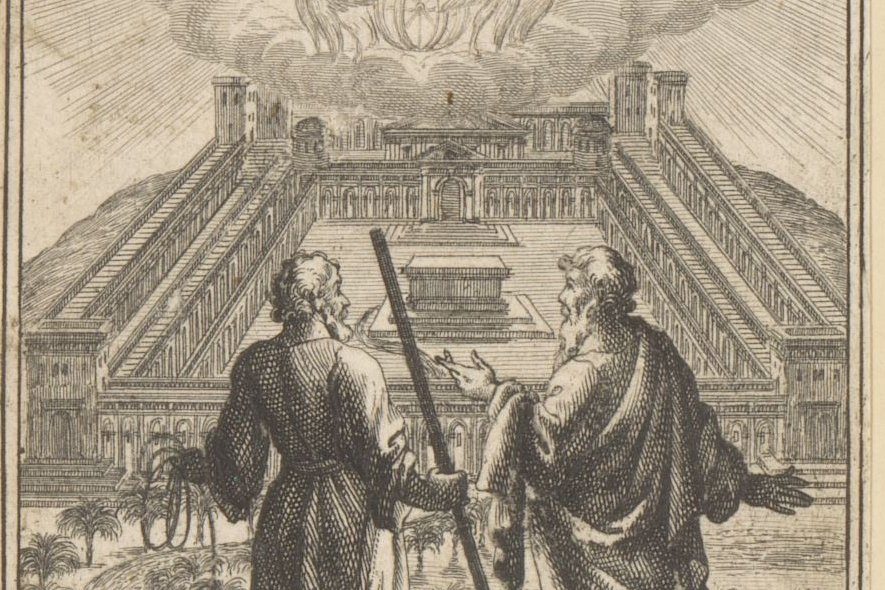
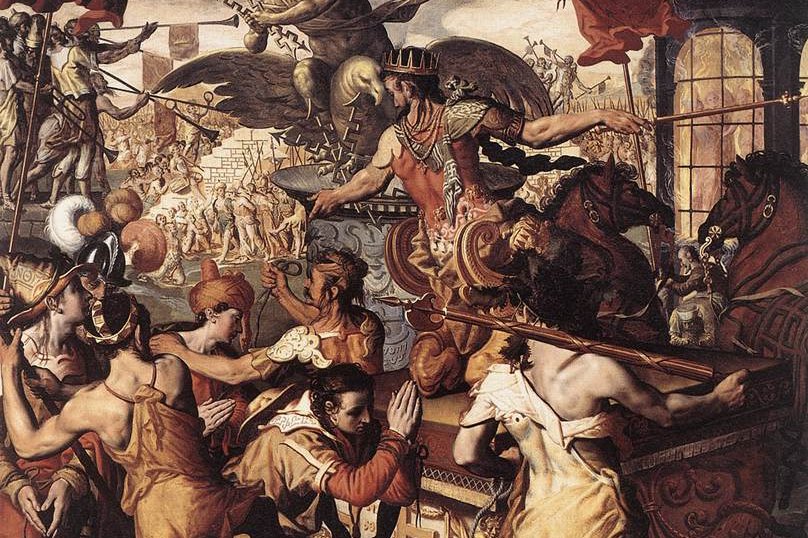
Rijksmuseum, "Ezekiel's Vision of the Temple to Be Rebuilt in Jerusalem," 1697 -- public domain (CC0).
It's in that state — displaced, writing from Babylon, with nothing left standing back home to return to — that Ezekiel describes being carried "in a divine vision" to "the land of Israel," set down on "a very high mountain," and shown "something like a city built on it" (Ezekiel 40:2, NABRE). What follows is one of the longest sustained visions in the entire Old Testament: three full chapters devoted almost entirely to architecture.
A bronze-bright figure with a measuring rod
Ezekiel doesn't have to interpret this vision alone. "There standing in the gateway was a man whose appearance was like bronze! He held in his hand a linen cord and a measuring rod" (Ezekiel 40:3, NABRE). The description is spare but distinct — not a description Scripture typically gives an ordinary human figure, and the role this "man" goes on to play across the vision matches how angelic guides function elsewhere in prophetic literature, walking a prophet through a scene too vast and symbolic to take in unassisted.
The guide's instruction to Ezekiel makes his purpose explicit from the outset: "Son of man, look carefully and listen intently. Pay strict attention to everything I show you, for you have been brought here so that I might show it to you. Then you must tell the house of Israel everything you see" (Ezekiel 40:4, NABRE). Ezekiel isn't simply a spectator; he's being trained as a witness, expected to carry every detail back to a scattered, discouraged people.
Measuring, gate by gate, room by room
What follows for nearly three chapters is measurement of an almost exhausting precision: gateways, thresholds, guard chambers, vestibules, courts, chambers for the priests, the dimensions of walls and pillars, recorded methodically as the guide moves from the outer wall inward. "Going to the gate facing east, he climbed its steps and measured the threshold of the outer gateway as one rod wide. Each cell was one rod long and one rod wide, and there were five cubits between the cells" (Ezekiel 40:6-7, NABRE) — and this pattern of careful, hands-on measurement continues, gate after gate, court after court, until the entire structure has been walked and recorded.
It would be easy for a modern reader to skim past the sheer volume of detail here, but the text itself explains why the precision matters. Once the tour is complete, God tells Ezekiel directly why he was shown all of it: "describe the temple to the house of Israel so they are ashamed for their sins. Let them measure its layout...tell them about the layout and design of the temple, its exits and entrances, with all its regulations and instructions; write it down for them to see, that they may carefully observe all its laws and statutes" (Ezekiel 43:10-11, NABRE). The exactness of the measuring isn't decoration — it's meant to produce an equally exact standard of obedience once the people hear it described.
The glory that had left, returning
The vision's emotional turning point comes once the measuring is finished. Ezekiel had recorded, in an earlier and far darker vision (Ezekiel 10-11), watching the glory of the Lord slowly withdraw from the doomed Jerusalem Temple before its destruction — a departure that, in the theology of the book, explained why the city could fall at all. This later vision reverses that departure point by point: "the glory of the God of Israel coming from the east...the glory of the Lord entered the temple by way of the gate facing east. Then the spirit lifted me up and brought me to the inner court. And there the glory of the Lord filled the temple!" (Ezekiel 43:2,4-5, NABRE). The same glory that had once fled an unfaithful city now fills a newly measured one, gate by gate the exact reverse of how it left.
Beyond architecture, a river of life
The guide's role doesn't end with the building itself. Later, in Ezekiel 47, he leads the prophet outside the temple to a stream flowing from beneath its threshold, growing steadily deeper the farther it runs, until Ezekiel is wading through water too deep to cross on foot. "Do you see this, son of man?" the guide asks, before explaining: "this water flows out into the eastern district...and empties into the polluted waters of the sea to freshen them. Wherever it flows, the river teems with every kind of living creature; fish will abound. Where these waters flow they refresh; everything lives where the river goes" (Ezekiel 47:6,8-9, NABRE). The precise, almost clinical measuring of walls and gates gives way, by the vision's end, to an image of overflowing, life-giving abundance — the same guide who counted every cubit of the temple's walls now showing Ezekiel water that turns even the dead sea toward life.
A vision still debated, a guide still remembered
Whether Ezekiel's temple describes a literal building still to come, a symbolic ideal never meant to be constructed exactly as measured, or something else entirely, remains genuinely disputed among Jewish and Christian interpreters, and Scripture itself doesn't settle the question outright. What the vision does leave clearly on record is the guide's patient, methodical presence throughout — measuring, explaining, asking Ezekiel directly whether he understands what he's seeing, and finally showing him water flowing out to make even ruined things live again.
Trivia
Who is the figure who measures the temple in Ezekiel's vision?
Why does the vision measure the temple in such exact detail?
What happens after the measuring is finished?
Does the guide do anything besides measure walls?
Was this temple ever actually built?
Related Reading