Ananias and Sapphira


A Church Built on Radical Generosity
To understand why Ananias and Sapphira's small deception mattered so much, it helps to see what came immediately before it in the Acts of the Apostles. Luke describes the earliest Jerusalem Christians living with a striking degree of shared ownership: "The community of believers was of one heart and mind, and no one claimed that any of his possessions was his own, but they had everything in common." (Acts 4:32). Those who owned land or houses sold them and brought the proceeds to the apostles, who distributed the funds "to each according to need" (4:35). Luke singles out one such donor by name just before the Ananias story begins — Joseph, called Barnabas by the apostles, who sold a field and laid the whole price at their feet (4:36-37).
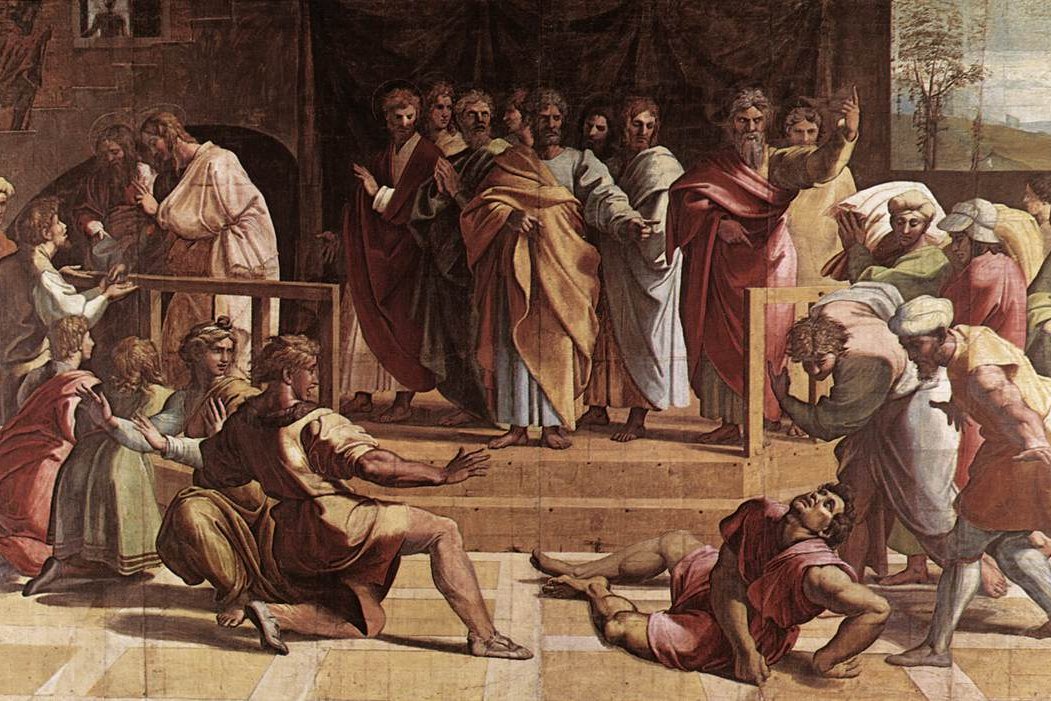
Raphael, The Death of Ananias (1515), Victoria and Albert Museum, London - Wikimedia Commons, public domain
This is the immediate backdrop against which Ananias and Sapphira's story unfolds. Their act was not, on its surface, unusual: another married couple choosing to support the growing community out of their own property, exactly as others around them were doing. What made it different — and what the text lingers on — was the deception underneath a public act that looked identical to genuine generosity.
The Sale, and the Lie
"A man named Ananias, however, with his wife Sapphira, sold a piece of property. He retained for himself, with his wife's knowledge, some of the purchase price, took the remainder, and put it at the feet of the apostles" (Acts 5:1-2). Luke's phrasing is careful and deliberate here: he does not say Ananias claimed the amount he brought was the full price, but the framing of the whole episode, and Peter's response to it, makes clear that this was the understood implication — the couple wanted credit for total self-sacrifice while privately keeping a reserve for themselves.
When Ananias brought his portion to the apostles, Peter's response was immediate and direct: "Ananias, why has Satan filled your heart so that you lied to the holy Spirit and retained part of the price of the land? While it remained unsold, did it not remain yours? And when it was sold, was it not still under your control? Why did you contrive this deed? You have lied not to human beings, but to God" (5:3-4). This is the theological center of the whole episode. Peter does not condemn Ananias for keeping money — he explicitly affirms that the land and its price belonged entirely to Ananias to do with as he pleased. The sin was the deception: presenting a partial gift under the guise of total surrender, and in doing so, lying not merely to the community but to the Holy Spirit dwelling within it.
"When Ananias heard these words, he fell down and breathed his last, and great fear came upon all who heard of it" (5:5).
Sapphira's Turn
The story does not end with Ananias. About three hours later, Sapphira arrived, apparently unaware that her husband had died or that his deception had been exposed. Peter gave her a direct opportunity to tell the truth, asking whether the land had sold for the amount stated. "Yes, that was the price," she answered (5:8) — repeating the same lie, unprompted and unpressured, showing her full and willing participation in the original scheme.
Peter's response names the deeper offense explicitly: "Why did you agree to test the Spirit of the Lord? Listen! The footsteps of those who have buried your husband are at the door, and they will carry you out" (5:9). "At once she fell down at his feet and breathed her last" (5:10), and Luke notes that the young men who had buried Ananias returned and buried her beside him. The episode closes with a summary judgment on its effect: "great fear came upon the whole church and upon all who heard of these things" (5:11) — the first time in Acts that Luke uses the word "church" (ekklesia) to describe the Christian community as a distinct body, a detail scholars have noted as significant given the weight of what has just happened to it.
Not Punished for Generosity's Limits
It is worth returning to the point Peter makes explicit, because it is easy to misread this story as condemning anyone who gives less than everything. That is not what happens here. Nothing in the text suggests partial giving was itself the problem, or that every believer in the early Church was expected to sell all property and hold nothing back — Peter's own words affirm the opposite, that the property and its price remained entirely Ananias's own affair before God, to give in whatever measure he chose.
What the story condemns is the specific act of dishonesty: claiming, publicly and before the community, a level of sacrifice that was not true, in order to receive praise and standing that had not been earned. The sin was not stinginess. It was fraud dressed as devotion, and it is that particular hypocrisy — using an appearance of holiness to deceive both the community and, as Peter insists, the Holy Spirit himself — that the episode treats with such severity.
An Early Church Still Being Tested
Ananias and Sapphira's story sits early in Acts, at a moment when the Jerusalem church was small, visible, and still defining itself in the eyes of both its own members and the wider world. The severity of the judgment against a private, easily hidden lie has struck many readers across the centuries as jarring, especially set against the mercy Jesus shows repeatedly toward far more public and dramatic sins elsewhere in the Gospels. Catholic commentary generally reads this contrast not as evidence of a harsher standard applied uniquely to this couple, but as underscoring how seriously the presence of the Holy Spirit within the newborn Christian community was to be regarded — deception against that presence carried consequences comparable to the gravity of offenses against God directly, rather than merely against other people.
The episode also serves a clear narrative function within Acts: it establishes, at the very outset of the Church's public life, that the community Luke is describing is not simply a voluntary social movement bound together by good intentions, but one animated by a real, active divine presence that could not be casually deceived. Readers curious about more of the early Church's formation may also enjoy Peter's Release from Prison and The Stoning of Stephen, two more episodes from Acts that show the young Jerusalem church under pressure from within and without.
Trivia
Where does the story of Ananias and Sapphira appear in the Bible?
What exactly did Ananias and Sapphira do wrong?
Why did Ananias and Sapphira die immediately after being confronted?
Did Peter know Sapphira was going to die when he questioned her?
How does Catholic tradition interpret Peter's harsh response, given the New Testament's emphasis on mercy?
Related Reading