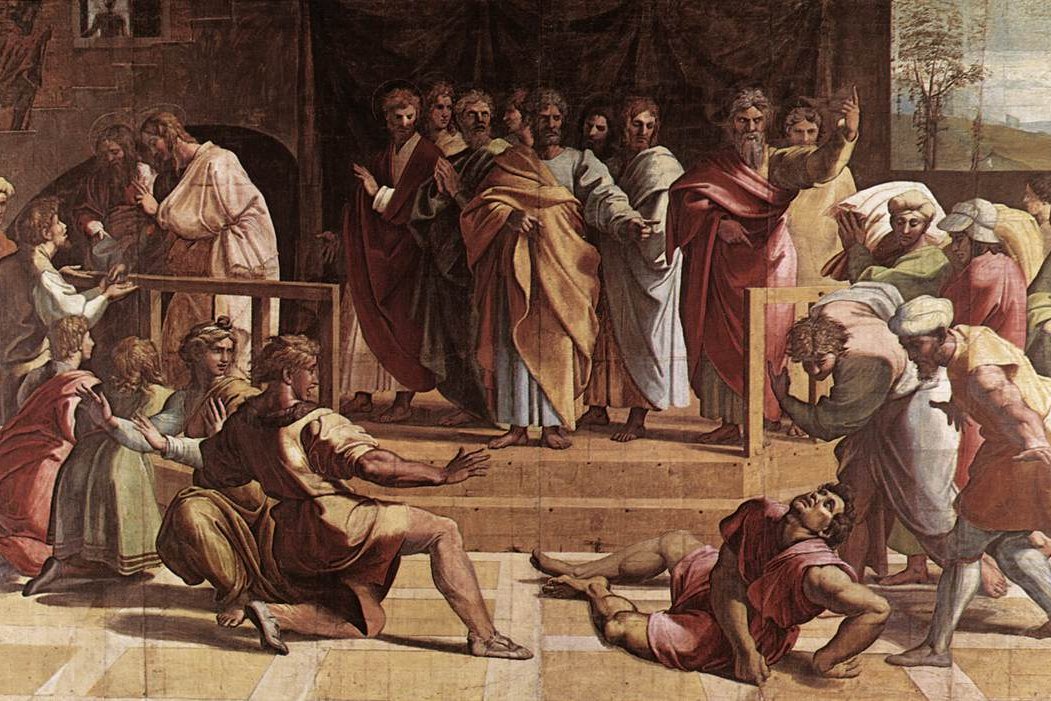
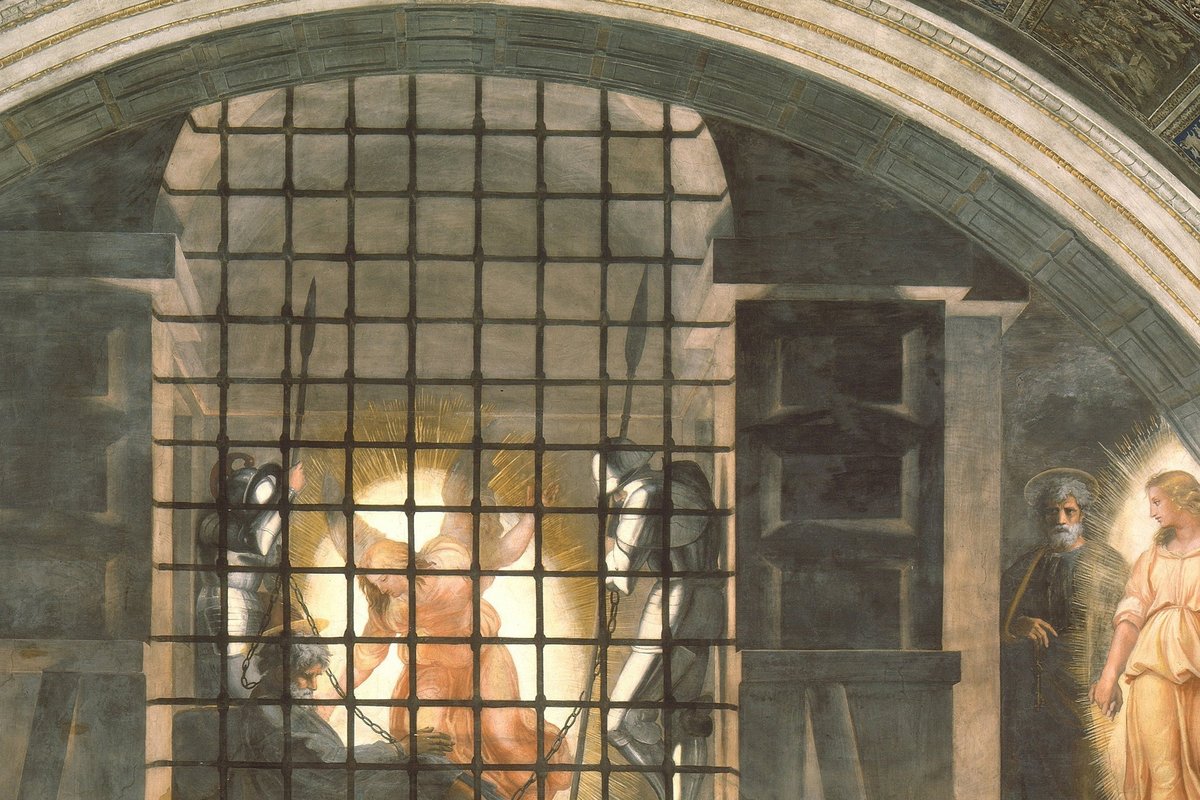
Paul and Silas in Prison, the Earthquake

An exorcism that costs someone money
The chain of events leading to this imprisonment starts with an unusual encounter in Philippi, a Roman colony in Macedonia. Paul and his companions were repeatedly followed by "a slave girl with an oracular spirit, who used to bring a large profit to her owners through her fortune-telling" (Acts 16:16), crying out that they were "slaves of the Most High God" proclaiming salvation (Acts 16:17). After days of this, "Paul became annoyed, turned, and said to the spirit, “I command you in the name of Jesus Christ to come out of her.” Then it came out at that moment." (Acts 16:18). The healing itself creates the problem: "when her owners saw that their hope of profit was gone, they seized Paul and Silas and dragged them into the public square before the local authorities" (Acts 16:19), accusing them not of exorcism but of "disturbing our city" and "These people are Jews and are disturbing our city and are advocating customs that are not lawful for us Romans to adopt or practice." (Acts 16:20-21).
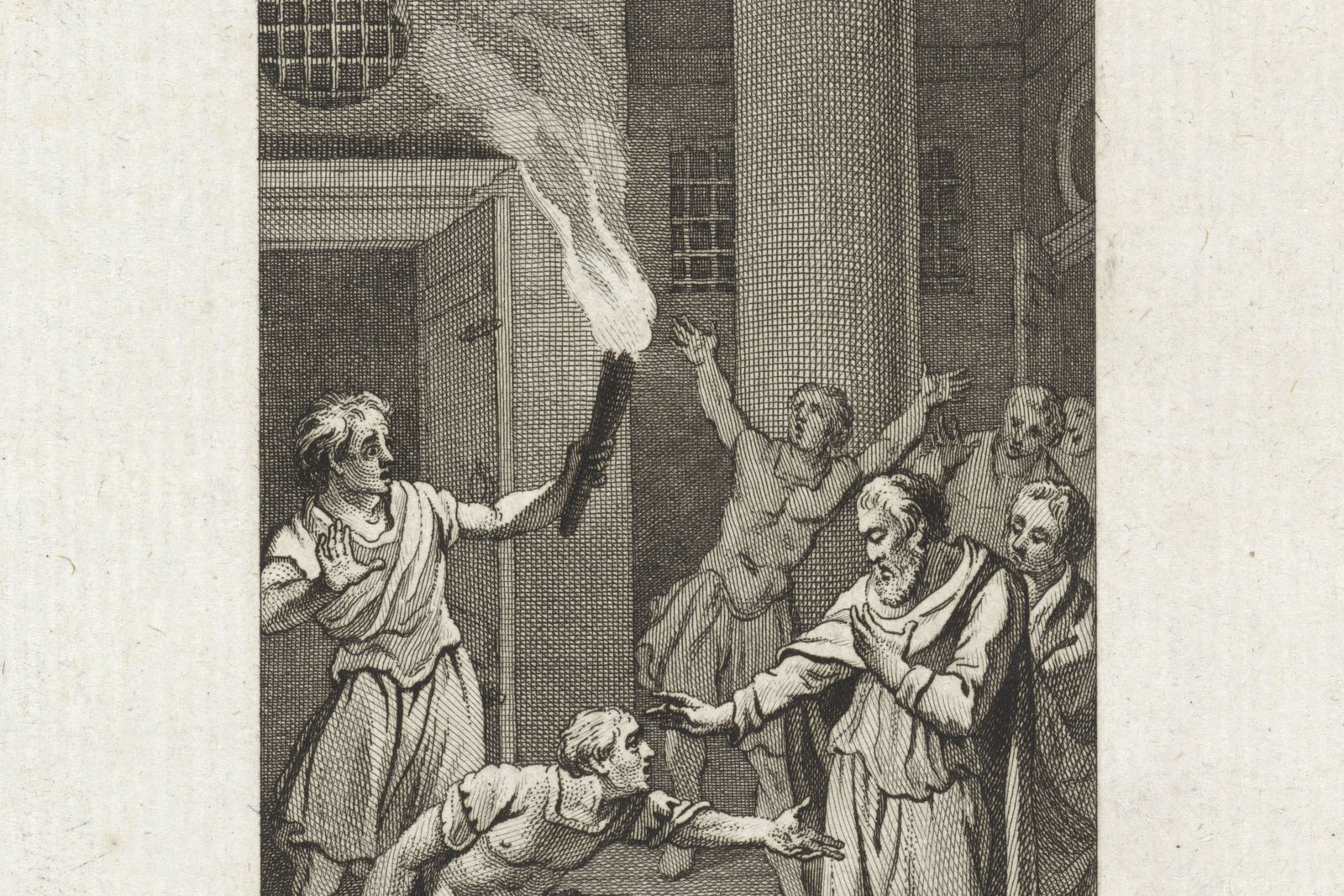
Rijksmuseum, "Paulus door een aardbeving uit de ketenen bevrijd" ("Paul freed from his chains by an earthquake"), 18th century engraving. Public domain (CC0).
Stripped, beaten, and locked in the innermost cell
The mob joins the accusers, and the response from the magistrates is swift and severe: "The crowd joined in the attack on them, and the magistrates had them stripped and ordered them to be beaten with rods. After inflicting many blows on them, they threw them into prison and instructed the jailer to guard them securely" (Acts 16:22-23). The jailer takes no chances: "he put them in the innermost cell and secured their feet to a stake" (Acts 16:24) — the most restrictive form of confinement available, well beyond what an ordinary prisoner would receive, reflecting how seriously the charges against them were being treated.
Singing hymns at midnight
What happens next is the detail that has made this story endure for two thousand years: "About midnight, while Paul and Silas were praying and singing hymns to God as the prisoners listened" (Acts 16:25). Freshly beaten, chained by the feet in the darkest part of the prison, with no reason to expect release, Paul and Silas spend the night not in despair but in prayer and song — audibly enough that Luke notes the other prisoners were listening. It's worth pausing on just how unusual this response is: nothing in the text suggests they knew rescue was coming. The praying and singing happen entirely without any promise that the night would end differently than it began.
A sudden earthquake, and doors that fly open
The response to their prayer is dramatic and immediate: "there was suddenly such a severe earthquake that the foundations of the jail shook; all the doors flew open, and the chains of all were pulled loose" (Acts 16:26). Not just Paul and Silas's chains, and not just their cell — every prisoner in the building finds themselves suddenly unbound, every door suddenly open, in the middle of the night.
A jailer about to take his own life
The jailer's reaction reveals just how high the stakes were for him personally: "When the jailer woke up and saw the prison doors wide open, he drew [his] sword and was about to kill himself, thinking that the prisoners had escaped" (Acts 16:27). Under Roman law, a guard who allowed prisoners to escape could face the same punishment the escaped prisoners would have received — for a jailer holding men accused of serious civil disturbance, that likely meant death. Rather than face that, he moves to end his own life before anyone can hold him responsible.
"We are all here"
It's at this exact moment that Paul intervenes, and not to make his own escape: "Paul shouted out in a loud voice, 'Do no harm to yourself; we are all here'" (Acts 16:28). None of the freed prisoners had fled — an extraordinary detail Luke doesn't explain, though the natural reading is that Paul and Silas's example, or the same divine intervention that freed them, held the whole prison in place. The jailer's response to being spared is instant and total: "He asked for a light and rushed in and, trembling with fear, he fell down before Paul and Silas. Then he brought them out and said, 'Sirs, what must I do to be saved?'" (Acts 16:29-30).
"Believe in the Lord Jesus"
Paul and Silas's answer is direct and unadorned: "Believe in the Lord Jesus and you and your household will be saved" (Acts 16:31). What follows moves quickly from crisis to hospitality: "He took them in at that hour of the night and bathed their wounds; then he and all his family were baptized at once. He brought them up into his house and provided a meal and with his household rejoiced at having come to faith in God" (Acts 16:33-34). The jailer who moments earlier was ready to kill himself is now washing the wounds of the men whose imprisonment he'd been ordered to secure, and his entire household is baptized before the night is over.
A morning reckoning, and Roman citizenship as leverage
The story doesn't end with the conversion. The next morning, the magistrates send word to quietly release Paul and Silas, but Paul refuses to leave without acknowledgment of the injustice done to them: "They have beaten us publicly, even though we are Roman citizens... And now, are they going to release us secretly? By no means. Let them come themselves and lead us out" (Acts 16:37). Roman citizens were legally protected from summary beating without trial, and Paul's invocation of that status — after already having been beaten in violation of it — forces the magistrates into an uncomfortable public apology (Acts 16:38-39), a detail that shows Paul using his own civil rights strategically even in service of the Gospel's spread, much as his own dramatic reversal from persecutor to apostle (see our article on the conversion of Saint Paul) had already reshaped how he moved through the Roman world.
A hymn in the dark, still sung today
This story has held a durable place in Christian memory and worship precisely because of what happens before the earthquake, not just after it — prayer and song offered with no guarantee of rescue, in the middle of real physical suffering and real uncertainty about what morning would bring. The image accompanying this article, an 18th-century Dutch engraving from the Rijksmuseum's collection, focuses on the moment of the earthquake itself: chains falling away, the prison's structure visibly disrupted, capturing in a single frame the abrupt reversal between midnight songs sung in the dark and the sudden, physical answer that followed them.
Trivia
Why were Paul and Silas arrested in Philippi?
How securely were Paul and Silas held?
What were Paul and Silas doing at midnight before the earthquake?
Why didn't Paul and Silas escape when the doors opened?
What happened to the jailer after this?
Related Reading