Christ Pantocrator

A title Scripture applies to God directly
"Pantocrator" isn't a later theological invention layered onto Christian art — it's a translation of a title Scripture itself uses. Revelation records God declaring: "I am the Alpha and the Omega," says the Lord God, "who is and who was and who is to come, the Almighty" (Revelation 1:8, RSV-CE) — with "Almighty" translating the Greek word pantokrator, literally "Ruler of All." Applying that same title to an image of Christ is, in effect, a visual claim about his identity: not simply a teacher or a healer, but the one Revelation names alongside God with this specific word.
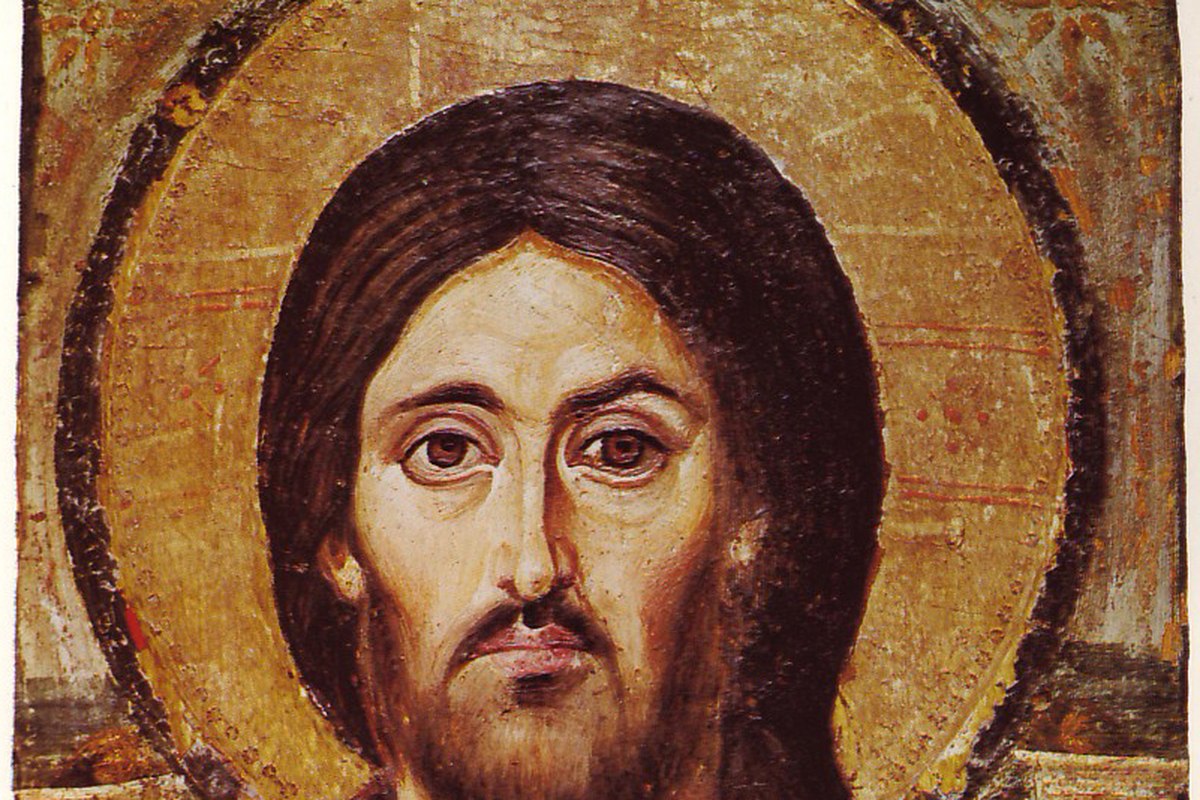
Christ Pantocrator icon, 6th century, Saint Catherine's Monastery, Sinai — public domain.
That claim carried real weight in the theological debates of the early Church. Councils in the fourth and fifth centuries had spent decades working out exactly how to describe Christ's identity without falling into one error or another — denying his full divinity, denying his full humanity, or splitting him into two separate persons rather than one. An image labeled Pantocrator, showing an unmistakably human face bearing the title Scripture reserves for God, was itself a kind of visual theology: a statement, understandable at a glance even by someone who couldn't read a word of Greek, that this one figure held both natures at once.
The oldest surviving face of Christ
Among the countless icons this title inspired, one stands apart simply by having survived. Painted in the 6th century using encaustic — a hot-wax painting technique that fell out of common use after Byzantine icon-making controversies in later centuries — the Sinai Christ Pantocrator is the oldest known icon of Christ in existence. Its survival owes entirely to location: preserved at the remote Saint Catherine's Monastery in the Sinai desert, it escaped the sweeping destruction of religious images during the Byzantine Iconoclastic period between 726 and 815 AD, a fate that claimed nearly all comparable icons produced before it.
The Iconoclastic controversy that the Sinai icon escaped was one of the most disruptive theological conflicts in Byzantine history. Beginning around 726, a series of emperors, believing that venerating painted images of Christ and the saints bordered on idolatry, ordered icons across the empire destroyed or plastered over, and had those who defended their use punished or exiled. The controversy wasn't finally settled in favor of icons until the Second Council of Nicaea in 787, and even then intermittent destruction continued into the ninth century. Saint Catherine's Monastery survived largely because of its extreme isolation at the base of Mount Sinai, far from the reach of imperial enforcement, and because the region fell for a time under Muslim rule following the Arab conquests — an administration with no particular stake in the internal Christian dispute over images, and under which the monastery's ancient artwork was simply left alone.
Two faces in one
Look closely at the icon, and something unusual becomes apparent: the two halves of Christ's face don't quite match. Art historians read this asymmetry as intentional rather than accidental — one side rendered calmer and more serene, the other more searching and intense. The effect is a single face built to hold two natures simultaneously: the two-dimensional, flatter side conveying divine transcendence, the more modeled, three-dimensional side conveying full, ordinary humanity, both joined in the hypostatic union central to Christian teaching about who Christ is.
Blessing and book, held together
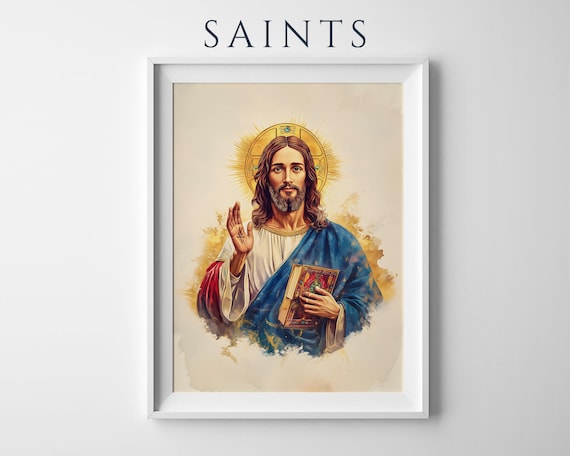
Compositionally, the icon shows Christ blessing with his raised right hand while holding a closed Gospel book in his left — an approachable gesture paired with the weight of the written word he represents. It's a combination that has echoed through nearly every Pantocrator image made since, in mosaics, frescoes, and icons across the Christian world, all tracing their basic visual grammar back to this single, weathered panel that outlasted thirteen centuries by simply being somewhere no one thought to destroy it.
A pattern repeated across the Christian world
Once the Iconoclastic controversy ended, the Pantocrator image became one of the most standardized compositions in all of Christian art, particularly suited to the domes of Byzantine and later Byzantine- influenced churches. Painters and mosaic artists placed an enormous, half-length figure of Christ, blessing and holding the Gospel, directly over the center of the church — positioned so that anyone standing in the nave and looking upward found Christ's gaze looking directly back down. Famous examples of this same essential composition survive in mosaics at the monasteries of Daphni and Hosios Loukas in Greece and in the cathedral of Cefalù in Sicily, each one, centuries after the Sinai icon and in a completely different medium, still built around the same core idea: blessing hand, closed book, and a face meant to hold both mercy and judgment in a single, steady expression. Byzantine theology held that an icon wasn't merely decorative but a kind of window — venerating the image was understood as honor passing through to the person it depicted, a distinction the Second Council of Nicaea took care to spell out precisely in order to separate proper veneration from the idolatry iconoclasts had feared. That theological framework is part of why the Pantocrator image endured so consistently across so many centuries and so many regions of the Christian world: it was never treated as simply one artist's interpretation, but as a faithful transmission of a fixed and weighty truth about who Christ is.
Trivia
What does 'Pantocrator' mean?
Why is the Sinai icon considered so significant?
Why do the two sides of Christ's face look different in the icon?
What is Christ holding and doing in the image?
Related Reading