The Four Evangelists and Their Symbols

Four writers, four faces
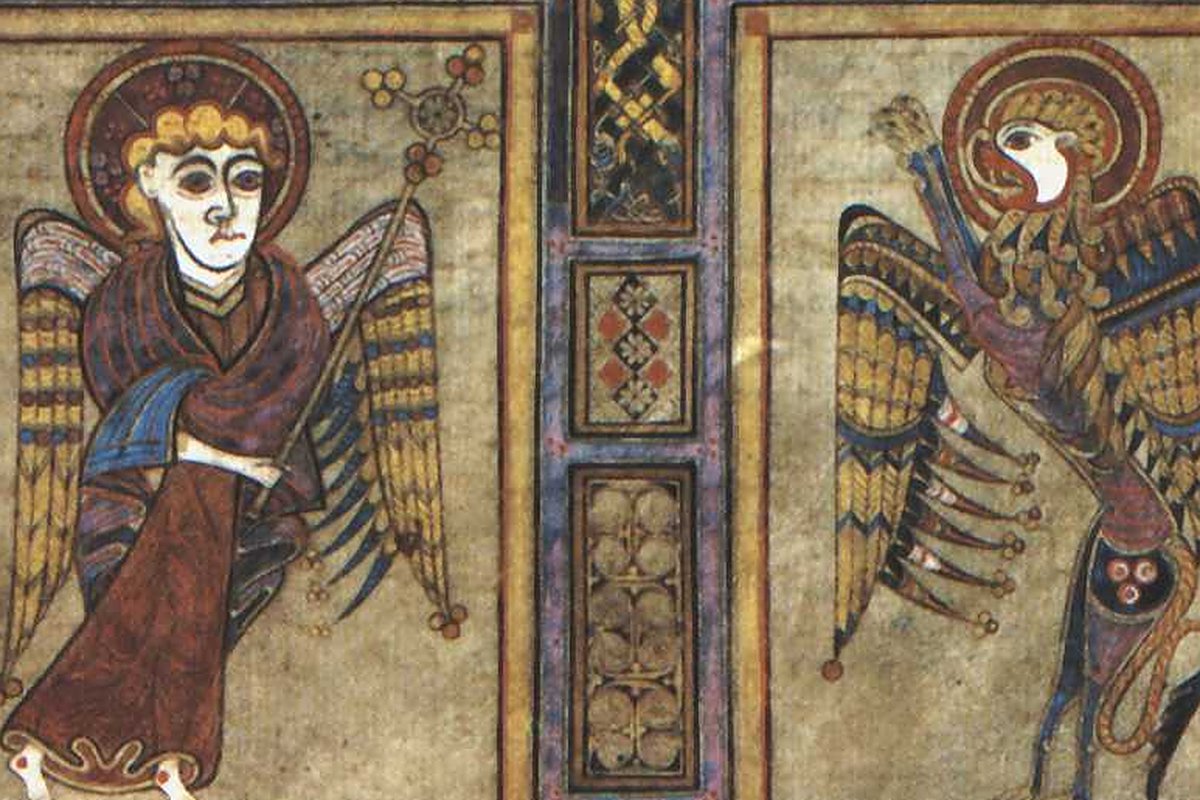
Matthew, Mark, Luke, and John are the four writers the Church recognizes as the authors of the canonical Gospels, the primary written accounts of the life, death, and resurrection of Jesus Christ. From very early in Christian history, artists and theologians paired each of the four with a specific symbolic creature — a winged man, a winged lion, a winged ox, and an eagle — collectively known as the tetramorph, from the Greek for "four forms." You'll find the set carved into cathedral tympana, painted onto illuminated Gospel manuscripts, worked into stained glass, and set into the corners of countless icons of Christ in Majesty, almost always in the same fixed arrangement.
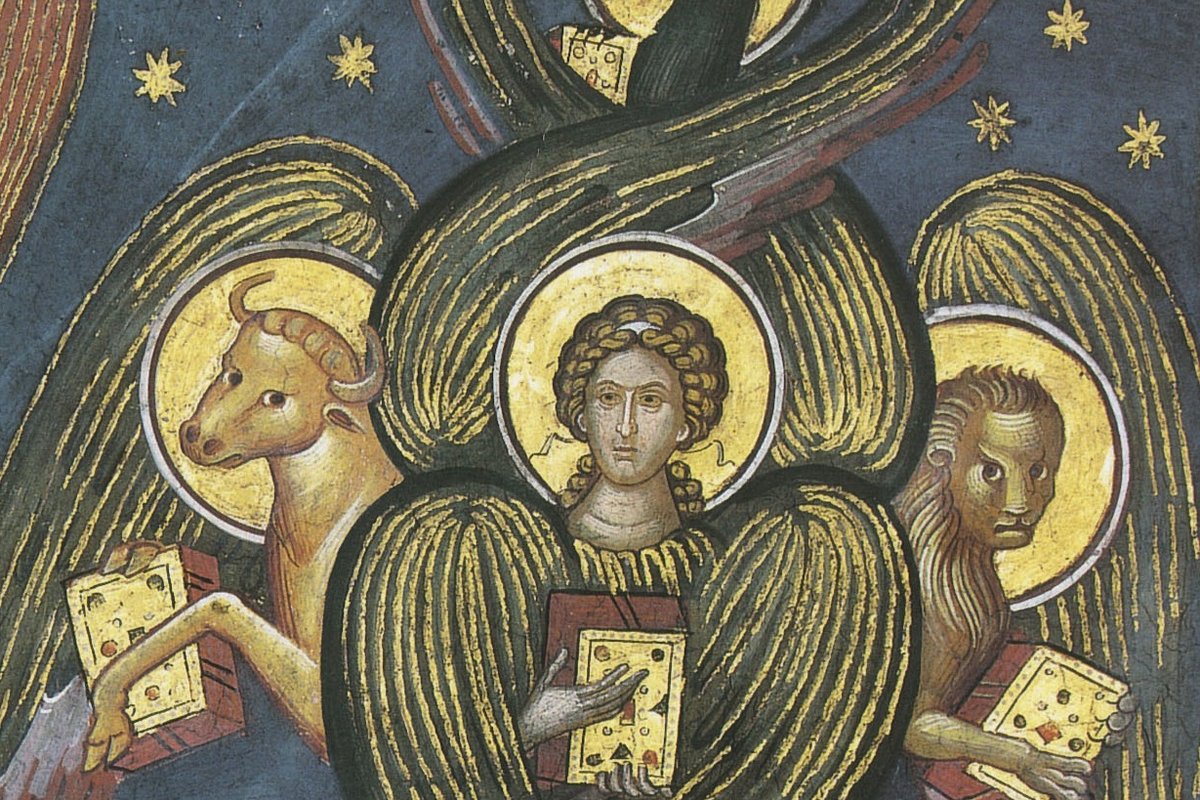
Unknown artist, tetramorph fresco, 16th century, Meteora monasteries, Greece — public domain.
Christ in Majesty, surrounded by four faces
The tetramorph rarely appears in isolation. Its most common setting, especially in Romanesque church art, is surrounding a central image known as Christ in Majesty — Christ enthroned in glory, often within an almond-shaped frame called a mandorla, with the four winged creatures arranged at the corners. That composition traces directly back to the throne visions in Ezekiel and Revelation, where the four living creatures surround God's own glory; placing the Evangelist symbols in the same position visually argues that the Gospels themselves surround and testify to Christ, the same way the four creatures surround the divine throne in the original prophetic visions. You can see the arrangement carved above countless Romanesque church doorways across France and Spain, and painted into illuminated Gospel books throughout the Middle Ages.
A vision borrowed twice over
The imagery didn't start with the Evangelists at all. Its root lies centuries earlier, in the prophet Ezekiel's opening vision, where four living creatures surrounding God's throne each have four faces — those of a man, a lion, an ox, and an eagle (Ezekiel 1:5-10). The same four-faced imagery resurfaces in the Book of Revelation, where John describes four living creatures around the heavenly throne, this time each bearing a single one of those four faces rather than all four at once (Revelation 4:7). Early Christian writers, most influentially Saint Irenaeus of Lyon in the 2nd century and later Saint Jerome, took that second vision and matched each of the four creatures to one of the four Gospel writers, reading the pairing directly out of how each Gospel opens or what it emphasizes about Christ.
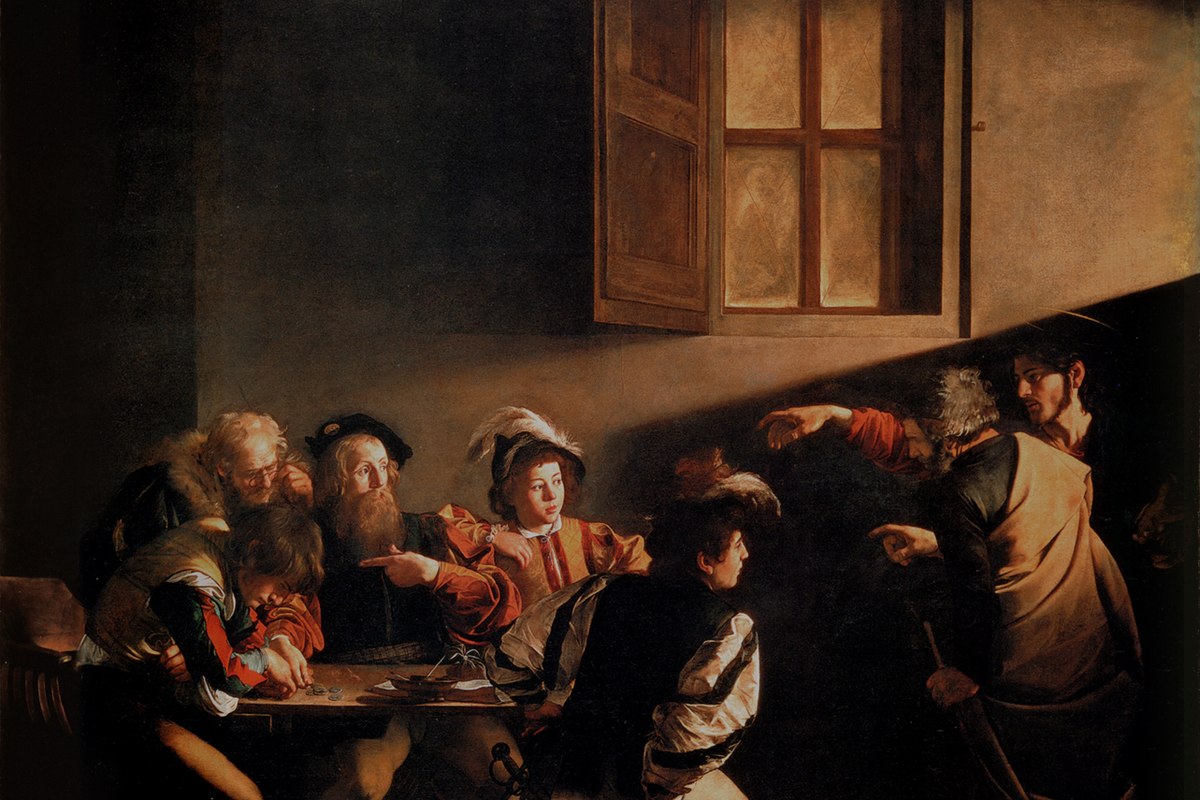
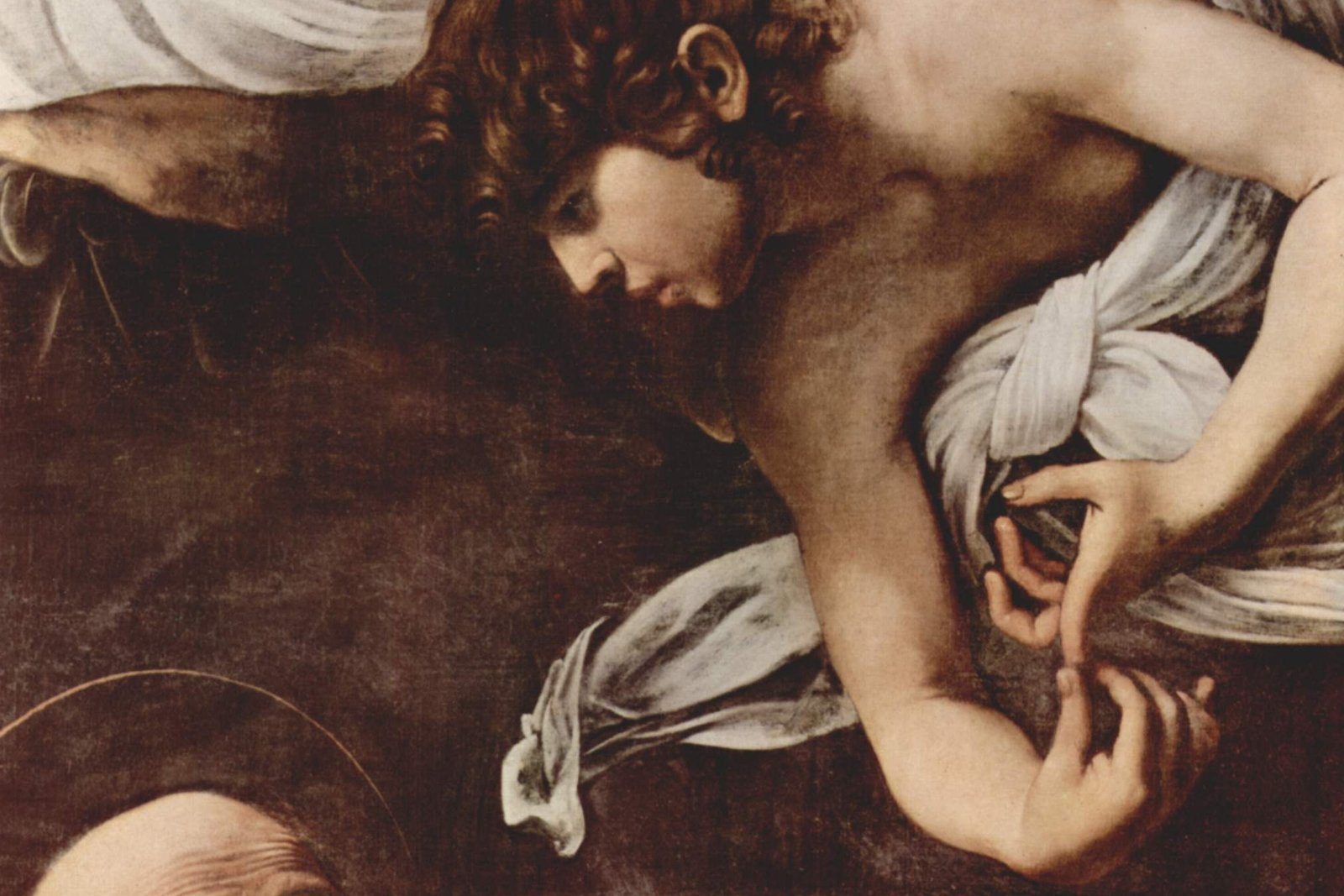
Matthew — the man, or angel
Matthew's Gospel opens with a long, deliberate genealogy tracing Jesus's human ancestry back through David to Abraham, grounding the story immediately in a specific human lineage and history. That emphasis on Christ's full humanity earned Matthew the winged man, or in some traditions an angel — the only one of the four symbols with an unmistakably human face. In Matthew's own story, a former tax collector called directly by Jesus, that human, grounded starting point fits naturally: his Gospel is the one most concerned with situating Jesus within the very human story of Israel.
Mark — the lion
Mark's Gospel opens abruptly in the wilderness, with John the Baptist's voice "crying out" to prepare the way of the Lord — an image early commentators connected to a lion roaring in the desert, combined with the lion's older association with royal and messianic power. No article yet exists on this blog specifically for Mark, but his symbol remains one of the most immediately recognizable of the four, especially as the emblem of the city of Venice, which claims him as patron and adopted the winged lion as its own civic symbol after acquiring relics believed to be his in the 9th century.
Luke — the ox
Luke's Gospel opens in the Jerusalem Temple with the priest Zechariah offering sacrifice, a scene that tied his Gospel from its very first lines to the ox, the traditional animal of Temple sacrifice. Luke's own account, told in fuller detail elsewhere on this blog, also carries a strong association with sacrifice and priestly ritual throughout, reinforcing the pairing well beyond its opening scene.
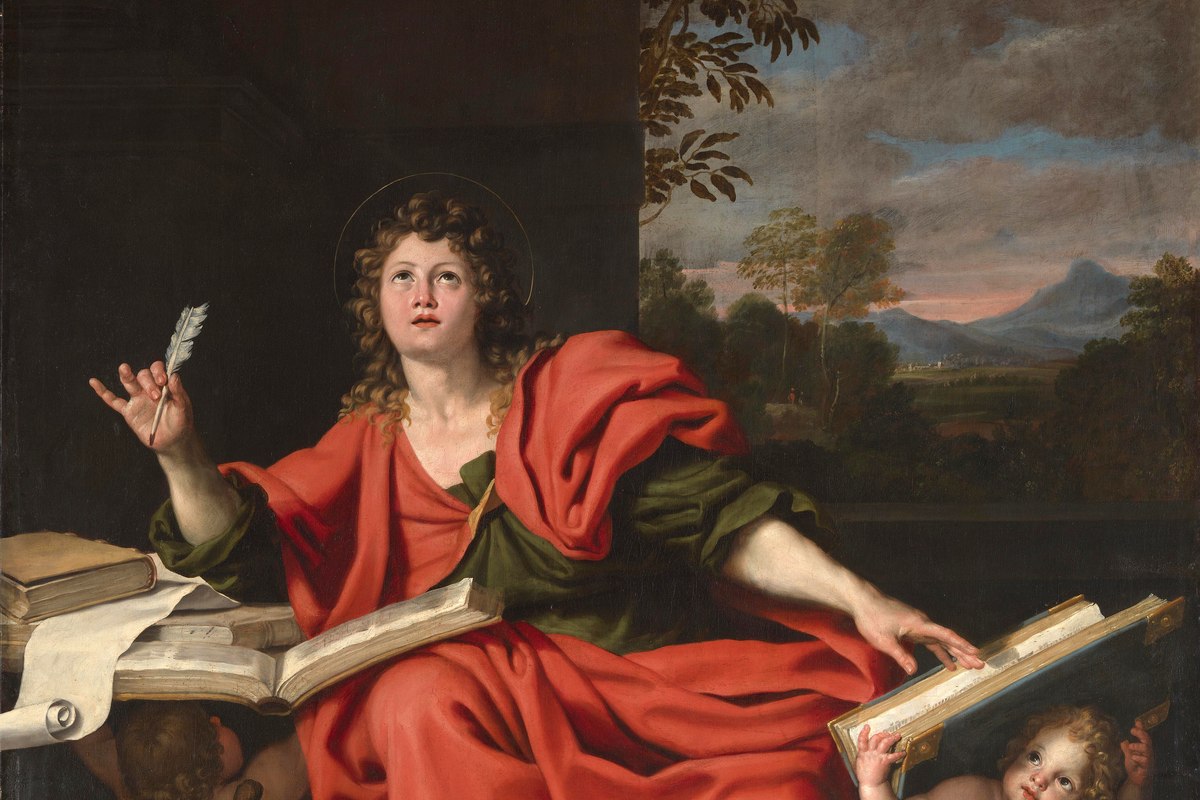
John — the eagle
John's Gospel takes a different route entirely, opening not with genealogy or Temple ritual but with soaring, cosmic language: "In the beginning was the Word, and the Word was with God, and the Word was God" (John 1:1). That vantage point — starting before creation itself rather than with any earthly event — earned John the eagle, prized in ancient tradition as the one bird believed capable of flying high enough and gazing directly enough at the sun to match the height of John's opening theology.
A code still worth reading
The tetramorph rewards a little familiarity precisely because it was never meant to be decorative filler — every winged lion carved into a cathedral doorway or painted into a manuscript margin is a compressed reference to a specific Gospel and the specific angle from which that Gospel chose to introduce Christ. Once you can read the four faces, the whole visual vocabulary of medieval Christian art opens up a little further.
Trivia
What are the traditional symbols of the four Evangelists?
Where does this symbolism come from?
Why is Matthew represented by a man or angel?
Why is Mark represented by a lion?
Why is Luke an ox and John an eagle?
You May Also Like
Related Reading