The Finding of Jesus in the Temple

A family on the road, and a boy gone missing
Every year, Luke tells us, Mary and Joseph traveled to Jerusalem for the feast of Passover, one of the great pilgrimage festivals of Jewish life (Luke 2:41, NABRE). When Jesus turned twelve, he made the trip with them for the first time as a boy on the edge of religious adulthood. Twelve was a meaningful age in first-century Jewish life — not yet the formal threshold of adult observance, but close enough that a boy would have started taking on more responsibility for his own religious practice.
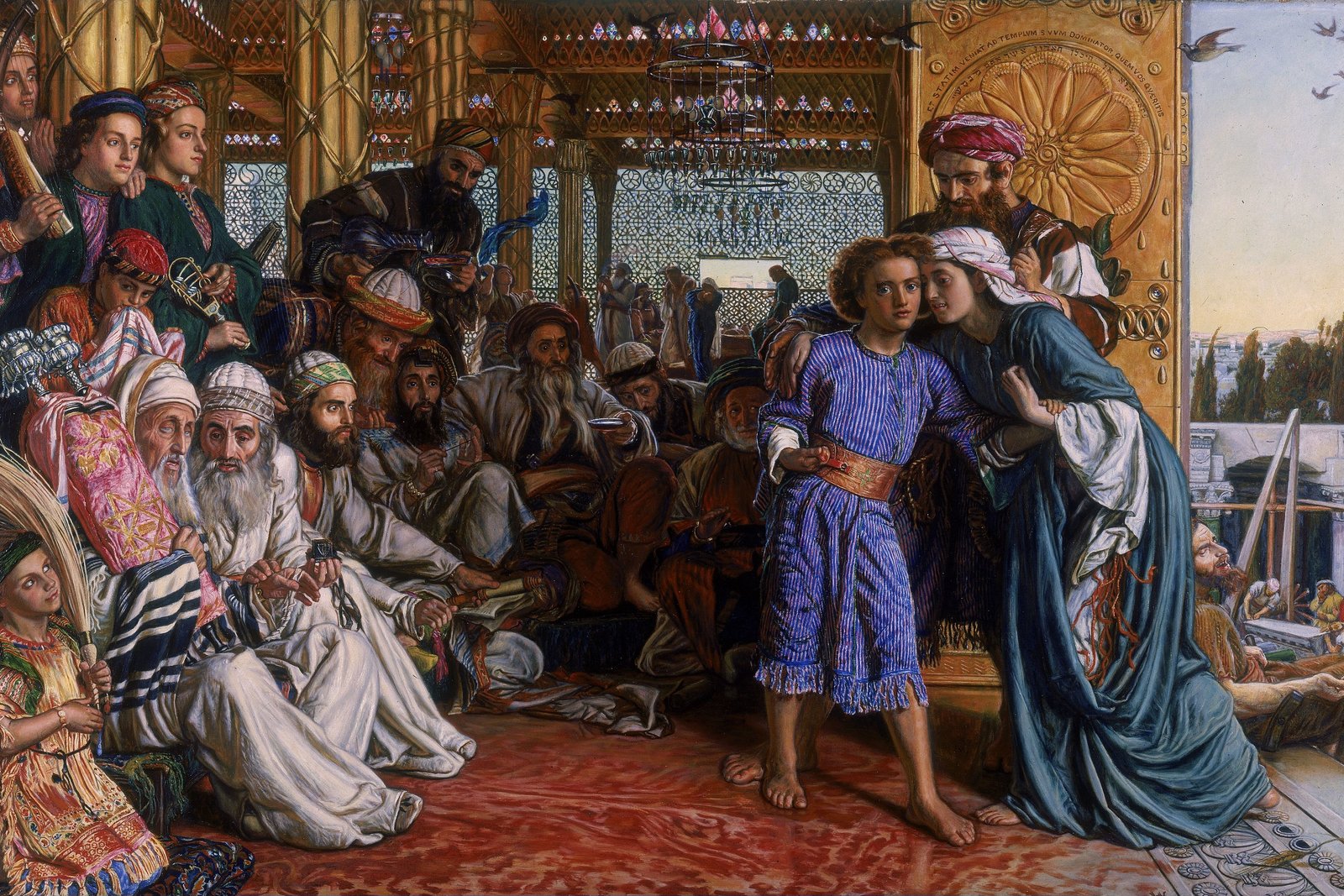
William Holman Hunt, "The Finding of the Saviour in the Temple," 1860, Birmingham Museum & Art Gallery — public domain.
The feast ended, and the extended caravan of family, neighbors, and fellow pilgrims began the journey home to Nazareth. It's easy to imagine how it happened: in a large traveling group, parents might reasonably assume a twelve-year-old was somewhere among the relatives, walking with cousins or family friends. Luke says exactly that — Mary and Joseph "were returning" before they realized Jesus "remained behind in Jerusalem," and they didn't notice until they'd already traveled a full day (Luke 2:43-44, NABRE).
Three days of searching
What follows is one of the few moments in the Gospels where we see Mary and Joseph simply as anxious parents. They turned back to Jerusalem and searched for their son among relatives and acquaintances first, then, not finding him, combed the city itself. Luke doesn't dwell on their emotional state, but the bare facts do the work: a missing child, a city without cell phones or the modern conveniences of a search, and three days — the text specifies "after three days" — before they found him (Luke 2:46, NABRE). For any parent, ancient or modern, that detail alone carries the story's weight.
They found him, finally, in the Temple — not lost, not frightened, but "sitting in the midst of the teachers, listening to them and asking them questions" (Luke 2:46, NABRE). The scene is a striking reversal of what they must have feared. Instead of a boy in danger, they found their son engaged in serious religious discussion with the scholars of Jerusalem, and Luke notes that "all who heard him were astounded at his understanding and his answers" (Luke 2:47, NABRE).
"Did you not know?"
Mary's first words on finding him are the words of any exhausted, frightened parent: "Son, why have you done this to us? Your father and I have been looking for you with great anxiety" (Luke 2:48, NABRE). Jesus's answer is the theological center of the passage, and also its most puzzling line: "Why were you looking for me? Did you not know that I must be in my Father's house?" (Luke 2:49, NABRE).
Scholars and saints alike have wrestled with what exactly Jesus meant. The phrase translated "my Father's house" could also be rendered "about my Father's business" or "among the things of my Father" — the original Greek is genuinely ambiguous. Either reading points to the same thing: a twelve-year-old boy asserting, gently but unmistakably, a relationship to God that goes beyond the ordinary. It's the first time in Luke's Gospel that Jesus speaks, and he uses the occasion to identify God, not Joseph, as his Father.
Luke is careful to note that this claim landed as a mystery rather than an explanation. "They did not understand what he said to them," he writes, and follows it with one of the Gospel's most quoted lines about Mary: she "kept all these things in her heart" (Luke 2:50-51, NABRE). It's a phrase Luke also uses after the shepherds' visit at Jesus's birth, suggesting a habit of quiet reflection rather than instant understanding — faith that holds a mystery without needing to solve it immediately.
Why the Temple setting matters
Luke's choice to place this scene inside the Temple rather than, say, at the family's lodging in Jerusalem isn't incidental to the story. The Temple was the physical center of Jewish religious life, the place where sacrifice was offered and where scribes and teachers of the Law gathered to debate and instruct, particularly during the crowded festival season when visiting scholars and pilgrims alike filled its courts. A twelve-year-old sitting among that company, holding his own in serious questioning rather than merely watching from the edges, would have struck any first-century reader as remarkable regardless of who the boy turned out to be. Luke sets the scene there deliberately, letting the location itself reinforce what Jesus's own words go on to say explicitly: that this house, and the God it belonged to, was where he most naturally belonged.
A boy who went home and obeyed
The episode doesn't end with a dramatic flourish. Jesus "went down with them and came to Nazareth, and was obedient to them," and Luke closes the chapter with a simple statement of ordinary growth: Jesus "advanced [in] wisdom and age and favor before God and man" (Luke 2:51-52, NABRE). After this one glimpse into his boyhood, the Gospels go silent on the next eighteen years of his life entirely.
For Catholic devotion, this account became the fifth Joyful Mystery of the Rosary, prayed as a reflection on the pain and relief of losing and finding something precious — a theme that resonates well beyond its original context. It also stands as the Gospels' sole window into Jesus's childhood, offering only this: a boy who could astonish the Temple's teachers, who spoke of God as his Father before anyone had taught him to, and who nonetheless went home and lived an ordinary, obedient life for years afterward. Readers interested in Mary and Joseph's earlier story might also enjoy the account of their betrothal.
Trivia
Where in the Bible is the story of the finding of Jesus in the Temple?
How old was Jesus when this happened?
What did Jesus say when his parents found him?
Is this considered one of the Joyful Mysteries of the Rosary?
Did Jesus's parents understand what he meant?
You May Also Like

Related Reading