Rebekah at the Well

An old servant, sent on an errand he couldn't fail
Genesis 24 opens with Abraham, now elderly, sending his most trusted household servant on a delicate mission: travel back to Abraham's own country and relatives, and find a wife there for his son Isaac — specifically forbidding the servant from letting Isaac marry a local Canaanite woman. It's a long journey and an enormous responsibility, resting entirely on the judgment of a man who has never met the family he's traveling to, with no way to verify character or suitability except through whatever happens once he arrives. Rather than trusting his own judgment alone, the servant does something distinctive as soon as he reaches the well outside the city of Nahor: he prays for a sign.
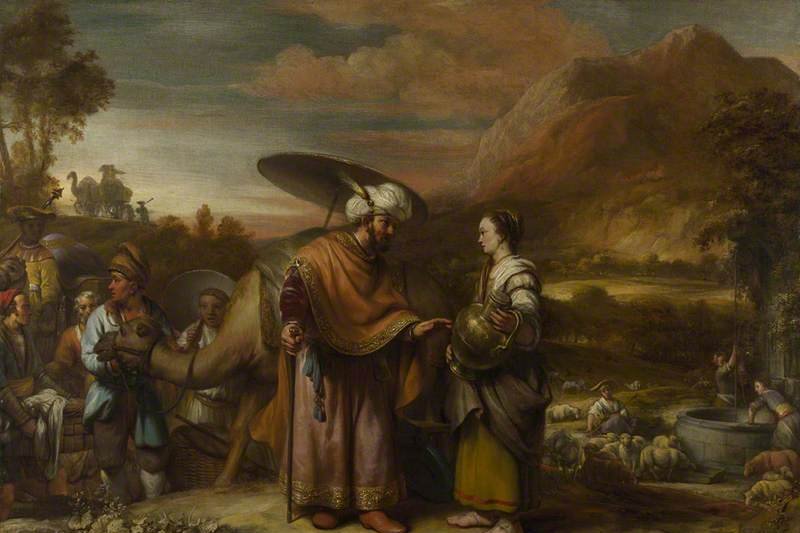
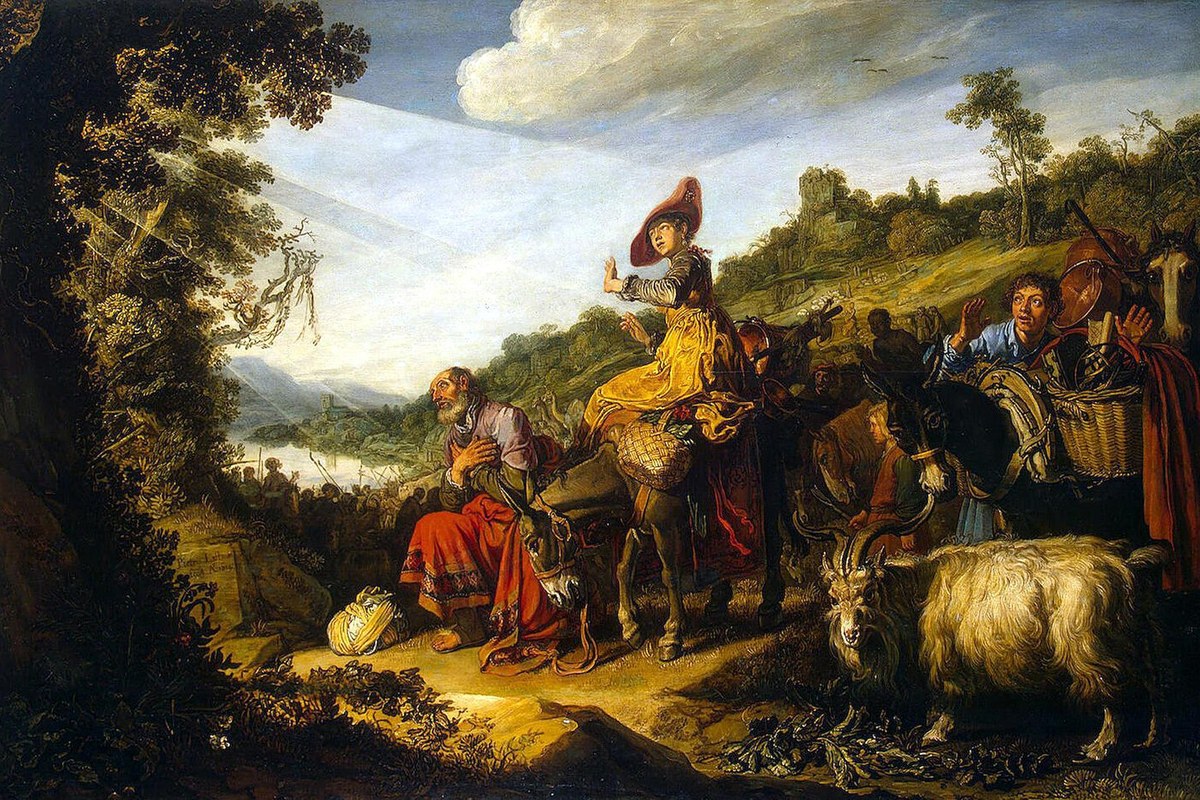
Gerbrand van den Eeckhout, Rebekah and Eliezer at the Well (17th century), public domain via Wikimedia Commons
A very specific prayer
The sign the servant asks for isn't vague. Standing by the well as the young women of the city come out in the evening to draw water, he prays that the right woman for Isaac will be identifiable by a very particular response: when he asks her for a drink, she won't just hand it over — she'll also offer, entirely on her own initiative, to water his ten camels as well, a substantial and unrequested act of generosity toward a tired stranger. Genesis is explicit about the timing: "He had scarcely finished speaking when Rebekah... came out with a jug on her shoulder" (Genesis 24:15, NABRE) — the answer to his prayer arriving, in the text's own telling, before he'd even finished asking for it.
Water for the man, then water for ten camels
What happens next plays out exactly as the servant had hoped, described in careful, unhurried detail. Rebekah goes down to the spring, fills her jug, and as she comes back up, the servant approaches and asks for a sip of water. "Drink, sir," she replies, lowering the jug for him — and then, without being asked, she adds: "I will draw water for your camels, too, until they have finished drinking" (Genesis 24:18-19, NABRE). She then runs back and forth to the well repeatedly, emptying jug after jug into the trough, "until she had drawn enough for all the camels" (Genesis 24:20, NABRE) — a genuinely demanding task, watering ten thirsty camels by hand, that she takes on immediately and without complaint. It's a small, unglamorous act of hospitality, but the text lingers on it precisely because it matches the servant's sign so exactly.
Gifts before the servant even knows her name
Striking in the sequence of events is that the servant rewards Rebekah's generosity before learning anything about who she is or whether she's even related to Abraham's family. "When the camels had finished drinking, the man took out a gold nose-ring weighing half a shekel, and two gold bracelets weighing ten shekels for her wrists" (Genesis 24:22, NABRE) — only after presenting these gifts does he ask whose daughter she is and whether there's room in her father's house for him and his men to stay the night. The order matters: Rebekah's kindness at the well is honored on its own terms, as an act worth rewarding regardless of lineage, before the servant discovers — to his evident relief — that she belongs to exactly the family he'd been sent to find.
A family's blessing, and Rebekah's own answer
Once the servant explains who he is and why he's come, Rebekah's family — her brother Laban and father Bethuel — recognize the encounter as providential and agree to the match. But Genesis doesn't stop at the family's agreement. When the arrangements are set, the family calls Rebekah herself and asks her directly, "Will you go with this man?" — and she answers simply, "I will" (Genesis 24:58, NABRE). In a narrative otherwise focused heavily on the servant's initiative and the family's negotiation, this small moment matters: Scripture records Rebekah's own consent as part of the story, not simply an arrangement made around her without her voice included at all.
A send-off blessing, and a first meeting in the fields
Before Rebekah leaves, her family sends her off with a blessing of their own: "Sister, may you grow into thousands of myriads; and may your descendants gain possession of the gates of their enemies!" (Genesis 24:60, NABRE) — words that, read alongside what Genesis later records about her descendants, carry more weight in hindsight than anyone present could have fully grasped at the time. The journey itself and the actual meeting of Rebekah and Isaac both pass with the same quiet economy as the rest of the chapter: "Rebekah, too, caught sight of Isaac, and got down from her camel. She asked the servant, 'Who is the man over there, walking through the fields toward us?' 'That is my master,' replied the servant. Then she took her veil and covered herself" (Genesis 24:64-65, NABRE). Genesis closes the episode simply: "Isaac brought Rebekah into the tent of his mother Sarah. He took Rebekah as his wife. Isaac loved her and found solace after the death of his mother" (Genesis 24:67, NABRE) — a brief, understated ending to a story that had begun with such a specific, carefully tested prayer.
A betrothal scene without the tension that follows
Read on its own, Rebekah's introduction at the well is one of Genesis's more straightforwardly warm episodes — generosity rewarded, a prayer answered almost immediately, a marriage arranged with apparent goodwill on every side. It stands in real contrast to what Rebekah's story becomes later: she gives birth to twin sons, Jacob and Esau, and eventually plays a central, morally complicated role in helping Jacob deceive his father Isaac to secure the blessing meant for his older brother. The woman who runs eagerly back and forth to water ten camels for a stranger, without being asked, becomes years later a mother willing to orchestrate deception on her favored son's behalf — a complexity worth noting, since the well scene alone tends to be remembered in isolation from the more difficult chapters that follow it.
Why the well scene endures
What keeps Rebekah's introduction memorable isn't drama or conflict — it's the opposite. The servant's prayer sets an unusually specific, almost testable standard for character: not beauty or family status alone, but a willingness to do more than what's asked, for a total stranger, at real personal cost of time and effort. Rebekah meets that standard immediately and without hesitation, and Genesis treats her response as evidence enough of who she is — a detail that has made the scene, across centuries of retelling, less a story about finding a wife than a story about recognizing character in a single small, demanding act of kindness.
Trivia
Who sent the servant to find a wife for Isaac?
What sign did the servant ask God for at the well?
How did Rebekah actually respond when the servant asked for water?
Did Rebekah have a choice in the marriage?
What happens to Rebekah later in Genesis?
Related Reading