Jacob and Esau: The Stolen Birthright

Rivals From the Womb
Isaac and Rebekah's twins struggled against each other before either was born — Genesis says the unborn children "jostled each other within her" so violently that Rebekah asked God what was happening (Genesis 25:22). The answer she received was a prophecy: two nations were struggling inside her, and "the older shall serve the younger" (25:23). Esau emerged first, red and hairy; Jacob followed gripping his brother's heel, which is where his name comes from — "Jacob" carries the sense of "heel-grabber" or "supplanter."
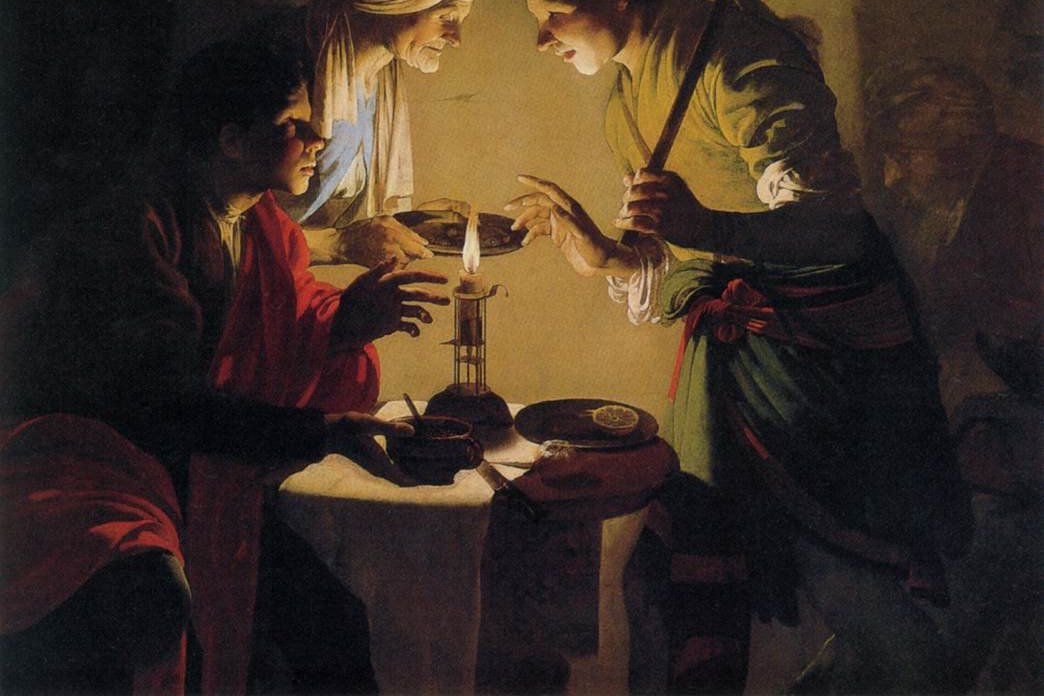
Hendrick ter Brugghen, Esau Selling His Birthright, c. 1627 — public domain.
The two grew into very different men. Esau became a skilled hunter, a man of the open country; Jacob was quieter, a homebody who "stayed among the tents" (25:27). Isaac, notably, favored Esau; Rebekah favored Jacob. The family was divided before the birthright was ever in play.
A Bowl of Stew
The famous scene arrives almost casually. Jacob was cooking a lentil stew when "Esau came in from the open country, famished" (25:29). Exhausted and hungry, Esau asked for "some of that red stuff" — the request is so blunt in the Hebrew that it becomes the origin of his other name, Edom, meaning "red." Jacob, rather than simply feeding his brother, saw an opening: "First sell me your right as firstborn." Esau, focused entirely on his hunger, answered, "I am on the point of dying. What good is the right as firstborn to me?" (25:31-32). Jacob made him swear to it first. Then Esau ate, drank, and left — and Scripture delivers its own verdict in the closing line: "Esau treated his right as firstborn with disdain" (25:34).
The text does not let either brother off easily. Esau is condemned for trading away something sacred for momentary appetite; Jacob is not praised for exploiting his brother's hunger.
The Stolen Blessing
Years later, when Isaac was old and blind and preparing to give his formal deathbed blessing, Rebekah orchestrated a second deception. She dressed Jacob in Esau's clothes and covered his arms with goatskins to mimic Esau's hairy skin, then sent him in to receive the blessing meant for the firstborn. Isaac, confused by the voice but convinced by touch and smell, blessed Jacob with the words meant for Esau — dominion over his brothers, abundance of grain and wine.
When Esau returned from hunting and the deception surfaced, his grief is one of the rawest moments in Genesis: he "cried out with a loud and very bitter cry" and begged, "Have you not saved a blessing for me?" (27:34, 36). He named what had happened plainly: "He is well named Jacob, is he not! He has supplanted me twice! First he took away my right as firstborn, and now he has taken away my blessing" (27:36). Isaac could give Esau only a lesser blessing; the primary one, once spoken, could not be reclaimed.
Reconciliation, Eventually
The rivalry does not end in permanent estrangement. Jacob fled his brother's fury and spent years in exile building a family and considerable wealth. When he finally returned and prepared, terrified, for a confrontation with Esau, Genesis 33 delivers a reversal: Esau ran to meet him, embraced him, fell on his neck, and wept. Whatever bitterness had defined their youth gave way, at least for that reunion, to something closer to grace.
Two Nations, Not Just Two Brothers
Genesis frames the twins' rivalry as bigger than a family quarrel from the very start — the oracle Rebekah receives while pregnant describes "two nations" struggling within her, not just two sons (Genesis 25:23). Esau becomes, in the text's own genealogies, the ancestor of Edom, the nation that occupied territory southeast of Israel and whose long, frequently hostile relationship with Israel's descendants runs throughout the Old Testament, from opposition during the Exodus to conflict in the era of the kings. That national dimension is part of why the prophet Malachi, writing centuries after Jacob and Esau were both long dead, can speak of God's love and rejection in terms of the two brothers' names as shorthand for the two nations they founded: "I loved Jacob, but rejected Esau; I made his mountains a waste, his heritage a desert for jackals" (Malachi 1:2-3). Paul draws on this same Malachi passage directly when making his argument in Romans 9, meaning the birthright story was never read by later biblical writers as simply personal history — it was treated as the founding episode of a much longer national relationship.
Catholic Reading: Election and Its Limits
St. Paul returns to Jacob and Esau in Romans 9 to make a theological argument about divine election — that God's choice of Jacob over Esau was made "before they had yet been born or had done anything, good or bad, in order that God's elective plan might continue, not by works but by his call" (Romans 9:11-12). Catholic tradition reads this passage as affirming the sovereign freedom of God's grace, not as retroactively excusing the deception by which Jacob obtained the blessing. Scripture never praises the trickery itself — Jacob pays for it over the following decades in his own life, deceived in turn by his father-in-law Laban and by his own sons regarding Joseph.
The deeper lesson theologians have drawn from the story is less about who deserved what and more about how God's larger purposes can work even through flawed human choices and outright family dysfunction — without ever making that dysfunction the ideal.
Related reading: see Joseph Sold Into Slavery by His Own Brothers for how sibling rivalry echoes a generation later in Jacob's own family, and Jacob Wrestling with the Angel for the moment Jacob's own character is finally reshaped.
Trivia
Why did Esau sell his birthright to Jacob?
What is a birthright in this context?
How did Jacob also steal Esau's blessing?
Were Jacob and Esau reconciled?
How does Catholic tradition interpret Jacob's favored status?
Related Reading