The Canaanite Woman's Faith

A mother outside Jesus's own mission field
Matthew places this encounter in the region of Tyre and Sidon, Phoenician coastal cities well outside Galilee and Judea — territory that put Jesus, for once, on the far edge of his own ministry's usual boundaries. It's there that "a Canaanite woman of that district came and called out, 'Have pity on me, Lord, Son of David! My daughter is tormented by a demon'" (Matthew 15:22). Matthew's choice of the word "Canaanite" is deliberate and loaded — an old term for the pre-Israelite inhabitants of the land, evoking centuries of history between Israel and the peoples it had displaced. This woman had no claim on Jesus by ethnicity, religion, or covenant. She approached him anyway.
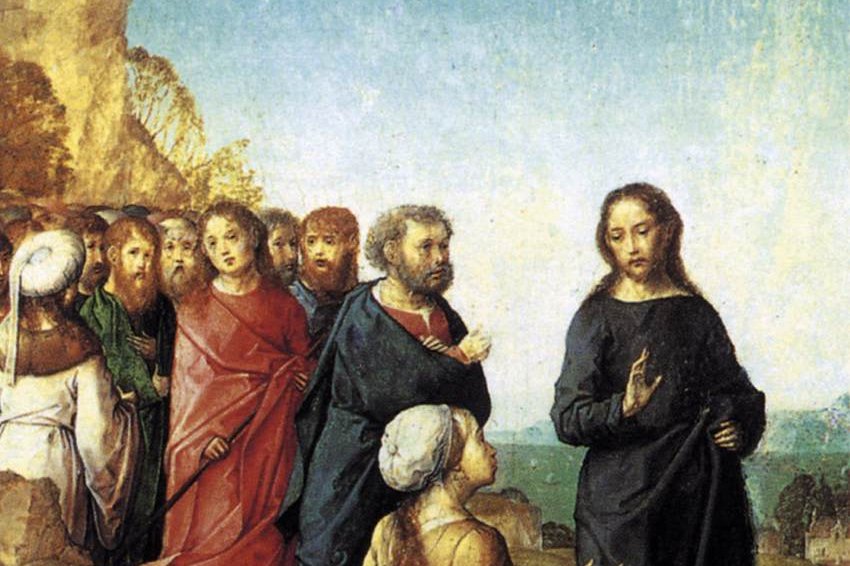
Juan de Flandes, "Christ and the Canaanite Woman," c. 1500-1504, National Gallery of Art, Washington. Public domain.
Silence, and a disciples' request to send her away
What happens next is one of the more uncomfortable pauses in the Gospels: "he did not say a word in answer to her" (Matthew 15:23). Not a gentle refusal, not an explanation — nothing. The disciples fill the silence with their own request, and it isn't sympathetic: "Send her away, for she keeps calling out after us" (Matthew 15:23), annoyed by her persistence rather than moved by her need. Jesus's answer to them, still not addressed to her directly, sounds like it settles the matter: "I was sent only to the lost sheep of the house of Israel" (Matthew 15:24) — a statement about the scope of his earthly mission that, on its face, excludes her entirely.
A direct plea, and a hard answer
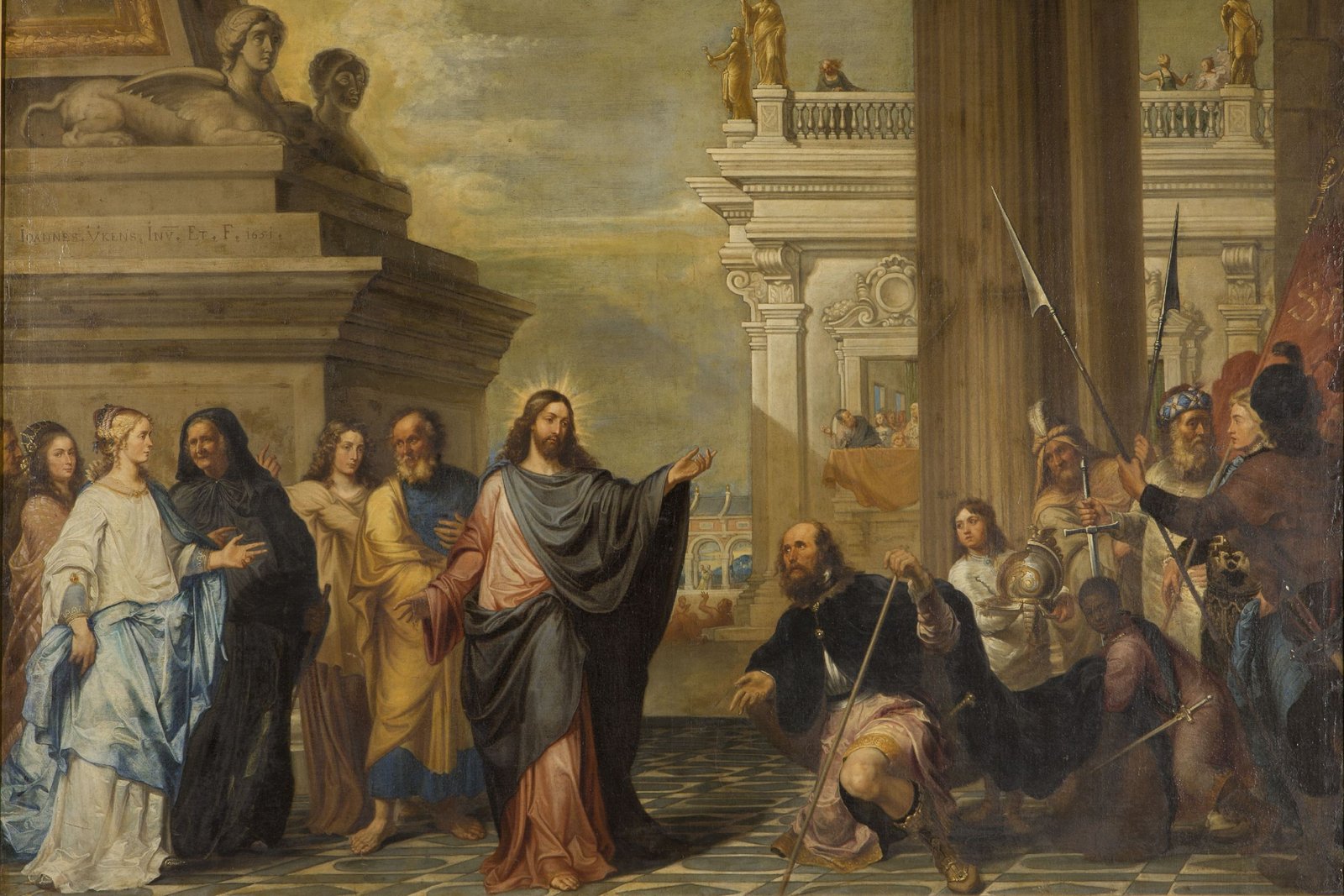
The woman doesn't take the hint. Matthew writes that "the woman came and did him homage, saying, 'Lord, help me'" (Matthew 15:25) — closing the distance, kneeling, making the request as simple and direct as it can be. Jesus's reply is the hardest line in the whole episode: "It is not right to take the food of the children and throw it to the dogs" (Matthew 15:26). Calling someone a "dog" was a recognizable, if unflattering, figure of speech in the period, generally used by Jews to describe Gentiles outside the covenant — Jesus is restating, in sharper form, the same boundary he'd just given his disciples: his mission, as he frames it here, belongs first to Israel.
Turning the metaphor back on him
Rather than retreating, she takes the image he's given her and works inside it: "Please, Lord, for even the dogs eat the scraps that fall from the table of their masters" (Matthew 15:27). She doesn't dispute the metaphor or claim equal standing with "the children" — she accepts the comparison and finds room to argue from inside it anyway, pointing out that even household dogs get something from the table they're not formally invited to. It's a quick, sharp piece of reasoning, delivered under real emotional pressure, from a mother whose daughter is still suffering while this whole exchange plays out.
"Great is your faith"
Jesus's response reverses everything that came before it: "O woman, great is your faith! Let it be done for you as you wish. And her daughter was healed from that hour" (Matthew 15:28). It's a remarkable phrase — in Matthew's Gospel, Jesus only uses the word "great" to describe someone's faith on one other occasion, praising the Roman centurion who asked him to heal his servant from a distance (see our article on the centurion's servant). Both people Jesus singles out for this specific praise are Gentiles, outsiders to the covenant he describes his mission as centered on — a pattern that Matthew, writing for an early Christian community working out how Gentiles fit into a movement that began entirely within Judaism, was unlikely to have included by accident.
Mark's version and a small but telling detail
Mark's Gospel tells the same story (Mark 7:24-30) with one small addition: it identifies the woman more specifically as "a Greek, a Syrophoenician by birth" (Mark 7:26), giving her both a religious and an ethnic identity distinct from Matthew's broader, more symbolically loaded "Canaanite." Mark also has the exchange happen inside a house where Jesus had gone, "wanted no one to know about it" (Mark 7:24) — suggesting he had come to this Gentile territory seeking rest or privacy, not a ministry encounter, and found himself unable to stay hidden from someone determined enough to find him.
How the Church has read this exchange
This episode has generated centuries of careful reading precisely because of how sharp Jesus's initial responses sound to modern ears. A common thread in Catholic commentary, going back to early Church writers, reads the silence and the hard words not as genuine rejection but as a kind of testing — drawing out and displaying a faith that was already there, the way pressure reveals the strength of something solid. Whether or not that fully resolves the discomfort of the exchange, the story's ending is unambiguous: a Gentile mother's persistence, reasoning, and refusal to be dismissed gets her daughter healed and gets her singled out by Jesus for a level of praise given to almost no one else in Matthew's Gospel.
A painter's quiet, humble version of an unresolved moment
Juan de Flandes, the Flemish-born painter working at the Spanish royal court around 1500, chose to depict this scene with a restraint that leaves out the sharper edges of the dialogue — no dogs, no visible tension between the woman and the apostles crowding behind Jesus, just a kneeling woman making her case and a Christ figure listening. It's a reminder that for centuries, artists have gravitated toward the resolution of this story — the healing, the praise, the persistence rewarded — more often than its uncomfortable middle section, even though the Gospel text refuses to skip past that discomfort itself.
A mother who wouldn't stop asking
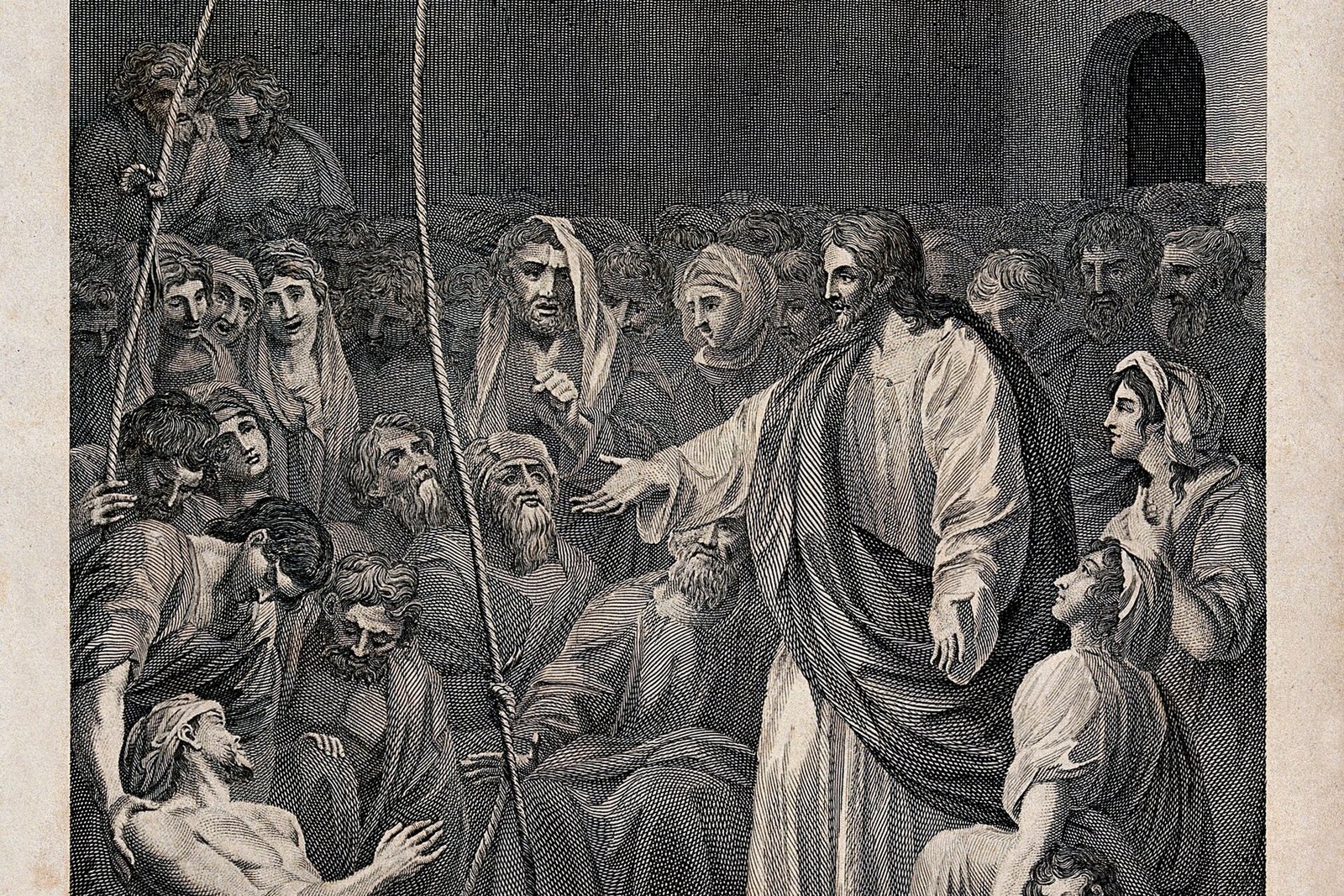
What makes this story endure isn't really the theology of Jew and Gentile, as important as that question was to Matthew's first readers — it's the woman herself, arguing her case in real time, under real emotional strain, refusing three separate signals (silence, a request to be sent away, an unflattering metaphor) to simply give up and leave. She never claims to deserve an answer. She just keeps asking, in increasingly specific and pointed ways, until she gets one. It's a portrait of persistent prayer that Christian tradition has returned to again and again — not faith as passive acceptance, but faith that keeps knocking, the same instinct at work in the paralytic's friends who tore open a roof rather than turn back from a crowded door.
Trivia
Who was the Canaanite woman and what did she want from Jesus?
How did Jesus initially respond to her request?
What did Jesus say that sounds harsh to modern ears?
How did the woman respond to being compared to a dog?
Did Jesus heal her daughter in the end?
Related Reading