The Centurion's Servant

An occupying officer with an unexpected request
Matthew places this story right after Jesus comes down from the Sermon on the Mount, back into Capernaum, a town that — like the rest of Galilee — sat under Roman military occupation. A centurion, an officer typically in command of around a hundred soldiers, would have been a visible, sometimes resented symbol of that occupation. So it's notable that Matthew doesn't record any hostility in this encounter at all. Instead: "he entered Capernaum, a centurion approached him and appealed to him, saying, 'Lord, my servant is lying at home paralyzed, suffering dreadfully'" (Matthew 8:5-6). No demand, no assertion of rank — just an appeal, from a man with every reason to expect obedience from those around him, made humbly to a Jewish teacher he had no formal claim on at all.
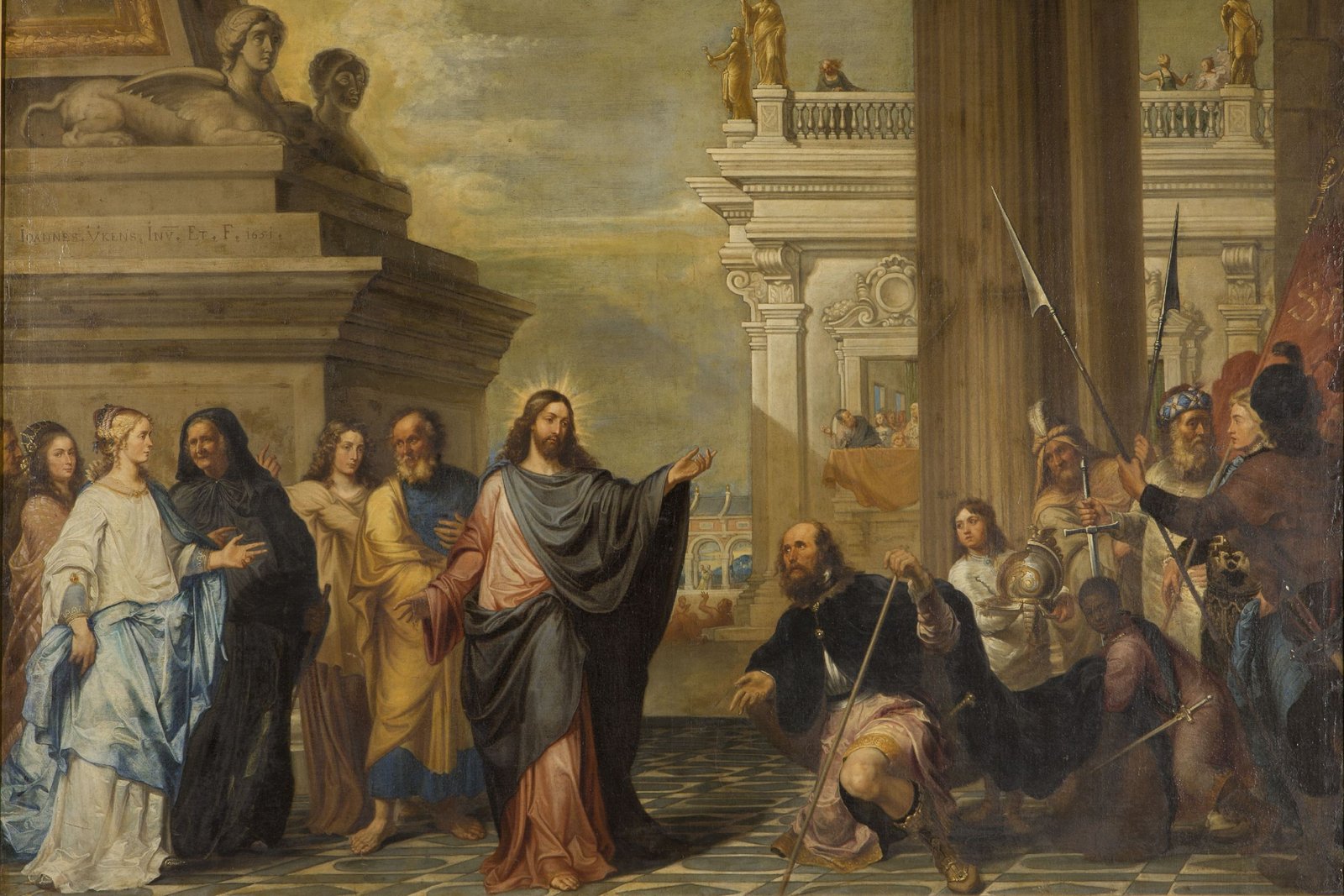
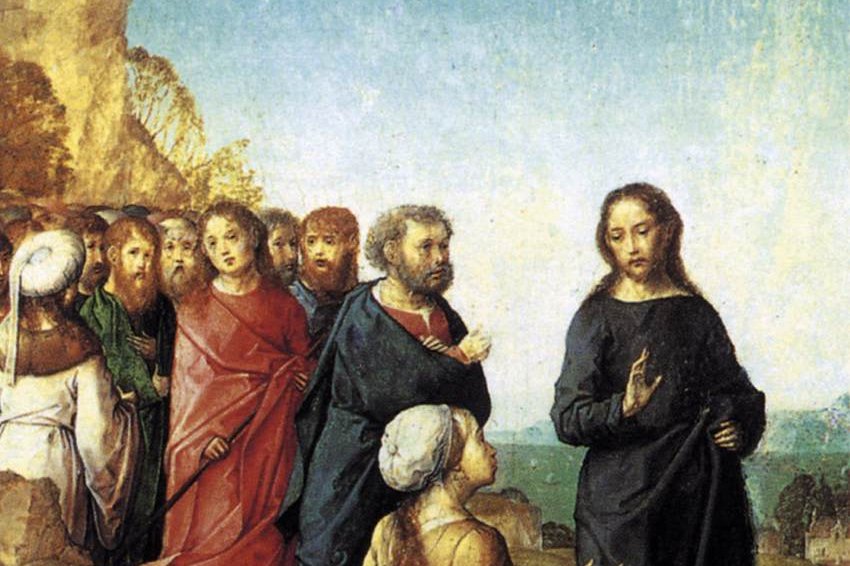
Johannes Ykens, "Centurion of Capernaum Begs Jesus to Heal His Servant," 1651 (Wikimedia Commons, public domain)
"I am not worthy to have you enter under my roof"
Jesus responds immediately and simply: "I will come and cure him" (Matthew 8:7). It's the centurion's reply that turns this into one of the more theologically dense short exchanges in the Gospels. "Lord, I am not worthy to have you enter under my roof; only say the word and my servant will be healed" (Matthew 8:8). For a Jewish teacher, entering the home of a Gentile — especially a Roman military officer — carried real social and ritual complications; the centurion seems to anticipate this, and instead of asking Jesus to cross that line, he asks for something that requires no visit at all.
An argument built from military experience
What makes the centurion's request so striking is the reasoning behind it, and it's reasoning drawn straight from his own profession: "For I too am a person subject to authority, with soldiers subject to me. And I say to one, 'Go,' and he goes; and to another, 'Come here,' and he comes; and to my slave, 'Do this,' and he does it" (Matthew 8:9). He isn't comparing Jesus to a fellow officer giving orders to soldiers — he's recognizing something much larger: that if his own words carry that kind of authority within a chain of command, then Jesus's word must carry an even greater authority over sickness itself, an authority that doesn't require physical proximity to take effect.
The faith Jesus says he hasn't found in Israel
Matthew records Jesus's reaction in blunt terms: "When Jesus heard this, he was amazed and said to those following him, 'Amen, I say to you, in no one in Israel have I found such faith'" (Matthew 8:10). The weight of that line comes from who's saying it about whom. Jesus is speaking to a crowd of his own Jewish followers, people who had grown up steeped in the covenant and the Law, and telling them that a Roman soldier — a Gentile with no claim on that inheritance — had shown him a depth of trust he hadn't found among them. Jesus goes on: "many will come from the east and the west, and will recline with Abraham, Isaac, and Jacob at the banquet in the kingdom of heaven, but the children of the kingdom will be driven out into the outer darkness" (Matthew 8:11-12) — a hard saying about the kingdom of heaven opening to people outside Israel's own boundaries, illustrated by exactly the kind of man standing in front of him.
Healing without a touch
The resolution comes quickly and without ceremony: "Jesus said to the centurion, 'You may go; as you have believed, let it be done for you.' And at that very hour [his] servant was healed" (Matthew 8:13). There's no visit to the house, no laying on of hands, not even a description of what happens at the moment of healing — only the centurion's word taken at face value, mirrored back to him in Jesus's own word, and the servant restored somewhere else entirely, out of sight, exactly as the centurion had asked.
Luke's fuller version: elders, a synagogue, and a friendship already in place
Luke's account of the same episode (Luke 7:1-10) adds context Matthew leaves out. In Luke's telling, the centurion doesn't approach Jesus directly at all — he sends Jewish elders ahead of him, who tell Jesus the man is worth helping "for he loves our nation and he built the synagogue for us." (Luke 7:5). It's a detail that reframes the whole encounter: this wasn't a stranger's desperate plea but the request of a Roman officer already known and respected in the local Jewish community for his generosity, which makes his own insistence — through a second group of friends — that Jesus needn't trouble himself to visit all the more striking. Luke also has the centurion send the "only say the word" message through messengers rather than in person, keeping the theme of an authority that operates at a distance consistent throughout the whole story.
Faith that doesn't need to see
This story has held a durable place in Catholic worship for centuries — the centurion's words "Lord, I am not worthy to have you enter under my roof" are echoed almost verbatim in the Mass, spoken just before Communion, as the whole congregation borrows this Roman soldier's language to approach the Eucharist. It's a striking piece of continuity: words first spoken by a man standing outside the covenant, asking for a healing he never even had to witness, have become the words Catholics use every time they approach the altar. The centurion never claims special standing or insider knowledge — only a clear-eyed recognition of where real authority lies, and a willingness to trust it without demanding to see it work up close. For more accounts of faith and healing like this one, see our guide to gospel stories and parables of Jesus.
Command, obedience, and a different kind of soldier
There's a reason Gaspar de Witte and other painters of his era were drawn to this scene: it stages an unusual reversal of who's kneeling to whom. A Roman officer, dressed in the unmistakable armor of occupying military power, bends before an itinerant Jewish teacher with no army, no rank, and no formal authority recognized by Rome at all — and it's the officer who understands, better than anyone else in the story, exactly what kind of authority he's dealing with. The painting captures that tension between visible military power and the invisible authority the centurion has already recognized, kneeling not because he's been ordered to, but because he has worked out, from his own professional experience of command, precisely who he's talking to.
A servant who is never named, and never speaks
It's worth noticing what the story leaves out. The servant at the center of the whole episode — the one whose suffering sets everything in motion — never appears on screen, never speaks, and is never named. Matthew tells us only that he is "lying at home paralyzed, suffering dreadfully" (Matthew 8:6), and that at the exact hour of the centurion's exchange with Jesus, he is healed. The story isn't really about him; it's about the man who advocated for him, and the recognition of authority that made the healing possible without either of them being in the same room as Jesus at all — a quiet reminder, alongside the story of the paralytic lowered through the roof, of how often the Gospels present healing as something set in motion by someone else's faith on a suffering person's behalf.
Trivia
What did the centurion ask Jesus to do?
Why did the centurion say Jesus didn't need to come to his house?
What did Jesus say about the centurion's faith?
Was the centurion's servant actually healed?
Does Luke's Gospel tell the same story?
Related Reading