The Paralytic Lowered Through the Roof

A house too full to enter
Mark places this scene early in Jesus's public ministry, back in Capernaum, the fishing town on the Sea of Galilee that had become something like his home base. Word had spread fast about what he could do, and "it became known that he was at home. Many gathered together so that there was no longer room for them, not even around the door" (Mark 2:1-2). Jesus was inside teaching, the crowd packed in and spilling out the door, and somewhere outside that crowd stood four men carrying a fifth on a mat — a friend who couldn't walk.
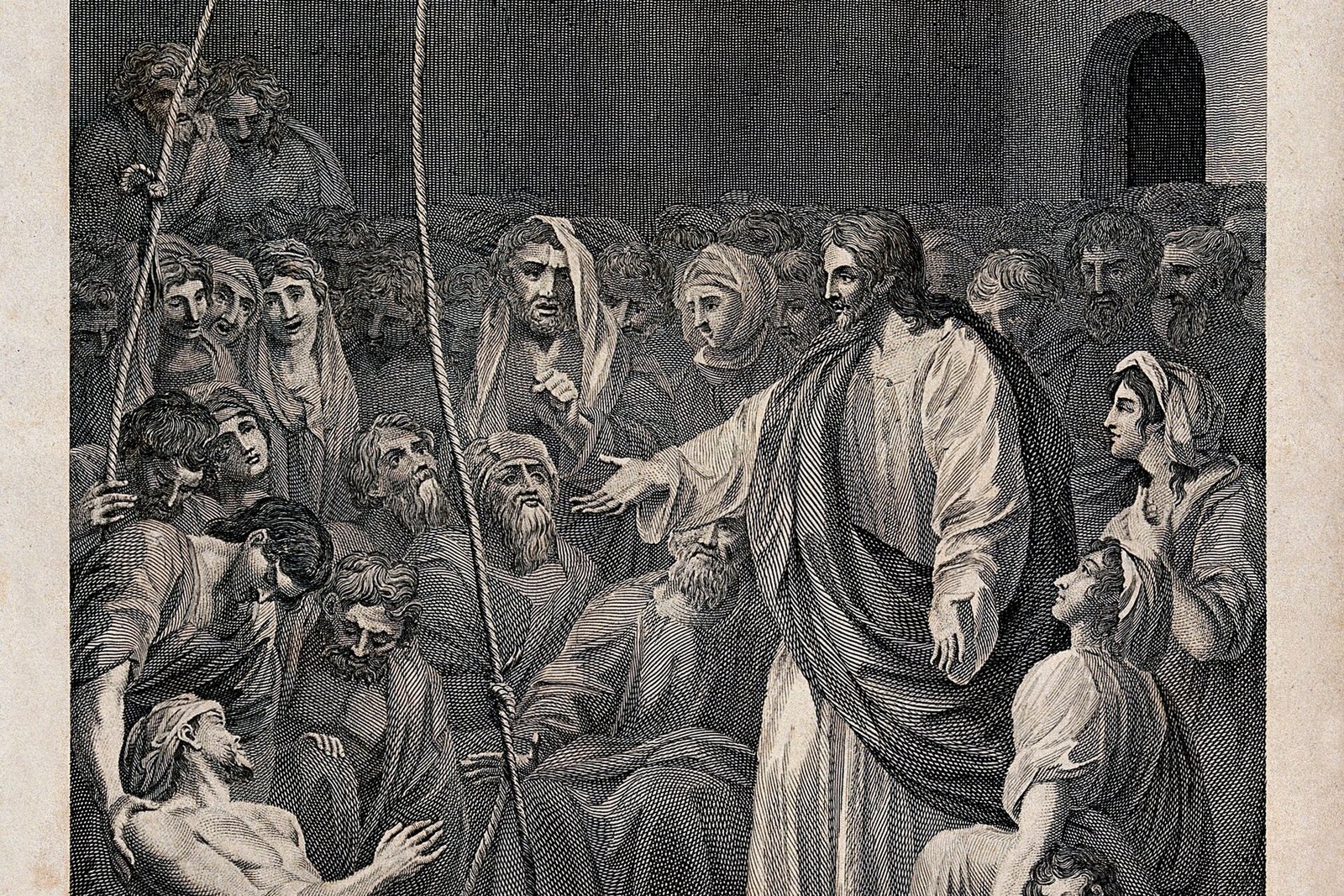
C.R. Ryley (engr. James Newton), "The Sick of the Palsy Healed and His Sins Forgiven," Wellcome Collection (Wikimedia Commons, CC BY 4.0)
Four men and a hole in the roof
They tried the obvious approach first and it didn't work: "unable to get near Jesus because of the crowd, they opened up the roof above him" (Mark 2:4). First-century Palestinian houses typically had flat roofs made of branches, mud, and packed earth over wooden beams, accessible by an outside staircase — not an impossible thing to open up, but not a small thing either. It meant climbing up with a disabled friend in tow, breaking through someone else's roof over their heads, and lowering a grown man down on ropes into a room full of strangers. "After they had broken through, they let down the mat on which the paralytic was lying" (Mark 2:4) — directly in front of Jesus, in the middle of everyone.
Forgiveness before healing
What happens next is the detail that makes this story more than a healing miracle. Jesus doesn't examine the man's legs or ask what's wrong. Mark writes: "When Jesus saw their faith, he said to the paralytic, 'Child, your sins are forgiven'" (Mark 2:5) — their faith, the friends' persistence and the man's willingness to be carried and lowered through a roof, credited alongside his own. And the first thing Jesus addresses isn't paralysis at all. It's sin. For a Jewish audience steeped in the idea that only God could forgive sins, this was a far more provocative claim than any healing would have been.
An accusation, and an answer that doubles as proof
Some scribes were sitting there — religious scholars, present to observe and evaluate what this itinerant teacher was up to — and Mark tells us exactly what went through their minds, even though they never said it aloud: "Why does this man speak that way? He is blaspheming. Who but God alone can forgive sins?" (Mark 2:7). Jesus doesn't wait for them to voice the accusation. "Jesus immediately knew in his mind what they were thinking to themselves, so he said, 'Why are you thinking such things in your hearts?'" (Mark 2:8). Then he poses a question that turns their unspoken objection into the proof of his authority: "Which is easier, to say to the paralytic, 'Your sins are forgiven,' or to say, 'Rise, pick up your mat and walk'?" (Mark 2:9). Either claim is unverifiable on its own — but Jesus is about to make the second one visibly, undeniably true, "that you may know that the Son of Man has authority to forgive sins on earth" (Mark 2:10).
"Rise, pick up your mat, and go home"
Jesus turns to the man on the mat and says exactly that: "I say to you, rise, pick up your mat, and go home" (Mark 2:11). Mark doesn't linger on the moment of healing itself — no description of sensation returning to withered limbs, no slow testing of strength. The text moves straight to the result: "He rose, picked up his mat at once, and went away in the sight of everyone. They were all astounded and glorified God, saying, 'We have never seen anything like this'" (Mark 2:12). The man who had to be carried in through a hole in someone's roof walked out the front door on his own legs, carrying the mat that had carried him.
Luke's version and a physician's added detail
Luke tells the same story with a few additional touches that fit his Gospel's careful, almost documentary style — tradition holds Luke was a physician, and his account adds the detail that the men "But not finding a way to bring him in because of the crowd, they went up on the roof and lowered him on the stretcher through the tiles into the middle in front of Jesus." (Luke 5:19), specifying tile roofing rather than the packed-earth roofs more typical further north, which may reflect a different architectural detail Luke had access to or simply his own vivid retelling. Luke also names the group of scribes and Pharisees present as having "come from every village of Galilee and Judea and Jerusalem" (Luke 5:17) — a crowd of religious authority large enough to suggest that word of Jesus's growing reputation had already spread well beyond Capernaum by this point in his ministry.
Faith that acts, not just faith that believes
Catholic tradition has long pointed to this episode as a portrait of intercessory faith — the idea that one person's faith and effort can open the way for another person's encounter with Christ, without diminishing the healed person's own faith or dignity. The four friends never ask Jesus for anything on the man's behalf in words; their whole "argument" is the physical fact of tearing open a roof rather than turning back. It's a scene that has resonated across centuries of preaching precisely because it doesn't require doctrine to make its point — anyone who has ever carried a friend's need to church, in prayer or in person, over their shoulders when the friend couldn't get there alone, recognizes something of themselves in these four men on the roof. For more scenes like this one, our guide to gospel stories and parables of Jesus gathers the healings and teachings that shaped early Christian memory of his public ministry.
A scene painters kept returning to
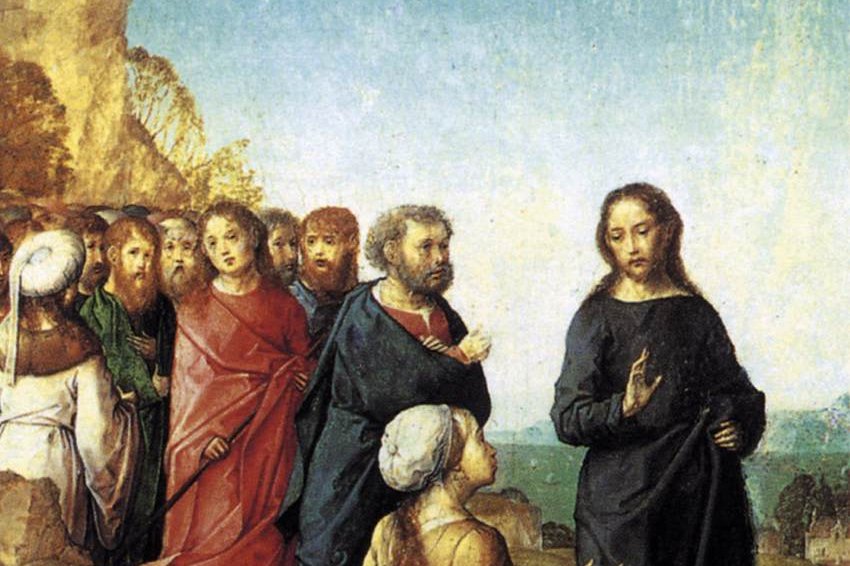
The anonymous 16th-century Netherlandish painting that illustrates this article shows the scene at its most theatrically busy: the crowd pressing in around Jesus, the paralytic's mat suspended mid-lowering, faces turned upward toward the opening in the roof. Northern European workshops of this period frequently produced devotional paintings built around exactly this kind of dense, multi-figure composition, designed less as a single dramatic moment than as an invitation to spend time studying every face and gesture in the scene — the friends straining at the ropes, the crowd's mixture of curiosity and alarm, and Jesus at the center, already looking toward the man before he has spoken a word.
Why the roof, and not just the door
It's worth sitting with just how deliberate the roof-breaking is, because the story doesn't present it as an act of last resort so much as an act of ingenuity born of refusing to be stopped. The men could have waited for the crowd to thin, or come back another day, or sent word ahead. Instead they carried their friend up an outside staircase, opened a hole in a stranger's roof, and lowered him down on ropes — a plan that required real physical coordination and a willingness to be conspicuous, loud, and a little destructive in pursuit of getting him in front of Jesus. Mark's Gospel rewards exactly that kind of persistence with the story's central line, "when Jesus saw their faith" — not the paralyzed man's faith alone, but the whole determined effort of the four men who wouldn't take a crowded doorway for an answer.
Trivia
Where did the healing of the paralytic lowered through the roof take place?
What did Jesus say to the paralyzed man before healing him?
Why did the scribes object to what Jesus said?
What did Jesus tell the paralyzed man to do after healing him?
What does this story emphasize about the faith of the four friends?
Related Reading