The Prodigal Son

The third of three lost things
The parable doesn't arrive on its own. Luke places it as the third and longest in a set of three, all told in response to the same complaint from the Pharisees and scribes that Jesus "welcomes sinners and eats with them" (Luke 15:2, NABRE). First comes a shepherd who leaves ninety-nine sheep to search for one that wandered off; then a woman who sweeps her whole house looking for a single lost coin. Both of those parables end the same way — with rejoicing, and with Jesus stating plainly that "there will be more joy in heaven over one sinner who repents than over ninety-nine righteous people who have no need of repentance" (Luke 15:7, NABRE). The prodigal son is the same argument told a third time, at far greater length and with far more emotional weight, because unlike a sheep or a coin, a son can choose to leave in the first place — and can choose, just as freely, to come home.
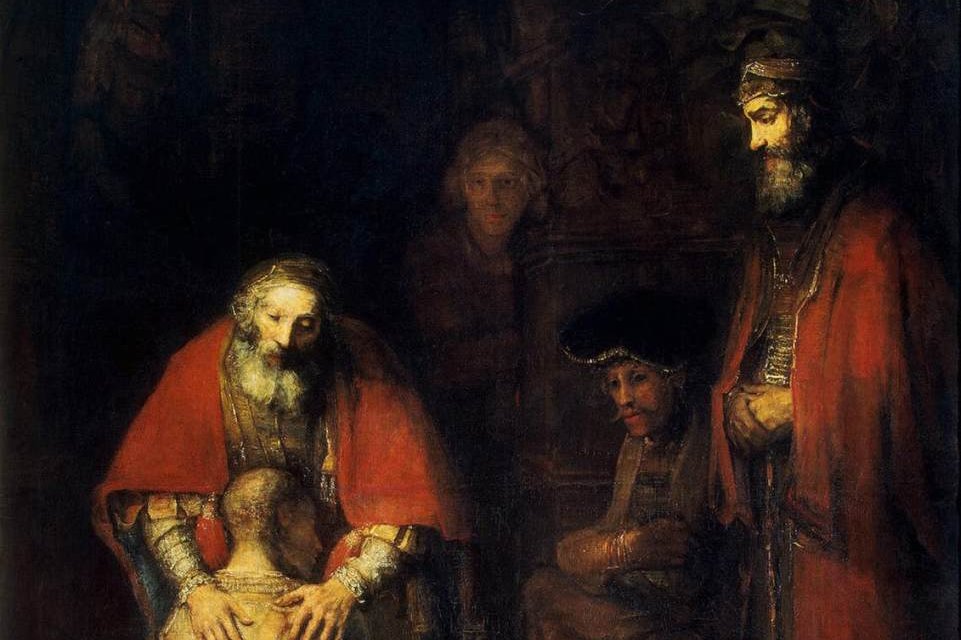
Rembrandt van Rijn, "The Return of the Prodigal Son," c. 1669, State Hermitage Museum. Public domain.
A request that amounted to a wish for a funeral
Jesus tells this parable to an audience already needling him for eating with "sinners" (Luke 15:2, NABRE), and he opens it with a request that would have landed on first-century ears as something close to scandalous. A son asking for his inheritance while his father is still alive and well was, in effect, treating that father as already dead. What's easy to miss is the father's response: he doesn't argue, lecture, or refuse. He simply divides the property between his two sons and lets the younger one go (Luke 15:12, NABRE). Nothing in the text suggests he expects to see that money — or that son — again.
From a distant country to a pig's trough
The younger son doesn't drift into ruin slowly. Scripture moves fast here: he "squandered his inheritance on a life of dissipation," and once the money runs out, a famine hits the region at the worst possible moment (Luke 15:13-14, NABRE). The job he eventually takes — feeding pigs — would have struck a Jewish audience as about as low as a person could sink, since pigs were unclean animals under Jewish law. The detail that clinches it: he's so hungry he starts eyeing the animals' own food, and even that isn't offered to him (Luke 15:16, NABRE). This is the bottom, described without any softening.
A father who was apparently watching for him
What snaps the son out of his situation is described almost clinically — "coming to his senses," he rehearses an apology and decides to go home, ready to ask only for a servant's position, since he no longer believes he deserves to be called a son (Luke 15:17-19, NABRE). But the turn of the parable happens in a single verse most readers move past too quickly: "while he was still a long way off, his father caught sight of him" (Luke 15:20, NABRE). For the father to see him at a distance means he had been watching the road — this isn't a man who has moved on. And instead of waiting at the door with arms crossed, he runs, embraces, and kisses his son before a word of the rehearsed apology gets out.
Restoration, not probation
The father cuts off the son's prepared speech partway through and orders not a quiet welcome back but a full public restoration: the finest robe, a ring, sandals, and a slaughtered calf for a feast (Luke 15:22-23, NABRE). Each of those items carried weight in the culture Jesus was speaking to — a robe of honor, a signet ring signaling authority within the household, sandals marking him as a free son rather than a servant. There's no trial period here, no probationary status. The father's own words explain why: "this son of mine was dead, and has come to life again; he was lost, and has been found" (Luke 15:24, NABRE).
The son who never left, and never celebrated
Jesus doesn't end the parable at the feast. He closes it with the older brother, who's been working the fields the entire time and returns to find a party already underway. His complaint to his father is raw and specific: years of obedience, and never so much as a young goat for his own friends, while this son — who "swallowed up your property with prostitutes" — gets a fattened calf (Luke 15:29-30, NABRE). The father doesn't dismiss the complaint. He simply states the deeper claim underneath it: "you are here with me always; everything I have is yours," and reframes the feast not as favoritism but as the only fitting response to a death reversed (Luke 15:31-32, NABRE). The parable ends there, without telling us whether the older son ever walks inside.
An ending Jesus deliberately left open
That unresolved final scene isn't a gap in the storytelling — it's the point. Jesus was speaking directly to the Pharisees and scribes grumbling about him at the start of the chapter, and the older son's resentment maps onto their objection almost exactly: righteous people who did everything right, watching sinners get welcomed home without having earned it. By refusing to tell us whether the older son goes in and joins the feast, Jesus leaves his actual audience standing at that same threshold, answering the question for themselves. It's one of the clearest examples in the Gospels of a parable used not just to illustrate a teaching but to put the listener inside the story and force a decision.
A father painted mid-embrace
Few Gospel scenes have drawn painters back as often as this one, and Rembrandt's version, reproduced with this article, is often considered the definitive treatment: an old, half-blind father bent over his kneeling son, hands resting on his shoulders in a gesture that reads as both blessing and embrace, while onlookers — including, many art historians argue, the resentful older brother — stand off to the side, faces unreadable. Rembrandt painted it near the end of his own life, after decades of financial ruin and personal loss, and the tenderness in the father's hands is often read as the work of a man who had spent years thinking about what it meant to be received back rather than judged. Its closest thematic companion in this blog's collection of parables is the Good Samaritan, another story where Jesus redefines who deserves mercy by simply showing what mercy looks like in practice.
Trivia
What did the younger son actually ask his father for?
What brought the younger son to his lowest point?
How did the father react when he saw his son returning?
What did the father order for his returning son?
Why was the older son upset, and how did the father respond to him?
Related Reading