The Blessing of Easter Food Baskets

A feast blessed before it's eaten
Most blessings in Catholic life happen either before a meal or as part of one — a quick grace, a sacramental gesture folded into an already-set table. The blessing of Easter food baskets works differently: it happens a full day ahead, on Holy Saturday, while Lent's fasting is still technically in effect and Easter Sunday's feast hasn't begun. Families — especially, though not exclusively, in Polish and other Central and Eastern European Catholic communities — pack a basket with a careful selection of foods and bring it to church, where a priest blesses the contents before anyone touches them. In Polish tradition, the custom is called Święconka, a word built from the same root as "blessing" itself.
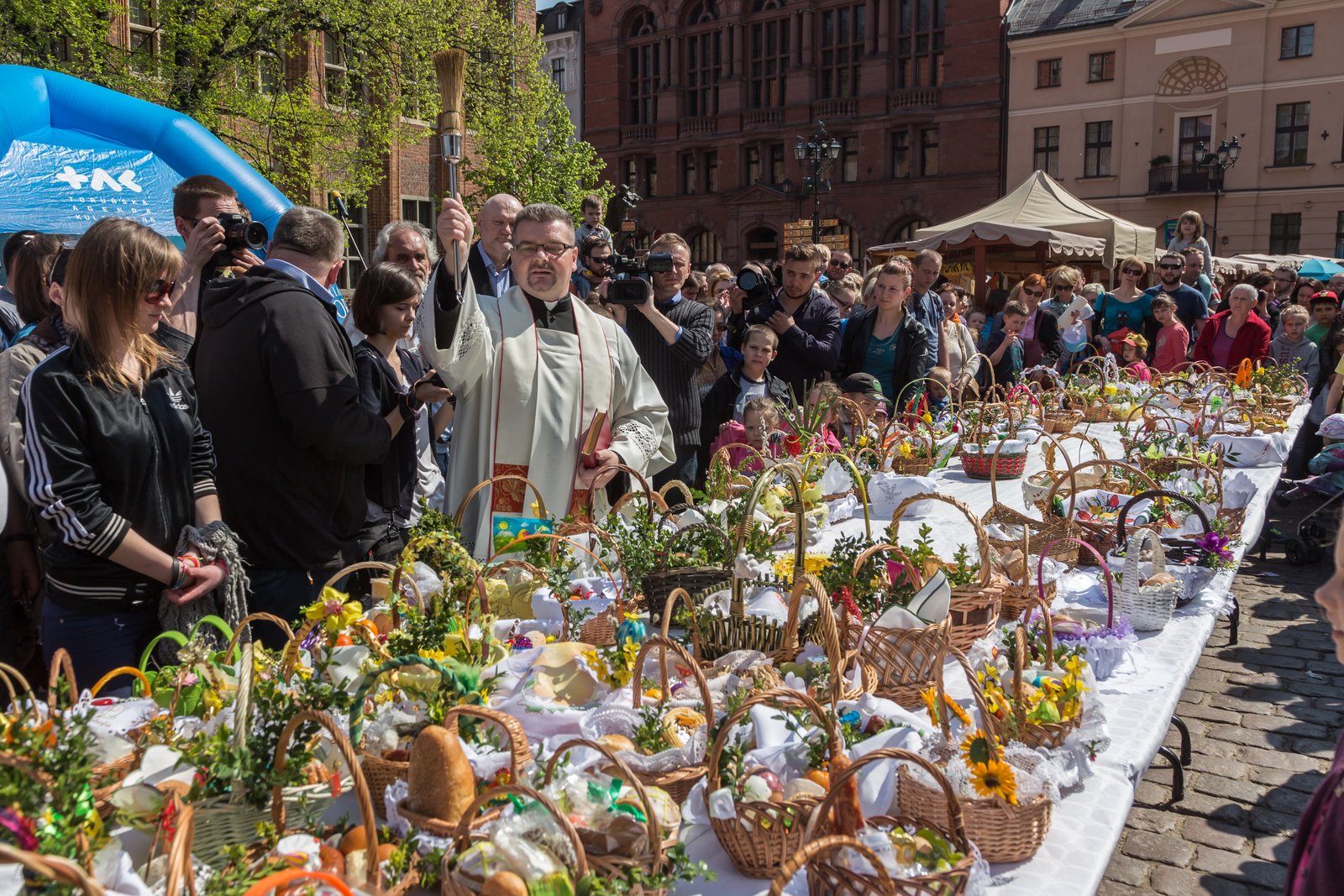
Blessing of the Baskets, Easter tradition, CC BY-SA 4.0 via Wikimedia Commons
What goes in the basket, and why
The specific items vary by family and region, but a fairly consistent core appears across most versions of the custom: decorated eggs, a loaf of bread, a portion of meat or ham, butter (sometimes molded into the shape of a lamb), salt, and horseradish, the whole collection typically arranged in a basket lined with white linen or lace and topped with sprigs of boxwood or other evergreen. Popular tradition has attached specific meaning to nearly every item: eggs are widely understood as symbols of new life and the Resurrection itself; bread carries associations with Christ; salt signals purification; horseradish, sharp and unpleasant on its own, is read as a reminder of the bitterness of Christ's suffering in the Passion; the meat represents the return to feasting and abundance after Lent's fasting ends. These specific food symbols developed through centuries of popular devotion and folk tradition rather than through any formal doctrinal statement assigning meaning to each ingredient — worth noting plainly, since it's easy to mistake a beloved custom's folk symbolism for official Church teaching when the two are, in this case, related but distinct.
Saturday's quiet, and what it interrupts
Holy Saturday sits in a strange, quiet place in the Church's calendar — Good Friday's mourning has passed, but Easter's joy hasn't officially begun until the Easter Vigil after nightfall. Bringing a basket of food to be blessed earlier in the day fits naturally into that in-between quiet: it's an act of anticipation, preparation for a feast that hasn't started yet, made concrete in a way that a purely spiritual kind of waiting isn't. Families typically don't eat from the blessed basket until Easter morning itself, often as the first meal of the day, breaking the Lenten fast with food that has already been set apart and blessed the day before — turning the very first bite of Easter breakfast into something that carries the blessing forward from Saturday into Sunday.
A tradition with roots older than most realize
Accounts of the custom's history describe its basic shape tracing back to around the seventh century, with the more elaborate, bread-and-egg-centered version most familiar today developing further by roughly the twelfth century. As with many customs that grew up gradually through popular practice rather than a single formal Church decision, exact dating this precisely should be read with some caution — what's clearer is that the custom has had many centuries to take root, spread, and accumulate the layered food symbolism it carries today.
The blessing itself, and its sacramental character
Like the blessing of animals or the blessing of homes, the Easter basket blessing is a sacramental — a Church-sanctioned prayer of blessing distinct from the seven sacraments proper, meant to dispose those who receive it toward grace rather than confer it automatically. Priests typically use a specific blessing prayer for the occasion, asking God to bless the food as a sign of the Resurrection and to bless those who will eat it, often with language connecting the basket's contents directly to the Easter mystery the family is about to celebrate. In many parishes the blessing happens at a scheduled time on Holy Saturday, with dozens of families arriving one after another, baskets in hand, the priest moving through the gathered group much as happens at an animal blessing — a brief, specific prayer and a sprinkling of holy water over each basket in turn.
Regional variations beyond Poland
Although Święconka is the name most widely known outside Eastern Europe, closely related customs exist under different names across the region. In Slovakia and the Czech Republic, families keep a similar basket blessing, sometimes with regional variations in which foods are considered essential. Croatian and Slovenian Catholic communities keep their own versions, often including a specially baked Easter bread alongside eggs and meat. In Italy, a related but distinct custom sees some regions blessing foods for the Easter table on Holy Saturday as well, though without the same elaborate basket-and-linen presentation found further east. What unites all these variants is the same underlying instinct: consecrating the literal food of the Easter feast in advance, so the meal itself becomes an extension of the liturgy rather than something separate from it.
A tradition that traveled with its people
While Święconka and its close relatives remain most strongly associated with Poland, Ukraine, and neighboring Central and Eastern European Catholic communities, the custom has traveled wherever those communities have settled, including many parishes across the United States and Canada with strong Polish-American congregations, where the Holy Saturday basket blessing remains a fixture of the parish calendar. For families who keep it, the custom does something Easter's liturgy alone doesn't quite manage on its own: it brings the Resurrection's meaning directly to the kitchen table, food item by food item, so that the feast beginning the next morning has already, quite literally, been blessed in advance.
Trivia
What is the blessing of Easter food baskets?
What foods typically go in the basket?
Does each food in the basket mean something specific?
How old is this tradition?
Is the blessing of Easter baskets practiced everywhere, or mainly in certain countries?
You May Also Like

Related Reading