Palm Sunday Customs and Traditions

A crowd's welcome, and its double meaning
Matthew's Gospel describes the scene plainly: as Jesus enters Jerusalem, a large crowd spreads their cloaks on the road, others cut branches from trees and scatter them in his path, and the whole procession cries out, "Hosanna to the Son of David; blessed is he who comes in the name of the Lord; hosanna in the highest" (Matthew 21:8-9, NABRE). It's a scene of genuine acclaim — the crowd is treating Jesus as a king entering his capital. The Catechism reads real theological weight into the moment: "It is with the celebration of that entry on Palm Sunday that the Church's liturgy solemnly opens Holy Week" (CCC 560), directly connecting this triumphant welcome to the very week that will end at the cross — Palm Sunday isn't a separate, cheerful prelude disconnected from the Passion; it's the deliberate opening scene of the same Holy Week that contains it.
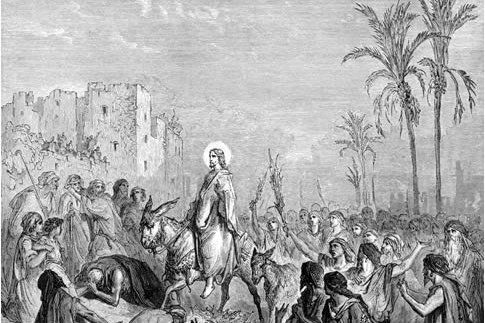
Gustave Dore, Jesus Rides into Jerusalem on a Donkey on Palm Sunday (1866), public domain via Wikimedia Commons
Branches, blessed at Mass
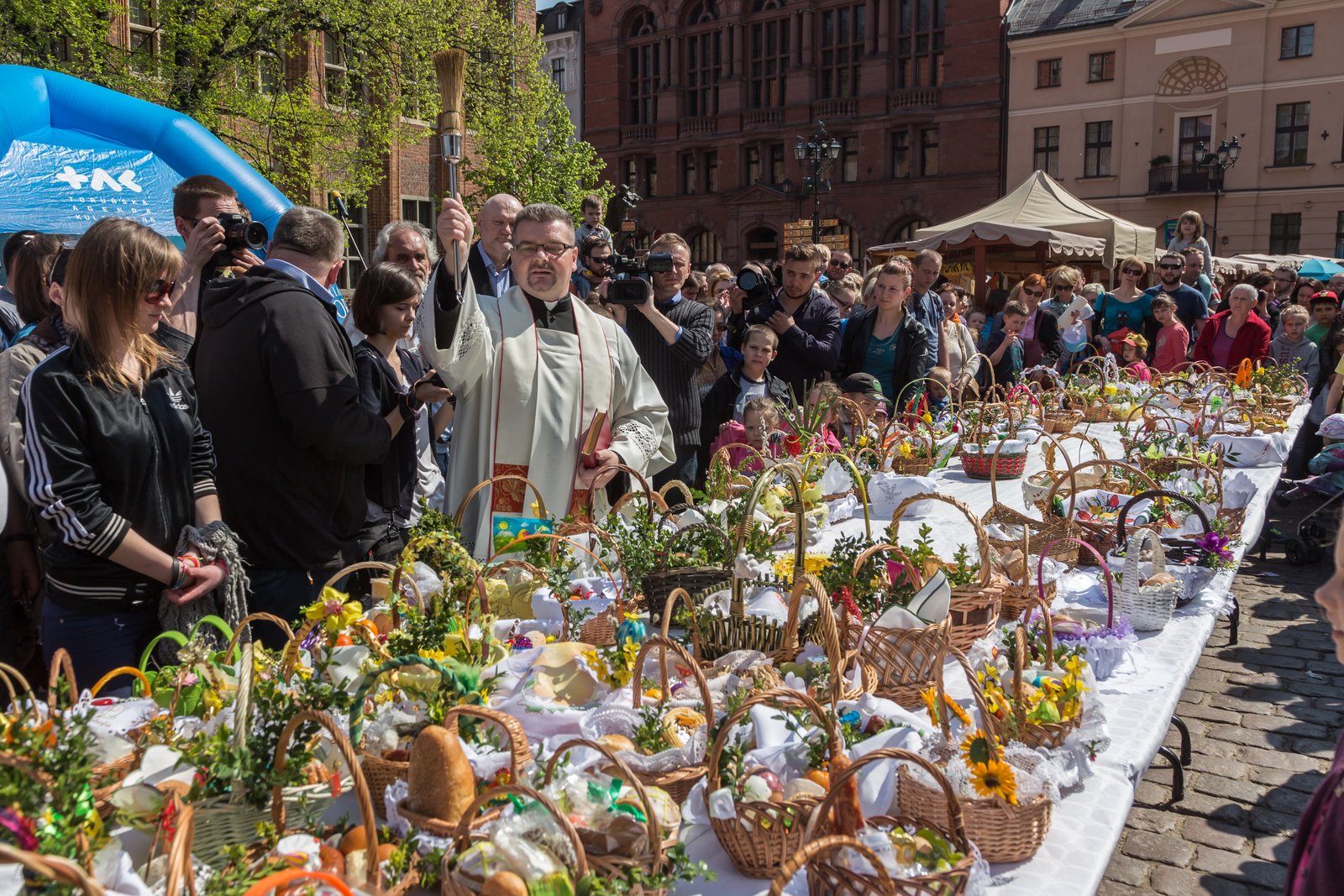
The Church's central Palm Sunday custom directly reenacts the Gospel scene: palm branches are blessed, typically at the start of Mass, often accompanied by a procession in which the congregation carries the blessed palms, echoing the crowd's own procession into Jerusalem centuries earlier. In parts of the world where palm trees don't grow, other branches have historically substituted for true palm — pussy willow branches, for instance, became closely associated with Palm Sunday in several Slavic and Eastern Christian traditions, adapting the same underlying gesture to whatever greenery was locally available.
Folded into a cross
One of the most widespread individual customs to grow out of the palm blessing is the palm cross — a single blessed frond folded or woven by hand into the shape of a small cross. The custom traces to a practical suggestion recorded in the ceremonial book used by bishops: that small crosses made of palm be attached to boughs in places where genuine palm branches weren't available in sufficient quantity for the whole congregation. Over time, the folded cross became popular well beyond that original practical purpose, valued as a simple, personal object that carries the day's central symbol — Christ's triumphant entry and, folded into the cross shape, his coming Passion — in a form small enough to keep close at hand.
A blessed object, not a decoration
What Catholics do with their blessed palm after Mass reflects how the Church treats it: not as a souvenir, but as a sacramental, something blessed and therefore treated with a degree of reverence beyond ordinary household decoration. Many families display the palm behind a crucifix or a religious image in the home, where it will typically stay for the better part of a year. Rather than simply discarding a blessed object once it dries out, a widespread practice has parishioners returning their old palm to the parish shortly before the following Ash Wednesday, where it's burned to produce that year's ashes — meaning the very ashes marked on foreheads at the start of one Lent were very likely, quite literally, last year's Palm Sunday branches.
Also called Passion Sunday
The day's official title in the current Roman calendar is "Palm Sunday of the Passion of the Lord," a name that deliberately holds both halves of the liturgy together rather than treating them as separate occasions. In some places and in earlier liturgical calendars, "Passion Sunday" referred instead to the Sunday before Palm Sunday, marking the start of the final, more intensely penitential two weeks of Lent — a naming history that can cause some confusion for anyone comparing older devotional books to the Church's current calendar, where Passion Sunday and Palm Sunday now fall on the same day.
Regional customs beyond the branch itself
Catholic cultures have layered their own customs onto the basic rite of blessing and procession. In Jerusalem itself, a procession retraces part of the traditional route from the Mount of Olives into the old city, drawing pilgrims who want to walk a version of the same path the Gospel crowd walked. In Spain and parts of Latin America, elaborate Palm Sunday processions carry large, intricately woven palm fronds and images through city streets, often organized by lay religious confraternities. In the Philippines, the custom of "Palaspas" sees elaborately woven and decorated palm branches blessed and proudly displayed at the entrance of homes afterward. In colder parts of Europe where palm trees don't grow, pussy willow and other early-budding branches have long substituted for palm, tying Palm Sunday's symbolism to a visible, local sign of approaching spring rather than an imported one.
A single day holding two moods at once
Palm Sunday's liturgy itself reflects the tension the Catechism names directly — most parishes pair the joyful palm blessing and procession at the start of Mass with a full reading of the Passion narrative later in the same liturgy, moving within a single service from "Hosanna" to the account of the crucifixion. That structure isn't an oversight or a jarring mismatch; it's a deliberate liturgical choice that keeps the crowd's welcome and Christ's coming suffering held together, refusing to let either overshadow the other as Holy Week formally begins.
Trivia
What does Palm Sunday commemorate?
Why does the Church call Jesus's entry into Jerusalem significant, given what happens right after?
Why are palm branches blessed at Mass on this day?
What is a palm cross, and where does the custom come from?
What do Catholics traditionally do with blessed palms after Palm Sunday?
Related Reading