Holy Thursday and the Washing of the Feet

A servant's task, done by the teacher
John's Gospel is specific about the scene's staging: Jesus "rose from supper and took off his outer garments," tied a towel around his waist the way a household servant would, poured water into a basin, and began washing his disciples' feet one at a time, drying them with the towel he was wearing (John 13:3-5, NABRE). In first-century Jewish and Greco-Roman households, washing a guest's dusty feet after travel was ordinary hospitality, but it was work reserved for the lowest servant in the house — not something a master or a respected teacher would be expected to do for his own followers. That inversion is exactly the point John's account draws attention to: a teacher and master performing the most menial task in the household, for the very people who called him "teacher" and "master" themselves (John 13:13, NABRE).
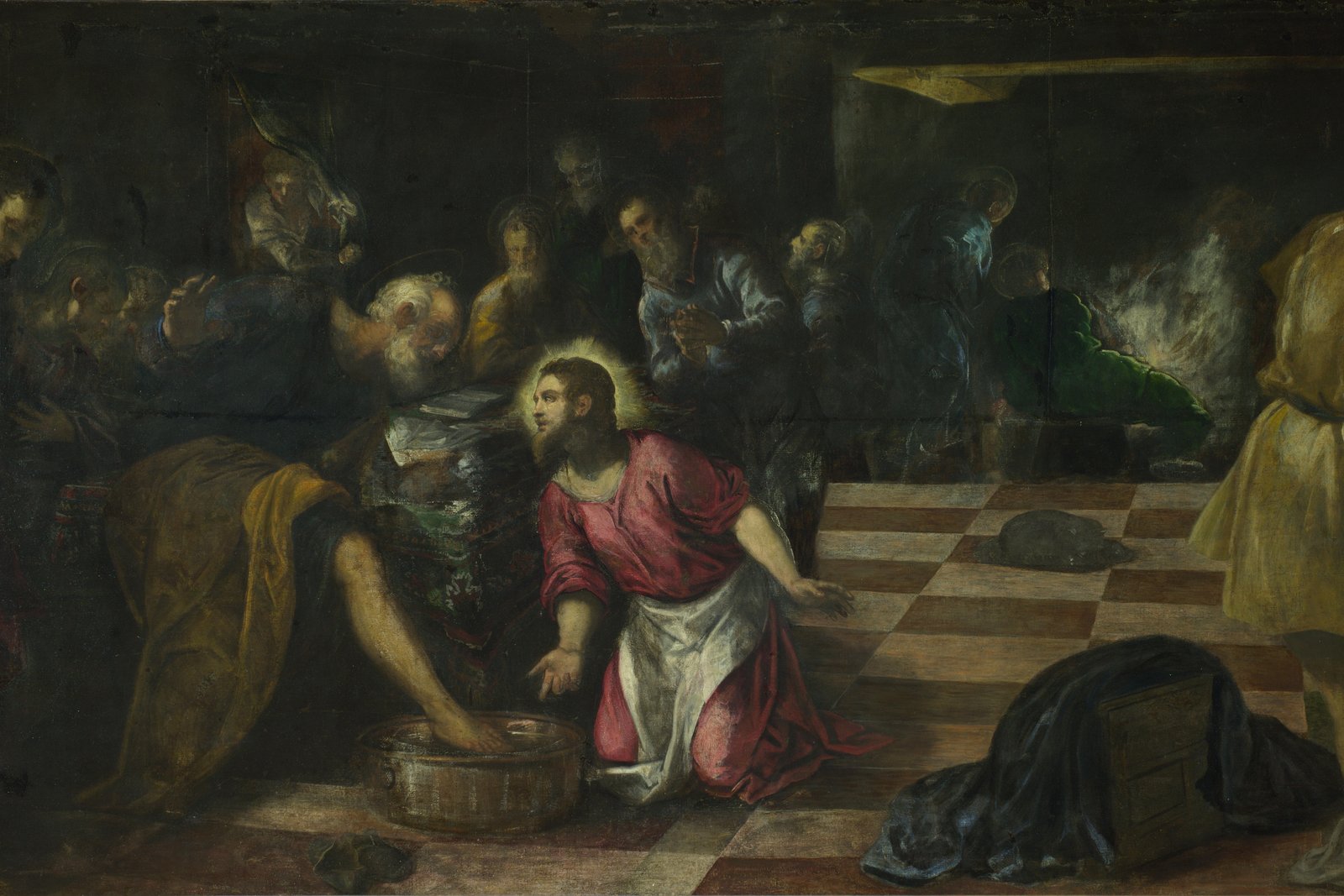
Jacopo Tintoretto, Christ Washing the Feet of the Disciples (16th century), public domain via Wikimedia Commons
"You ought to wash one another's feet"
Jesus doesn't leave the gesture to speak entirely for itself. Once finished, he asks the disciples directly, "Do you realize what I have done for you?" before drawing out the lesson explicitly: "If I, therefore, the master and teacher, have washed your feet, you ought to wash one another's feet. I have given you a model to follow, so that as I have done for you, you should also do" (John 13:12-15, NABRE). The washing isn't presented as a one-time act of humility performed for its own sake; it's framed as a pattern the disciples are explicitly told to continue — service modeled downward, from master to servant, meant to be imitated in every direction afterward.
The Mandatum, named for a command
The liturgical rite that reenacts this scene is known as the Mandatum — Latin for "commandment." The name draws on two connected sources: Jesus's own words at the Last Supper about the model he's given the disciples to follow, and the opening word of a traditional antiphon sung during the ceremony, "Mandatum novum do vobis, ut diligatis invicem" — the Latin rendering of Jesus's words later at the same meal, "I give you a new commandment: love one another. As I have loved you, so you also should love one another" (John 13:34, NABRE). The rite's name ties it directly back to Christ's own instruction rather than treating it as a free-standing custom invented independently of the Gospel text it reenacts.
A ceremony documented since at least the seventh century
Historical evidence for a formal, liturgical version of the foot-washing rite reaches back a considerable way. The earliest clear reference comes from a seventh-century document, the Roman Ordo in Coena Domini, which describes the pope washing the feet of his attendants on Holy Thursday. A Council of Toledo held in 694 also addressed the custom, suggesting foot washing at the Holy Thursday liturgy (referred to there by its Latin name, the Coena Domini, "Supper of the Lord") had already fallen into disuse in some places by that point and needed to be reaffirmed as an observance that "must be observed everywhere" — evidence the practice likely predates even this seventh-century documentation, even if an earlier written record hasn't survived.
From clerical rite to parish-wide practice
For much of its history, the Mandatum was closely tied to monastic and clerical settings — a pope or bishop washing the feet of a small, often exclusively male and clerical group of attendants, a fairly restricted and formal version of the ceremony. That began to shift with the Holy Week liturgical reforms carried out under Pope Pius XII in the twentieth century, which gave the foot-washing rite a more visible, public place within the evening Mass of Holy Thursday as celebrated in ordinary parishes, not just in monasteries or at the papal liturgy. More recent liturgical guidance has broadened further who may be included among those whose feet are washed during the parish rite, extending a ceremony that began as an exclusively clerical observance into something now witnessed, and often participated in directly, by ordinary parishioners each Holy Thursday.
One rite within a night of several meanings
The Mandatum doesn't stand alone on Holy Thursday; it's folded into an evening Mass that also commemorates the institution of the Eucharist and, by extension, the priesthood itself, since it was at this same meal that Jesus told the disciples to "do this in memory of me." That layering matters for understanding why the foot-washing happens where it does in the liturgy: it isn't a separate devotional add-on, but part of a single night's commemoration of the same Last Supper from multiple angles — the gift of the Eucharist, the institution of priestly ministry, and the explicit command to serve one another modeled by Christ himself. Many parishes also observe a period of eucharistic adoration after the Mass concludes, extending the night's themes of service and presence well past the final blessing, often continuing until midnight to recall Christ's own agony in the garden that same night.
Regional variations on who is washed
While Western parishes typically wash the feet of twelve parishioners, echoing the twelve apostles, the exact custom has varied by place and era. Some dioceses have historically included only men in the rite, reflecting its origin as a reenactment involving the twelve apostles; more recent guidance has opened the rite to include women as well, a change adopted with varying speed from parish to parish and diocese to diocese. In some countries, bishops perform the Mandatum publicly in settings beyond the parish Mass entirely — popes have at times washed the feet of prisoners, the elderly, or refugees rather than clergy, extending the rite's reach toward exactly the kind of people who, in a first-century household, would have had their own feet washed by the lowest servant rather than ever being asked to serve in turn.
Service, performed rather than only preached
What makes the Mandatum distinct among Holy Week's rites is its insistence on physical enactment rather than verbal instruction alone. A homily can describe humility and service; the Mandatum requires a priest, deacon, or bishop to actually kneel down and wash real feet, in front of the whole congregation, on the same night the Church recalls Christ doing exactly that for his own disciples. It's a small, deliberately uncomfortable ceremony by design — asking those who witness and participate in it to sit, for a few minutes, inside the same reversal of expected roles that startled the disciples gathered around that first table.
Trivia
What does Scripture say happened at the Last Supper before the meal itself?
What did Jesus say the washing was meant to teach?
What is the 'Mandatum,' and where does the name come from?
How far back does the liturgical foot-washing ceremony date?
Who gets their feet washed during the modern Holy Thursday liturgy?
Related Reading