Friar vs. Monk: What's the Real Difference?

Two very different daily lives
The confusion is entirely understandable, since both monks and friars are men who have taken formal, permanent vows of poverty, chastity, and obedience and committed themselves to a life of prayer and service within the Catholic Church. From a distance — a robed figure, a simple lifestyle, a title of "Brother" or "Father" — they can look identical. The real difference lies not in the vows themselves but in the structure of the life those vows are lived within: where a man lives, how his community supports itself, and what his daily work actually looks like.
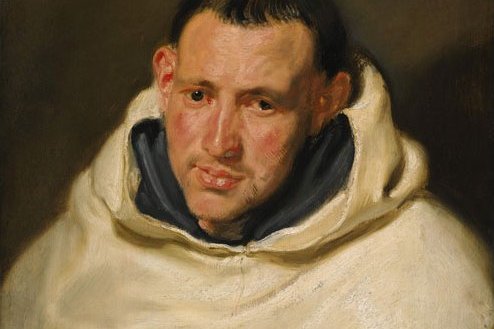
Attributed to Anthony van Dyck, Portrait of a Carmelite Monk, 17th century — public domain, Wikimedia Commons.
The monk: stability in one place
A monk belongs to what the Church calls monastic life, a tradition that traces back to the Egyptian desert fathers of the third and fourth centuries and was later given its most influential and lasting structure by Saint Benedict of Nursia in the sixth century. Benedictine monasticism, and the many traditions that grew from it, is built around a vow the Rule of Saint Benedict calls stabilitas — stability — meaning a monk commits himself to one specific monastic community for life, not to the wider Church in general or to a roving ministry.
That stability shapes everything else about monastic life. A monk's days follow a fixed, demanding rhythm centered on the Liturgy of the Hours, gathering with his community multiple times a day and night for communal prayer, interspersed with manual labor, study, and private prayer — famously summarized in the Benedictine motto ora et labora, "pray and work." Traditionally, monasteries are also largely self-sufficient, supporting themselves through farming, craftwork, or other productive labor carried out on monastery grounds, rather than depending on charity from the surrounding population. Contact with the outside world is limited by design, not as a punishment but because the whole structure is oriented toward a contemplative life, set apart.
The friar: mission on the move
A friar belongs to what the Church calls a mendicant order — from the Latin mendicare, to beg — a very different model of religious life that emerged in the early 13th century, most prominently through Saint Francis of Assisi's Franciscans and Saint Dominic's Dominicans. These orders arose during a period of rapid growth in medieval European towns and cities, and they were deliberately designed to meet a need monasteries, by their nature, could not: an active, visible ministry among ordinary people living in those growing urban centers.
Where a monk commits to one monastery for life, a friar is typically attached to a wider province or order rather than a single fixed building, and can be assigned to travel and serve in many different locations over the course of his life. Where a monk's work is centered inward, on the monastery and its own self-sufficiency, a friar's work is centered outward: preaching, hearing confessions, teaching, running schools and universities, and historically, relying on begging and the charity of the surrounding community for his order's material support, rather than on land and labor. The word "friar" itself comes from the Latin frater, brother — a title that reflects how these men understood their relationship to the ordinary people they lived and worked among, rather than living apart from them.
Why the distinction mattered so much in the Middle Ages
This wasn't a minor administrative difference to medieval Catholics — it represented two genuinely different visions of how religious life could serve the Church. By the early 13th century, Europe's population was shifting rapidly into growing towns and cities, and existing rural monasteries, however spiritually rich, were poorly positioned to minister to that expanding urban population directly. Francis and Dominic each recognized this gap in their own way and built new kinds of religious orders specifically to fill it — orders whose members could live among ordinary townspeople, preach in the vernacular in public squares, and respond quickly to the practical and spiritual needs of a rapidly changing society, all without the fixed geographic ties that came with a stable monastery.
This is also why the mendicant orders became so closely associated with the great medieval universities and with preaching against heresy — both activities depended on mobility, contact with lay society, and direct public engagement in a way monastic life, by its founding structure, was never designed for.
A distinction worth knowing, not a hierarchy
None of this makes one form of religious life superior to the other — the Church has always held both monastic and mendicant vocations as fully legitimate and valuable expressions of consecrated life, simply oriented toward different purposes. A man drawn to sustained silence, communal prayer, and a life set deliberately apart from the world is likely called to monastic life. A man drawn to active ministry, preaching, and direct engagement with ordinary people's daily struggles is more likely called to a mendicant order as a friar.
Knowing the difference does more than settle a point of trivia. It explains, for instance, why a Trappist monastery sells its own honey and bread from land it has farmed for centuries, while a Franciscan friary in the middle of a city runs a soup kitchen and a parish school — two profoundly different, equally Catholic answers to the same underlying call to a life given entirely to God.
Trivia
What is the main difference between a friar and a monk?
Are Franciscans and Dominicans monks or friars?
Are Benedictines monks or friars?
Does 'monk' just mean any religious brother in general use?
What is the word for a woman in religious life comparable to a friar or monk?
Related Reading