The Liturgy of the Hours Explained: Prayer Through the Day

Prayer organized around the clock
The formal name is the Liturgy of the Hours; the older, still-common name is the Divine Office, from the Latin officium, meaning "duty" or "service." Both names describe the same thing: an official, structured cycle of prayer that the Catholic Church prays daily, distinct from private devotions like the rosary because it is, technically, a liturgy — an act of public worship belonging to the whole Church, not a personal prayer that happens to be shared.
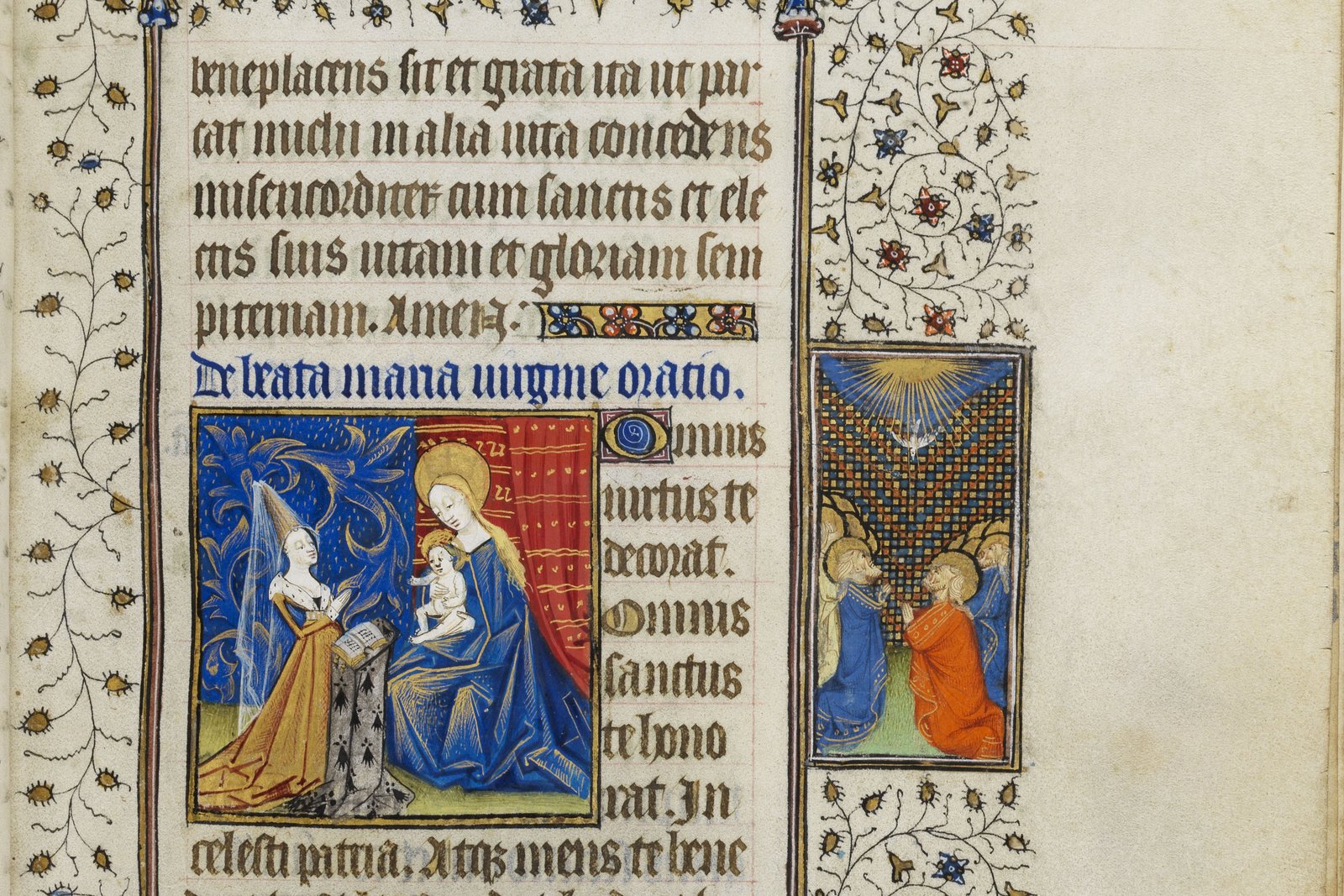
Master of the Coëtivy Hours (illuminator), Hours of Isabella Stuart, c. 1431, Fitzwilliam Museum, Cambridge — public domain.
The Hours are built primarily around the Book of Psalms, supplemented with other biblical canticles, short Scripture readings, brief writings from saints and Church Fathers, and set intercessions and closing prayers. The full cycle rotates through all 150 psalms and a set of Old and New Testament canticles over four weeks, which means a Catholic who prays the full Office consistently ends up praying through essentially the entire Psalter on a repeating monthly rhythm — a very different experience of the Psalms than reading them occasionally or out of order.
A rhythm as old as the early Church
The instinct behind the Liturgy of the Hours — praying at set points across the day rather than only once — reaches back to Jewish practice that predates Christianity entirely. The Psalmist writes, "Seven times a day I praise you because your judgments are righteous" (Psalm 119:164), describing exactly this kind of regular, repeated turning to prayer throughout the day, not a single daily devotion. Saint Paul's exhortation to the church in Thessalonica to "pray without ceasing" (1 Thessalonians 5:17) became, for later Christian communities, less a poetic ideal and more something to actually structure a day around.
By the fourth century, monastic communities in Egypt, Syria, and later throughout Europe had formalized this instinct into a fixed set of prayer times distributed across the day and night — a discipline closely associated with monastic life ever since, and one this site covers in more detail when explaining the difference between a friar and a monk. Saint Benedict's sixth-century Rule, one of the most influential documents in the history of Western monasticism, laid out a detailed daily schedule of prayer hours that heavily shaped how the Office would be structured for the next fifteen centuries of Catholic religious life.
The hours themselves
The modern Liturgy of the Hours, reformed and simplified after the Second Vatican Council, organizes the day into several distinct hours:
- Office of Readings — a longer, more meditative hour that can be prayed at any point in the day, combining a psalm-focused opening with an extended Scripture reading and a second reading, often drawn from the writings of saints, popes, or Church Fathers.
- Morning Prayer (Lauds) — prayed near daybreak, this and Evening Prayer are described by the Church's own official documents as the two "hinges" the whole day's prayer turns on, meaning they carry the greatest liturgical weight of all the hours.
- Daytime Prayer — one brief hour (sometimes three separate short ones — Midmorning, Midday, and Midafternoon) that can be prayed whenever convenient during the working day.
- Evening Prayer (Vespers) — prayed toward the close of the working day, the second of the two "hinge" hours.
- Night Prayer (Compline) — a short, simple hour prayed just before sleep, ending each day, notably, with the same handful of ancient prayers regardless of the day of the week — a settled, restful pattern that has changed very little over centuries.
Who prays it, and why
Canon law obligates priests, transitional and permanent deacons, and members of many religious orders to pray the full Liturgy of the Hours daily as a defining part of their vocation — not an optional devotion layered on top of ministry, but one of its central, required expressions. For a priest, praying the Office is understood as praying on behalf of the whole Church, joining his voice to a prayer being offered continuously, somewhere, at every hour.
Lay Catholics carry no such canonical obligation, but the Church has consistently and explicitly encouraged lay participation, particularly after the Second Vatican Council's reforms made the Office considerably more accessible. Many parishes now pray Morning or Evening Prayer together publicly, and a growing number of lay Catholics pray at least one hour privately as a daily discipline — often Morning Prayer, Evening Prayer, or Night Prayer, since these are shorter and easier to fit around a working schedule than the longer Office of Readings.
Getting started without a monastery
The prospect of learning a four-week rotating cycle of psalms, antiphons, and readings can look intimidating from the outside, but it's far more approachable in practice than it sounds. Most lay Catholics today use either a single-volume printed edition — in English, commonly Christian Prayer or Shorter Christian Prayer — or a free app such as iBreviary or Universalis, both of which assemble the correct prayers for the current day automatically, removing the need to navigate ribbons and page numbers by hand.
Starting with a single hour, most often Morning or Evening Prayer, is the practical way in. The prayer itself does the rest: because it draws so heavily and consistently from the Psalms, praying the Hours regularly tends to reshape how a person reads Scripture more broadly, turning what can otherwise feel like a static ancient text into words that genuinely mark the hours of an ordinary day.
Trivia
What is the Liturgy of the Hours?
Who is required to pray the Liturgy of the Hours?
What are the main hours in the Liturgy of the Hours?
What is the difference between the Liturgy of the Hours and a rosary or novena?
What book do Catholics use to pray the Liturgy of the Hours?
Related Reading