The Jesse Tree: An Advent Tradition Explained

A prophecy about a stump
The image behind the Jesse Tree starts with a single verse from Isaiah, written centuries before Christ, at a moment when the royal line of King David looked finished. "But a shoot shall sprout from the stump of Jesse, and from his roots a bud shall blossom," the prophet writes (Isaiah 11:1, NABRE) — describing not a flourishing tree but a stump, cut down, with new life emerging from it unexpectedly. Jesse was David's father; naming the stump after Jesse rather than David reaches back past the famous king to the ordinary family the whole royal line sprang from in the first place. Christian readers came to see this verse as a prophecy of the Messiah: new growth from an apparently ended family line, arriving from a source nobody would have expected to produce a king.
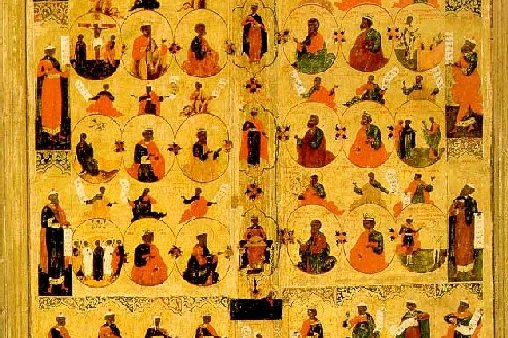
Tree of Jesse icon (17th century), public domain via Wikimedia Commons
From a single verse to a church-wide image
That verse eventually grew into one of medieval Christian art's most elaborate visual traditions. Large "Jesse trees" — carved in stone, worked into tapestries, or set in stained glass — began appearing in European churches, with a design showing Jesse reclining at the base and a tree growing directly out of his body, its branches carrying figure after figure upward: patriarchs, kings, prophets, culminating in Mary and Christ at the top. For a largely illiterate medieval congregation, these windows and carvings functioned as visual catechesis, laying out the sweep of the Old Testament's genealogy and its arc toward the Incarnation in a single glance, long before most worshippers could have read the Bible passages the images were built from.
A church image turned into a family devotion
The version of the Jesse Tree familiar in Catholic homes and classrooms today is a modern adaptation of that older image, not itself a centuries-old household custom. In its typical form, a family sets up a small tree, branch, or wall hanging at the start of Advent, and adds one ornament each day, paired with a short Scripture reading and reflection tied to that day's figure or story. A common sequence might move from creation and the fall, through Noah, Abraham, Jacob, Joseph, Moses, and David, on through the prophets, and finally to John the Baptist, Mary, and Joseph, arriving at the Nativity on Christmas Eve. The exact set of figures, and the exact number of days covered, varies considerably between families, parishes, and published Jesse Tree guides — there's no single official Church-mandated list, which leaves room for a family to build a version that fits its own Advent rhythm.
What the ornaments are made of
Because there's no official version to purchase or follow exactly, many families build their own ornaments from paper cutouts, felt, salt dough, or simple wood shapes, each one a small visual shorthand for that day's story — an ark for Noah, a ladder for Jacob's dream, a harp for David, a star for the Magi. The craftsmanship isn't really the point. What gives the devotion its weight is the daily pairing of a short reading with a tangible object a child can hold or hang, turning Advent's month-long waiting period into a sequence of small, concrete steps rather than one abstract span of time to get through before Christmas.
Teaching salvation history one day at a time
What makes the Jesse Tree distinct among Advent customs is its shape: it isn't really about Advent's themes of watchfulness or hope in the abstract, the way an Advent wreath tends to be — it's a chronological walk through the specific chain of people Scripture identifies as leading, generation by generation, toward Christ's birth. That structure gives Advent an educational backbone alongside its devotional one, especially for households raising children in the faith, turning the weeks before Christmas into a daily review of exactly how salvation history was understood to have unfolded before the first Christmas — a stump, in Isaiah's image, that turned out not to be the end of the story at all.
Rooted in the Gospel genealogies too
Isaiah's prophecy isn't the only scriptural thread feeding into the Jesse Tree image. Both Matthew and Luke open their Gospels with a genealogy of Jesus reaching back through the generations — Matthew's moving forward from Abraham, Luke's moving backward all the way to Adam — each tracing exactly the kind of long family chain the Jesse Tree visualizes. Matthew in particular names David and Jesse directly in his opening genealogy (Matthew 1:5-6), tying the Gospel's own account of Jesus's ancestry directly to the same figures Isaiah's prophecy pointed toward centuries earlier. A Jesse Tree, in this sense, isn't a loose devotional invention tacked onto Advent; it's a visual expansion of material the Gospels themselves treat as significant enough to open with.
A natural fit for the O Antiphons
The Jesse Tree's chronological structure pairs naturally with another ancient Advent custom: the O Antiphons, a set of seven short prayers traditionally sung at Vespers on the final days before Christmas, each addressing Christ by a different Old Testament title — O Wisdom, O Adonai, O Root of Jesse, and so on. The third of these antiphons, "O Radix Jesse" ("O Root of Jesse"), draws on the exact same Isaiah passage behind the Jesse Tree itself, and many families and parish programs deliberately time their Jesse Tree's final days to overlap with the O Antiphons, letting the two traditions reinforce the same image of Christ as the long-awaited growth from Jesse's family line, arriving from two different directions in the same final days of Advent.
In classrooms and parishes, not just homes
While the Jesse Tree works well as a private family devotion, it's also widely used in Catholic school classrooms and parish religious education programs, often as a shared, growing display built collectively by a group of children over the course of Advent rather than something one household keeps privately. In that setting, the devotion does double duty as both prayer and as straightforward religious education — a daily, cumulative review of Old Testament figures that many children would otherwise encounter only in scattered, disconnected lessons throughout the year, now gathered into a single visual sequence that builds toward one clear destination on Christmas Eve.
Trivia
What is a Jesse Tree?
Where does the name 'Jesse Tree' come from?
Is the Jesse Tree an ancient Catholic tradition?
How many ornaments does a Jesse Tree usually have?
Do you need special ornaments to start a Jesse Tree?
Related Reading