Why Do Catholics Pray to Saints? Intercession Explained

The distinction Catholic teaching actually makes
The word "worship" in modern English has narrowed to mean almost exclusively religious adoration, which is part of why "pray to saints" sounds alarming out of context — it sounds like adoration split between God and other beings. Catholic theology has always kept two very different categories separate, even if the everyday English word "pray" blurs them for outsiders.
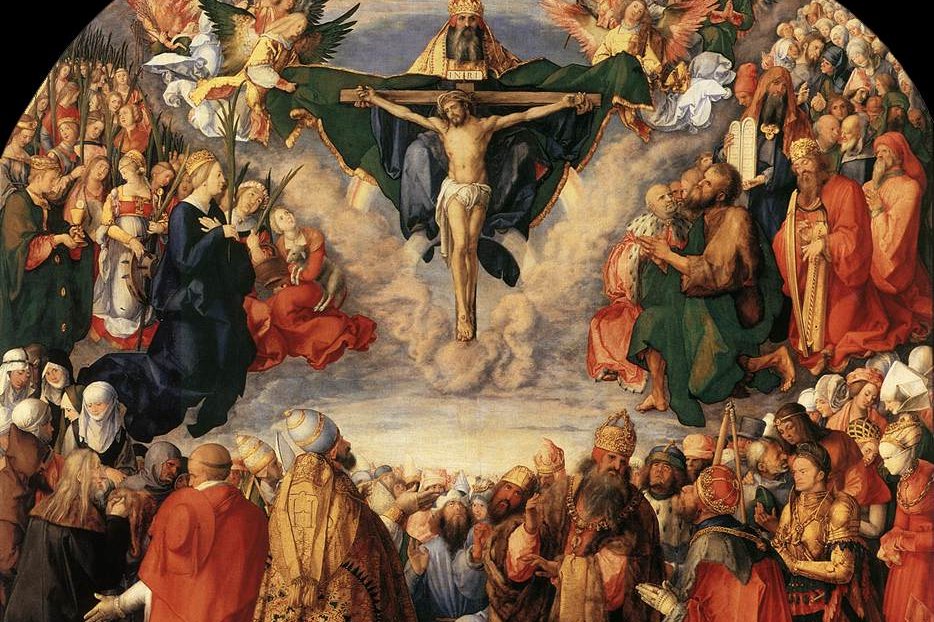
Albrecht Dürer, Adoration of the Trinity (Landauer Altarpiece), 1511, Kunsthistorisches Museum, Vienna — public domain.
The first is latria, from the Greek for the adoration owed to God alone — the total, absolute worship due only to the Creator. The second is dulia, the honor and veneration given to saints, understood as a lesser kind of respect appropriate to holy human beings, not the divine kind. A special subset, hyperdulia, applies uniquely to Mary, honoring her singular role as the mother of Christ while still remaining categorically distinct from the worship reserved for God. Mixing these categories up — offering latria to a saint — would itself be considered a serious theological error within Catholic teaching, not a devout excess of it.
What's actually happening when someone "prays to" a saint
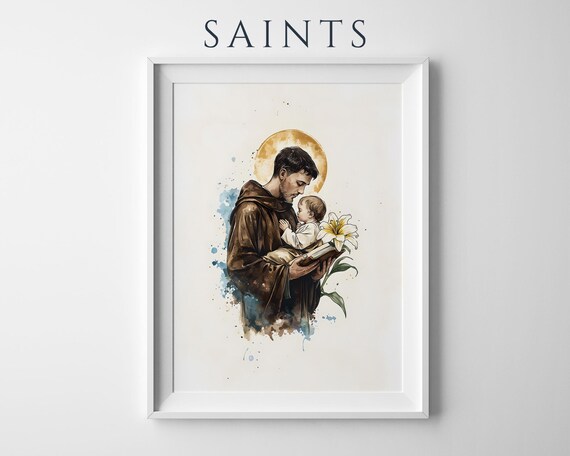
In practice, asking a saint's intercession looks almost exactly like asking a living person to pray for you, except across the boundary that ordinarily separates the living from the dead. Someone struggling with a difficult diagnosis might ask Saint Peregrine or another patron associated with illness to pray for their healing, the same way they'd ask a friend at church to keep them in prayer. Someone who has misplaced their keys might mutter a quick word to Saint Anthony of Padua, the traditional patron invoked for lost things — see the Patron Saints Directory for dozens of these traditional associations and where they came from.
The theological basis for this is the doctrine of the communion of saints — the belief that the Church is one body spanning heaven, purgatory, and earth, bound together in prayer rather than separated by death. The Catechism describes the saints in heaven as remaining "more closely united to Christ" and continuing to "intercede with the Father for us," offering before God the merits they acquired during their earthly lives, "through the one mediator between God and men, Christ Jesus" (CCC 956). That last phrase matters enormously: the saints' intercession is presented as flowing through Christ's mediation, never around it or in competition with it.
The "one mediator" objection, taken seriously
This is the most substantial theological question Christians outside the Catholic tradition raise about the practice, and it deserves a straightforward answer rather than a dismissal. Saint Paul writes to Timothy: "there is one God, and one mediator of God and men, the man Christ Jesus" (Douay-Rheims, 1 Timothy 2:5). If Christ alone mediates between God and humanity, doesn't asking a saint to intercede introduce a second mediator?
Catholic teaching's answer is that intercessory prayer among the faithful — living or dead — isn't a second, competing mediation, but a shared participation in Christ's one mediation, the same way a friend praying for you at church isn't setting up a rival channel to God alongside Christ's. The Catechism situates the saints' intercession explicitly within, not beside, Christ's unique role: their prayers reach God "through the one mediator" (CCC 956). Asking Saint Thérèse of Lisieux or Saint Jude to pray for you, on this view, is categorically the same act as asking a friend to pray for you — just directed at someone already united with God rather than someone still on the earthly side of that communion.
Where the custom historically began
The practice traces back further than most people expect. In the earliest centuries of Christianity, believers gathered to worship in private homes; there was no yet-established custom of naming church buildings after particular saints. Once Constantine legalized Christianity in the early fourth century, churches began to be built directly over the graves of martyrs, and each building naturally took the name and association of the martyr buried there. Asking that martyr's prayers, given their nearness to the altar and their witness to the faith even unto death, developed organically out of that physical proximity and grew into the broader custom of patron saints — extending eventually from places to occupations, life situations, and countries.
A practice of relationship, not substitution
Nothing about asking a saint's intercession is meant to replace direct prayer to God — Catholics who ask a saint's help are still, in the same breath or the same day, praying the Our Father, attending Mass, and addressing God directly in countless other ways. The saints are approached the way a trusted, holy friend already in God's presence might be approached: someone who has finished the race, as Paul puts it elsewhere, and whose prayers on your behalf are asked precisely because of how close they now stand to the one true mediator, not instead of him.
Trivia
Do Catholics worship saints?
What does it mean to "pray to" a saint if it's not worship?
Isn't Jesus the only mediator between God and humanity?
Why ask a saint instead of praying directly to God?
How does a saint know what people are praying for?
Related Reading