How to Build Your Spiritual Life as a Busy Working Adult

The false assumption to drop first
A lot of Catholics quietly believe that a "real" spiritual life belongs to people with more free time — retirees, monks, stay-at-home parents with a flexible morning. Under that assumption, a demanding job and a full calendar look like permanent excuses, and prayer gets postponed to some future season that never quite arrives. The Church's own teaching doesn't support that assumption. The Catechism describes prayer as a living, ongoing relationship with God sustained through the whole of daily life, compatible with any state of life a person actually occupies, not a practice reserved for those with unusual leisure (CCC 2697-2699). The question isn't whether a busy adult has time for a spiritual life. It's what a spiritual life looks like when it's built for an actual calendar instead of an imagined one.
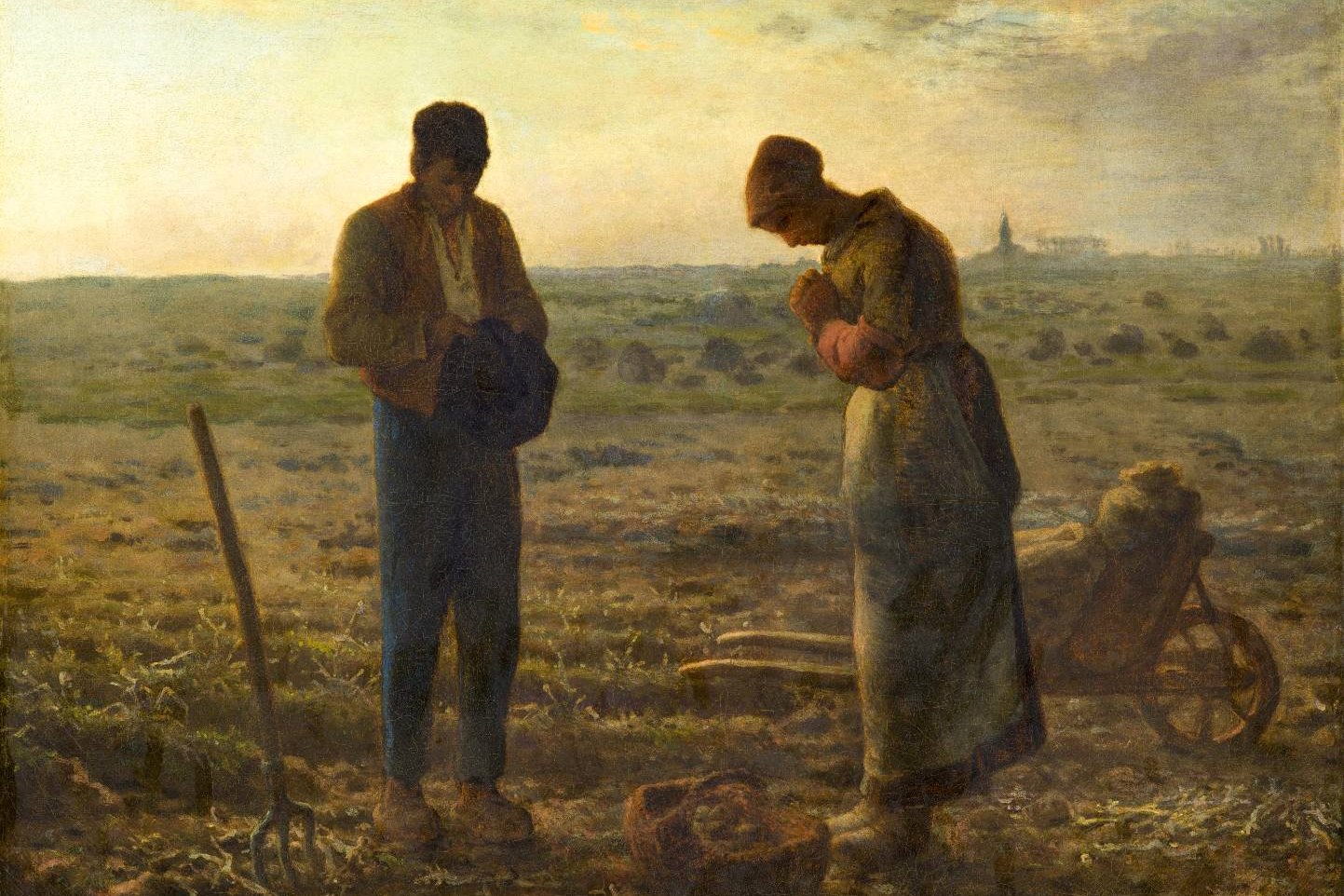
Jean-François Millet, The Angelus, 1857–1859, Musée d'Orsay, CC0.
Start with a floor, not a ceiling
The single biggest mistake busy people make with prayer is aiming too high on day one — a full hour, a whole Rosary, twenty minutes of silent meditation — and abandoning the attempt within a week when life interferes. A better approach is choosing a floor deliberately small enough to survive a bad day: three minutes with a short morning offering, one decade of the Rosary, a single Psalm read on the train. The floor can always be exceeded on good days. What matters is that it's low enough to actually happen on the days that aren't good, because consistency, not intensity, is what builds a spiritual habit that lasts years instead of weeks.
Anchor prayer to something that already happens daily
Prayer that depends on remembering to do it gets forgotten. Prayer attached to an existing daily anchor — the first coffee, the shower, the commute, brushing teeth before bed — inherits that anchor's reliability. A short morning offering said while the coffee brews, an examen said in the last few minutes before sleep, a decade of the Rosary during a drive: none of these require finding new time, because they're layered onto time that's already spoken for.
Mass on a packed schedule
Sunday Mass is the non-negotiable center of Catholic practice, and the Church treats it that way for good reason: the Catechism calls Sunday the pre-eminent day for the assembly of the faithful around the Eucharist, the day the entire liturgical rhythm of the Church is built around (CCC 2177-2178). For a genuinely overloaded week, protecting that one hour — treating it with the same non-negotiable status as a client meeting or a doctor's appointment — does more for a spiritual life than almost anything else on this list, precisely because it's the one commitment the Church asks of every Catholic regardless of schedule.
Weekday Mass is a different matter: valuable where it fits, but not expected of someone working a full job. Many parishes offer an early-morning or lunchtime weekday Mass specifically because a meaningful number of working Catholics can fit a twenty-five-minute Mass into a workday in a way they couldn't fit an evening holy hour. It's worth checking a parish bulletin or website for the exact time before assuming it doesn't exist.
Confession on a realistic rhythm
Confession doesn't need to be weekly to be meaningful. The Church's actual requirement is confession of grave sin at least once a year, and specifically before receiving Communion while aware of unconfessed mortal sin (CCC 1457); beyond that floor, more frequent confession is recommended as spiritually beneficial, not strictly required (CCC 1458). A quarterly or even semi-annual rhythm, chosen deliberately and kept, serves a busy adult better than an aspirational weekly plan that quietly stops happening after the second month.
Faith and ordinary work aren't competitors
One of the more practically useful pieces of Catholic teaching for working adults is the theology of work itself: that ordinary labor, offered with intention, is not a distraction from the spiritual life but a legitimate part of it. Vatican II's Lumen Gentium teaches that all the faithful — explicitly including those living out demanding, ordinary occupations — are called to the same fullness of Christian holiness as those in religious life, lived out through the actual duties of their state rather than in spite of them. A demanding job doesn't have to be endured until "real" spiritual life resumes after hours; it can itself be the material a spiritual life is built from, when approached with honesty, integrity, and small, repeated moments of offering the work itself to God.
A practical version of this: a thirty-second prayer before opening the inbox, a brief offering of frustration during a hard meeting instead of just gritting through it, treating a difficult coworker with patience as a deliberate spiritual practice rather than an unrelated inconvenience. None of this requires extra time. It requires noticing that the time already spent working is not spiritually empty by default.
What a realistic week can actually look like
A workable pattern for a genuinely busy adult might include: a two-to-five-minute morning prayer anchored to coffee or the commute, Sunday Mass treated as fixed and non-negotiable, a short night-time examen reviewing the day in a minute or two before sleep, occasional weekday Mass when the schedule allows it, and confession on a deliberate quarterly rhythm rather than an aspirational weekly one. None of this requires a free afternoon. It requires deciding, once, on a floor small enough to survive a bad week — and then actually keeping it, week after ordinary week, which turns out to be most of what a spiritual life ever really is.
Trivia
Do I need an hour a day to have a real prayer life?
Is it possible to grow in holiness through ordinary work, or is that only for people in religious life?
What if I can only get to Mass on Sunday and never during the week?
How do I pray when I genuinely don't have quiet time alone all day?
Is it wrong to feel like my spiritual life is thin right now because of work or family demands?
Related Reading