The Seven Spiritual Works of Mercy Explained

Needs that don't show up on an X-ray
The corporal works of mercy answer needs that are usually visible and urgent: an empty stomach, an unhoused body, an untreated illness. The spiritual works of mercy answer a different category of human need entirely — one that's often invisible from the outside and easy to overlook, precisely because nothing about it announces itself the way hunger or homelessness does. A person can be perfectly fed, housed, and physically well cared for, and still be carrying real spiritual anguish: crushing doubt, unresolved grief, isolating guilt, a habit they can't seem to break. Catholic tradition holds that tending to needs like these is every bit as much an act of Christian mercy as filling an empty plate.
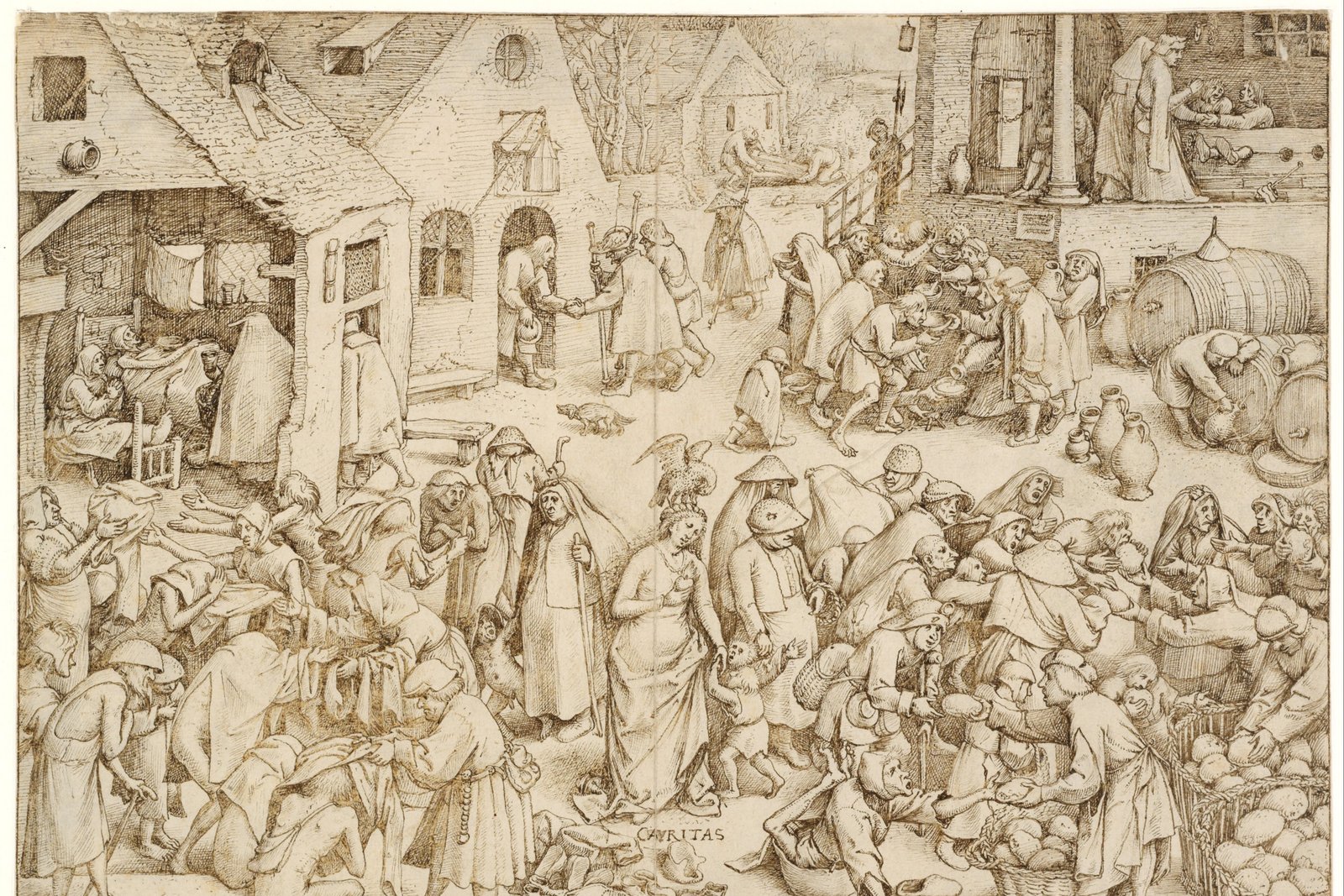
Pieter Bruegel the Elder, Charity (Caritas), 1559 — public domain.
The full list of seven
The traditional list, developed over centuries of Catholic moral and catechetical teaching, names seven spiritual works:
- Counsel the doubtful — helping someone struggling with uncertainty in faith or a difficult decision find clarity, not by dismissing their doubt but by walking through it with them.
- Instruct the ignorant — sharing knowledge, especially of the faith, with those who haven't had the opportunity to learn it.
- Admonish sinners — lovingly, respectfully pointing out when someone is heading toward serious wrongdoing, out of genuine care rather than judgment.
- Comfort the sorrowful — being present with someone in grief or suffering, without rushing them past it.
- Forgive offenses willingly — releasing resentment toward those who have wronged you, rather than holding onto it.
- Bear wrongs patiently — accepting the ordinary frustrations and injustices of life, including from other people, without letting bitterness take root.
- Pray for the living and the dead — interceding in prayer for others' needs, including souls the Church believes continue to benefit from prayer after death.
A list without one single source verse
Unlike the corporal works of mercy, which map cleanly onto Christ's own words in Matthew 25, the spiritual works don't come from one specific biblical passage. They developed more gradually, gathered by Christian moral tradition from various threads of New Testament teaching about correction, comfort, forgiveness, and prayer scattered across the Gospels and epistles. Saint Paul's instruction to the Galatians — "Brothers, even if a person is caught in some transgression, you who are spiritual should correct that one in a gentle spirit, looking to yourself, so that you also may not be tempted" (Galatians 6:1) — captures the spirit behind "admonish sinners" specifically, including its built-in warning against doing so with pride rather than humility.
Medieval theologians, including Thomas Aquinas in the 13th century, played a significant role in gathering these scattered teachings into the organized seven-item list still used today, treating it as a natural companion to the corporal works rather than a separate or lesser category of Christian charity. Because the list developed this way — through the Church's own catechetical tradition rather than direct citation of a single Gospel passage — it's fair to describe the specific number and wording as a traditional teaching tool the Church has used consistently for centuries, rather than as a numbered list found verbatim anywhere in Scripture itself.
The hardest ones to practice
Several of the spiritual works ask for something considerably more difficult than a single act of generosity — they ask for an ongoing disposition of heart. Forgiving offenses willingly and bearing wrongs patiently, in particular, aren't one-time actions so much as habits of character that have to be renewed, sometimes daily, especially toward people who have caused real and lasting harm. Catholic tradition doesn't pretend this is easy; it treats these two works as genuine spiritual struggles, not simple gestures, which is part of why they're listed as works of mercy rather than merely good manners — mercy, in the Christian sense, is precisely what's required when something is genuinely hard to give.
Praying for the dead carries its own distinct theological weight within Catholic teaching, tied to the doctrine of purgatory: the belief that souls being purified after death can still be helped by the prayers of the living. This connects directly to devotions like the novena for the souls in purgatory, one of the more concrete, structured ways Catholics put this seventh spiritual work into practice.
Two lists, one vision of mercy
The Church has never treated the spiritual works as somehow more advanced or optional compared to the corporal ones, or vice versa. Together, they represent a single, unified Catholic vision of what it means to love a neighbor fully — attending not only to an empty stomach but to an anxious mind, not only to a body needing shelter but to a heart needing comfort or correction. A faith that fed the hungry but ignored the sorrowing, or one that comforted the grieving while ignoring the starving, would be incomplete by the Church's own standard. The two lists exist side by side precisely because a whole person — body and soul together — is what mercy is ultimately meant to reach.
Trivia
What are the seven spiritual works of mercy?
What is the difference between the spiritual works of mercy and the corporal works of mercy?
Where do the spiritual works of mercy come from?
What does it mean to 'admonish sinners' as a spiritual work of mercy?
Is praying for the dead considered a spiritual work of mercy?
Related Reading