Novena for the Souls in Purgatory: A Nine-Day Prayer for the Dead

An offering sent to Jerusalem for the dead
The practice behind this novena is older than the word "purgatory" itself. In the Second Book of Maccabees, part of the Old Testament in the Catholic canon, the military leader Judas Maccabeus discovers that soldiers who died in a battle had been secretly wearing pagan amulets — a serious offense — and responds not with condemnation but with prayer. He takes up a collection "amounting to two thousand silver drachmas, which he sent to Jerusalem to provide for an expiatory sacrifice," the text explains, "for if he were not expecting the fallen to rise again, it would have been superfluous and foolish to pray for the dead" (NABRE, 2 Maccabees 12:43-44). The passage concludes that this was "a holy and pious thought," made "that they might be absolved from their sin" (NABRE, 2 Maccabees 12:45-46).
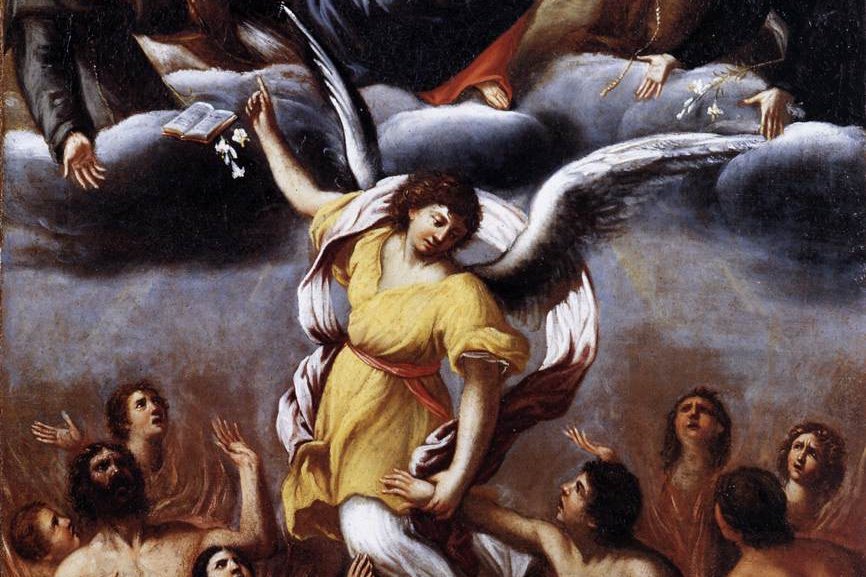
Ludovico Carracci, Purgatory, c. 1610, Pinacoteca Vaticana — public domain.
That single episode carries a lot of theological weight for something so brief. It assumes three things Catholic teaching still holds today: that death does not sever the bond between the living and the dead, that prayer can still benefit someone who has died, and that some form of purification or forgiveness remains possible after death for those who are not beyond hope. Centuries of Christian reflection on this and related texts eventually developed into the formal doctrine of purgatory.
What purgatory actually means in Church teaching
It's worth being precise here, since the word carries a lot of popular misunderstanding. The Catechism describes purgatory as a "final purification" for those "who die in God's grace and friendship, but still imperfectly purified," so that they may attain "the holiness necessary to enter the joy of heaven" (CCC 1030). It is not, according to Catholic teaching, a second chance for souls who died rejecting God, nor is it a lesser or slower version of hell — those in purgatory are already saved, already destined for heaven, and the process is described in terms of hope and certainty rather than uncertain punishment. For a fuller treatment of how purgatory fits alongside heaven and hell in Catholic doctrine, see Heaven, Hell, and Purgatory: What the Church Actually Teaches.
The Church also teaches that the dead in purgatory are not beyond the reach of the living. The Catechism describes an ongoing spiritual bond called the Communion of Saints, uniting "the faithful on earth, the dead who are being purified, and the blessed in heaven" (CCC 962), which is precisely why Catholics pray for the dead at all rather than treating death as the end of any possible help. November 2, All Souls' Day, is the Church's principal annual observance built around this belief; see The Commemoration of All the Faithful Departed for its history and how it developed alongside this same theology.
How the novena developed
Like the Christmas Novena and the Novena to the Holy Spirit, the nine-day structure of this devotion traces back to the apostles' nine days of prayer between the Ascension and Pentecost, described in Acts — the template every Catholic novena borrows, regardless of its specific intention. For that fuller history, see What Is a Novena? Praying a novena for the dead applies that same nine-day discipline to a particular kind of intention: not a personal need, but an act of intercession on someone else's behalf, asking God's mercy for a soul that can no longer pray for itself.
Unlike novenas tied to a saint's feast day, this one has no single fixed date. Many Catholics pray it during November, the month the Church has traditionally set aside for remembering the dead, or in the days immediately before All Souls' Day. Others pray it in the days following a specific death — a parent, a spouse, a friend — as an extended act of mourning that also does something concrete: asking for the deceased person's purification and swift entry into the full presence of God.
How to pray it
The novena typically combines a fixed prayer, repeated once daily for nine days, with a specific intention named at the start: a particular person, a family member, or "all the souls in purgatory, especially those who have no one to pray for them" — a common phrase found in several traditional versions, reflecting the belief that some souls may otherwise be entirely forgotten. A widely used traditional prayer runs:
Eternal rest grant unto them, O Lord, and let perpetual light shine upon them. May the souls of the faithful departed, through the mercy of God, rest in peace. Amen.
Many novena texts pair this "Eternal Rest" prayer with a decade of the Rosary, the Divine Mercy chaplet, or a specific plea such as "Lord Jesus, have mercy on the souls in purgatory," repeated daily alongside the Eternal Rest prayer. No version is mandated by the Vatican; parishes, religious orders devoted to the dead, and devotional publishers each circulate their own wording, much as with other well-known novenas.
A quieter kind of devotion
This novena doesn't ask for a favor granted, a crisis resolved, or a specific outcome the way many novenas do. It asks nothing for the person praying at all. That makes it, in a sense, one of the more selfless devotions in Catholic practice — nine days spent asking mercy for someone who cannot ask for themselves anymore, offered in a tradition that stretches back, by the Church's own account, to a Jewish general's collection for soldiers he could no longer help in any other way. What began as silver drachmas sent to Jerusalem is, today, nine quiet days of prayer — the same conviction, carried forward across more than two thousand years, that death does not put anyone beyond the reach of love.
Trivia
What is the Novena for the Souls in Purgatory?
Where does the idea of praying for the dead come from?
What does the Catholic Church actually teach about purgatory?
Can the living really do anything for souls in purgatory, according to Catholic belief?
Is there an official Church text for this novena?
Related Reading