What Is a Scapular? The Brown Scapular Explained

From full habit to small sign
The word "scapular" comes from the Latin scapula, meaning shoulder blade, and the object began as exactly what that suggests: a long strip of cloth, worn over the shoulders and hanging down the front and back, that formed part of the working habit of many monastic and mendicant orders. Its original, practical purpose was closer to a protective apron than a devotional object — something a monk could wear over his tunic while doing manual labor.
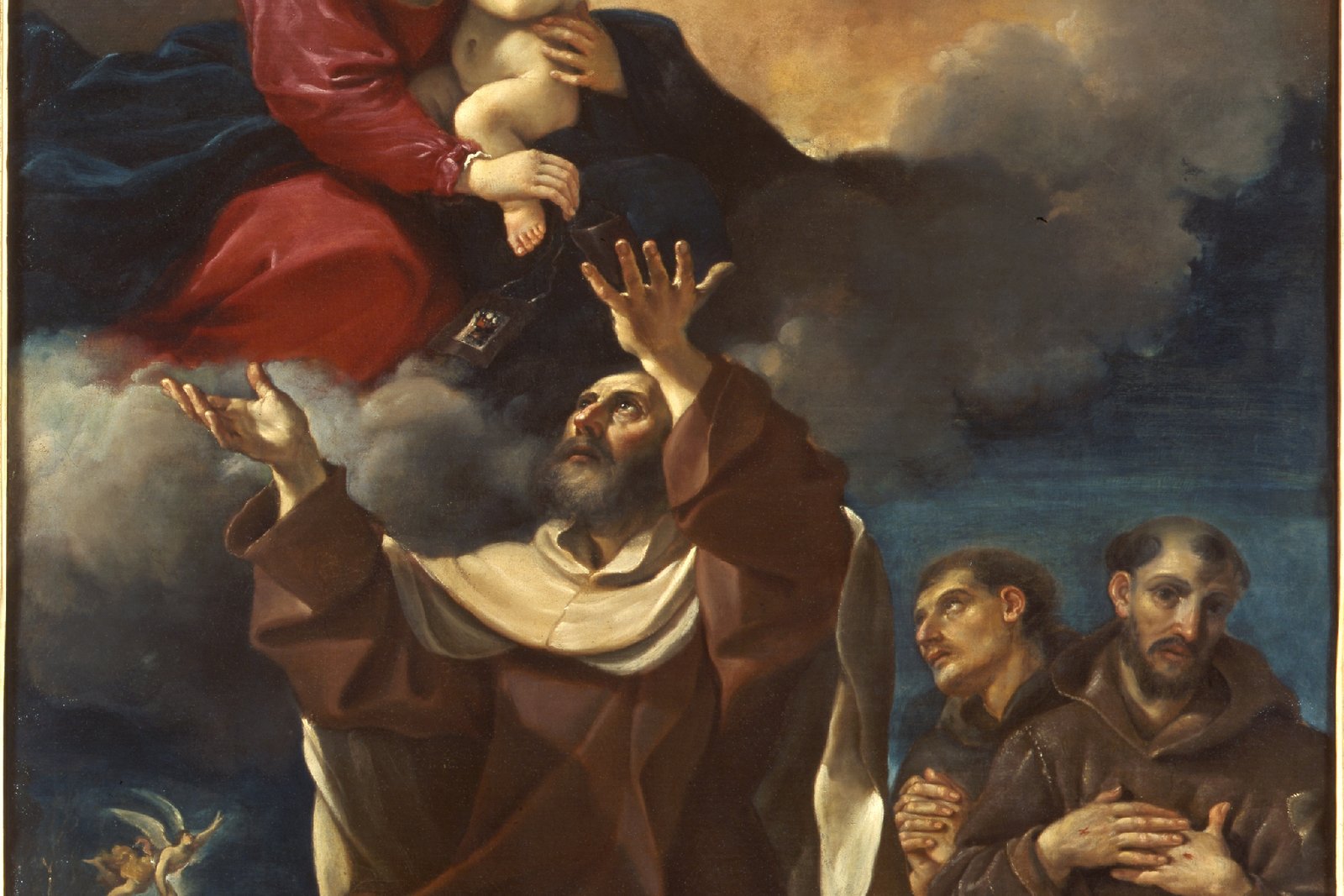
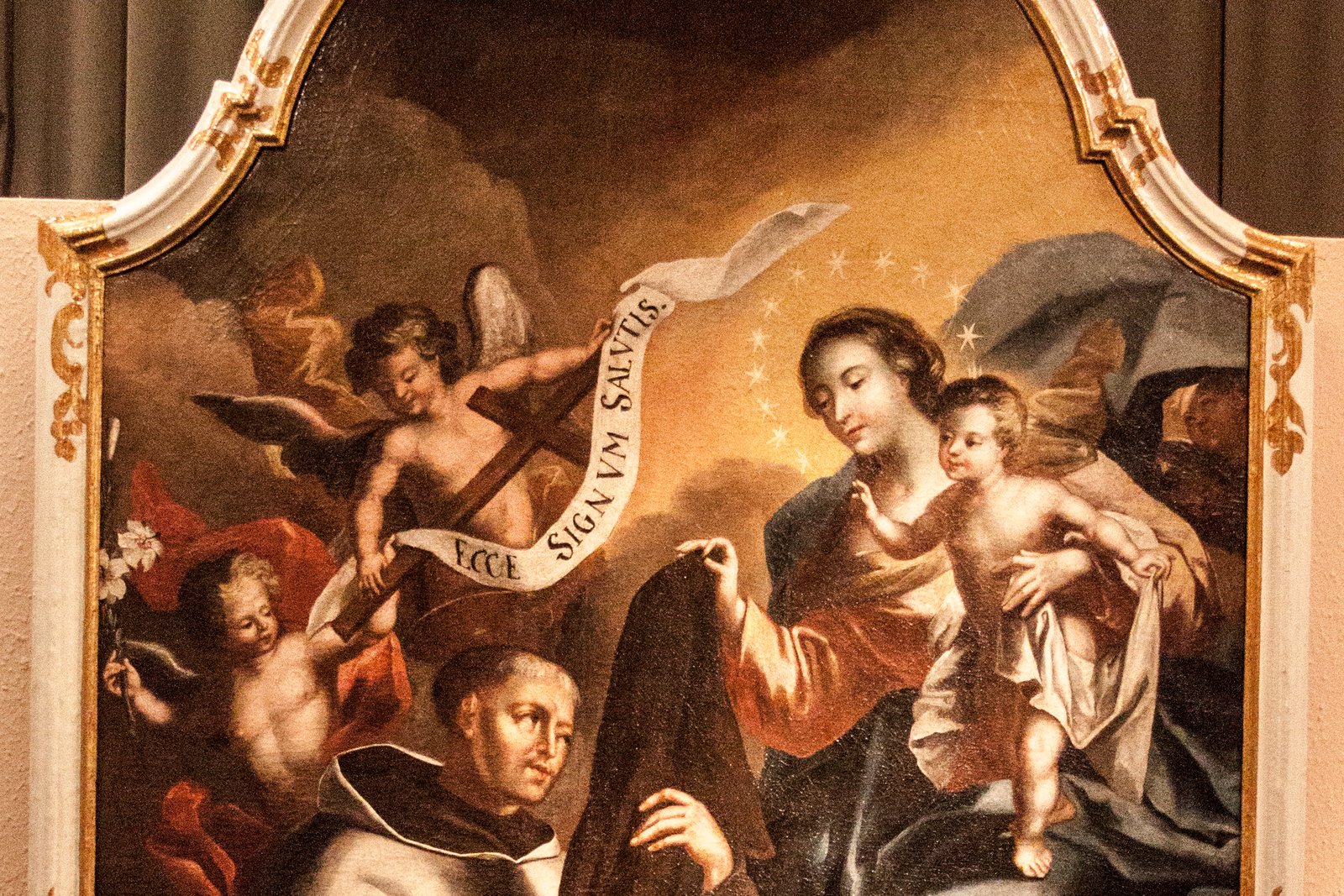
Guercino, Madonna of Mount Carmel with Saints Albert, Francis, and a Franciscan, 17th century — public domain, Wikimedia Commons.
Over time, religious orders began offering laypeople an association with their spiritual life and community without requiring them to enter religious life themselves, and the scapular became the visible sign of that connection. A miniature version — two small rectangles of cloth joined by cords, worn under ordinary clothes, one piece resting on the chest and the other on the back — let a layperson carry a tangible reminder of that bond throughout an ordinary day, at work, at home, wherever life took them, without ever needing to wear a full religious habit.
The Carmelites and Our Lady of Mount Carmel
The most famous scapular by far is the Brown Scapular, associated with the Carmelite religious order and specifically with the title Our Lady of Mount Carmel, one of many Marian feasts celebrated through the liturgical year. According to a tradition that developed within Carmelite spirituality, the Virgin Mary appeared to Saint Simon Stock, an English Carmelite prior, in the year 1251, and gave him the brown scapular as a sign of her particular protection over the Carmelite order and, by extension, over anyone who wears it faithfully while living a genuinely devout life.
It's important to be precise here about what belongs to official Church teaching and what belongs to devotional tradition. The vision itself, its exact date, and the words traditionally attributed to Mary in that encounter come down to us through Carmelite tradition, not through any Church-defined dogma — historians continue to debate the earliest sources behind the story. What the Catholic Church has done, repeatedly and across many centuries, is formally approve and indulgence the Brown Scapular devotion itself as a legitimate, encouraged form of Marian piety — meaning the Church affirms the practice and its spiritual value, even while treating the founding apparition narrative as pious tradition rather than a matter requiring belief.
What the "promise" actually means
The tradition attached to the Brown Scapular includes a promise, often summarized loosely as protection from hell for those who die wearing it. Stated that bluntly and without context, it invites exactly the kind of misunderstanding the Church has worked for centuries to correct: the scapular is not a magic charm, and wearing one is never a substitute for an actual life of faith, the sacraments, and moral conversion.
The Carmelite order and Church teaching consistently frame the promise as conditional on genuine devotion — the scapular is a sign and reminder of a person's consecration to Mary and their effort to live according to the Gospel, not a talisman that works independently of how a person actually lives. Popes across several centuries have encouraged the devotion precisely because, understood correctly, it functions the way other sacramentals do: not causing grace automatically like a sacrament, but disposing a person toward grace by keeping a visible, physical reminder of their faith close at hand, day after day.
Formal enrollment versus simply wearing one
Historically, full participation in the Brown Scapular devotion involved a specific rite of enrollment, performed by a priest with the authority to do so, who blesses the scapular and formally invests the person wearing it — sometimes, though not always, recording the enrollment in a register connected to a parish or Carmelite community. This formal step traditionally marked entrance into the broader Carmelite spiritual family, known as the Confraternity of the Brown Scapular, extending a share in the prayers and spiritual benefits of the wider Carmelite order to laypeople who might never set foot in a monastery.
In practice today, many Catholics simply wear a scapular purchased from a religious goods store without undergoing formal enrollment, and it still functions as a genuine sacramental and sign of devotion. But for Catholics who want the fuller, traditionally intended experience of the devotion — including its connection to the Carmelite spiritual family specifically — seeking out formal enrollment through a priest remains the historically intended path, and it's readily available at most parishes with any Carmelite connection, or through Carmelite religious houses directly.
Other scapulars, briefly
While the Brown Scapular dominates Catholic devotional life to the point that "the scapular" often means it by default, it isn't the only one. The Blue Scapular of the Immaculate Conception, the Red Scapular of the Passion of Christ, and the Green Scapular, associated with conversion, each carry their own distinct history and promises, tied to different apparitions, religious orders, or devotional movements. None has achieved anything close to the Brown Scapular's centuries-long, worldwide popularity, but all of them share the same underlying logic: a small, physical object worn close to the body as a constant, quiet reminder of a much larger spiritual commitment.
That, ultimately, is what any scapular is for — not a substitute for a life of faith, but a companion to one, worn where it can't easily be forgotten.
Trivia
What is a scapular in the Catholic Church?
What is the Brown Scapular of Our Lady of Mount Carmel?
Is the Brown Scapular promise official Catholic teaching?
How does someone get formally enrolled in the Brown Scapular?
Are there other scapulars besides the brown one?
Related Reading