The Meaning of Holy Water

Not a sacrament, but a sacramental
Holy water belongs to a category of Catholic religious objects and practices called sacramentals — distinct from the seven sacraments (like Baptism or the Eucharist), which Catholic teaching holds directly confer grace by the very fact of being performed. A sacramental, by contrast, is defined by the Catechism as a sacred sign that "prepares [people] to receive the chief effect of the sacraments" and sanctifies different circumstances of life (CCC 1667). Holy water doesn't act automatically the way a sacrament does; its effect is understood to depend on the faith and devotion of the person using it, working alongside the Church's prayer rather than independent of it. Sacramentals as a whole cover a wide range of blessed objects and gestures, and holy water is among the most universally recognized and frequently used.
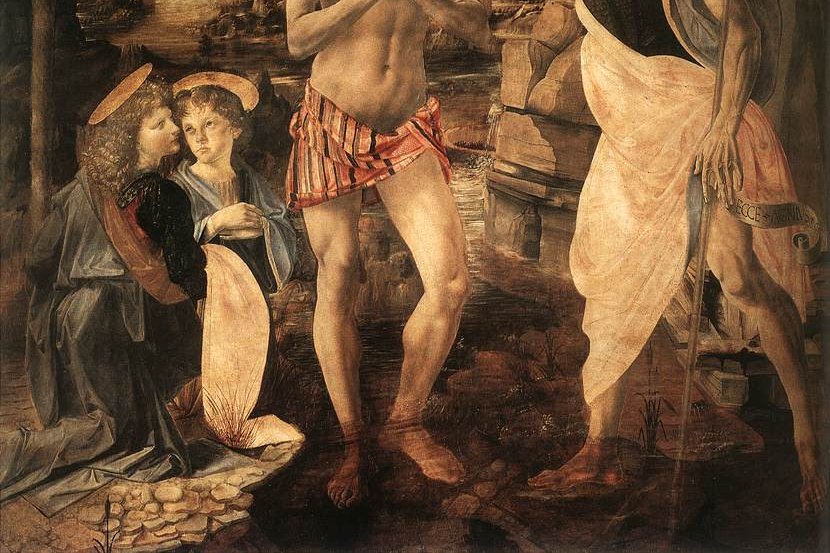
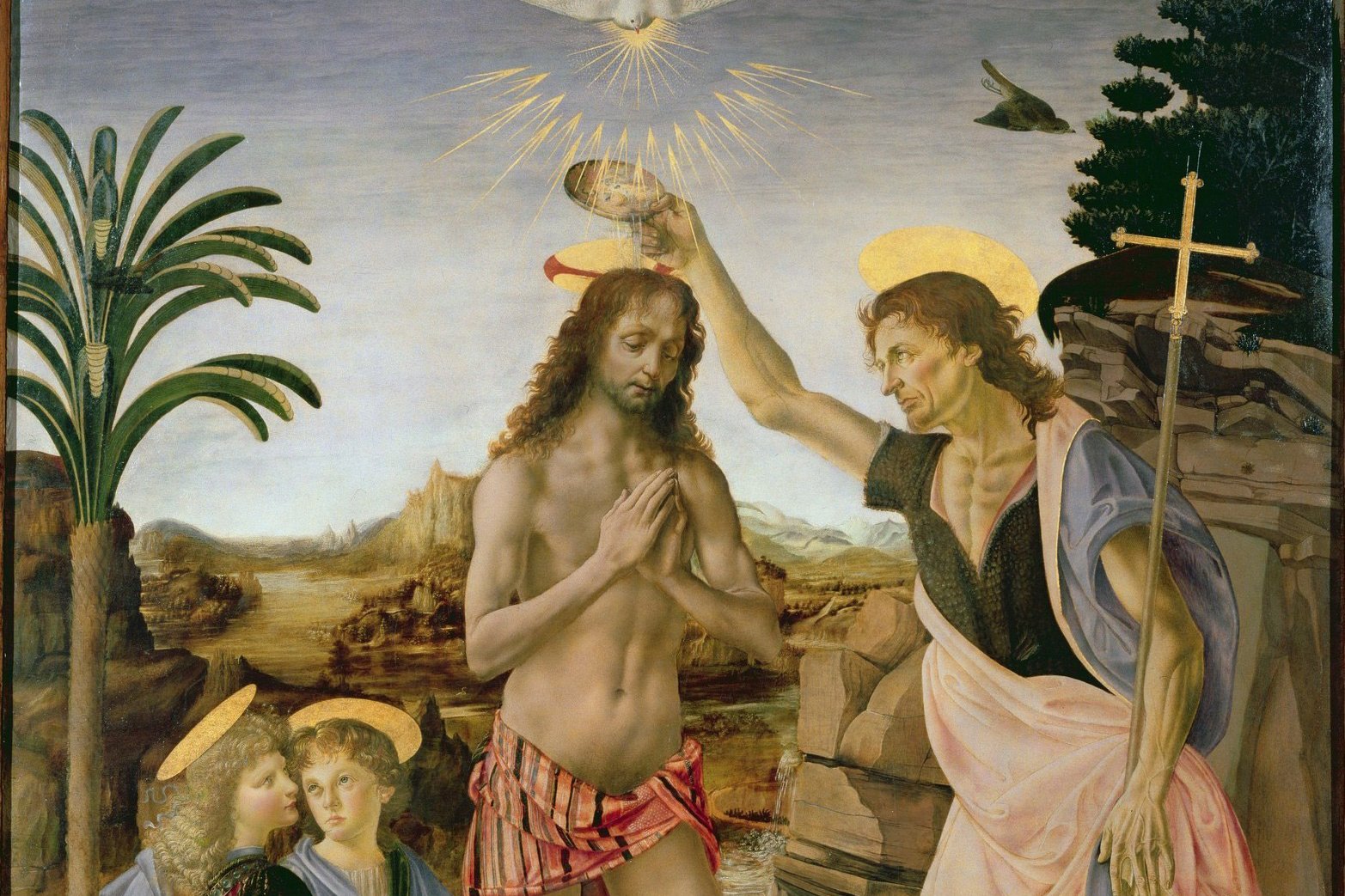
Andrea del Verrocchio (with Leonardo da Vinci), The Baptism of Christ, c. 1472-1475, Uffizi Gallery, Florence — public domain.
A gesture that points straight back to Baptism
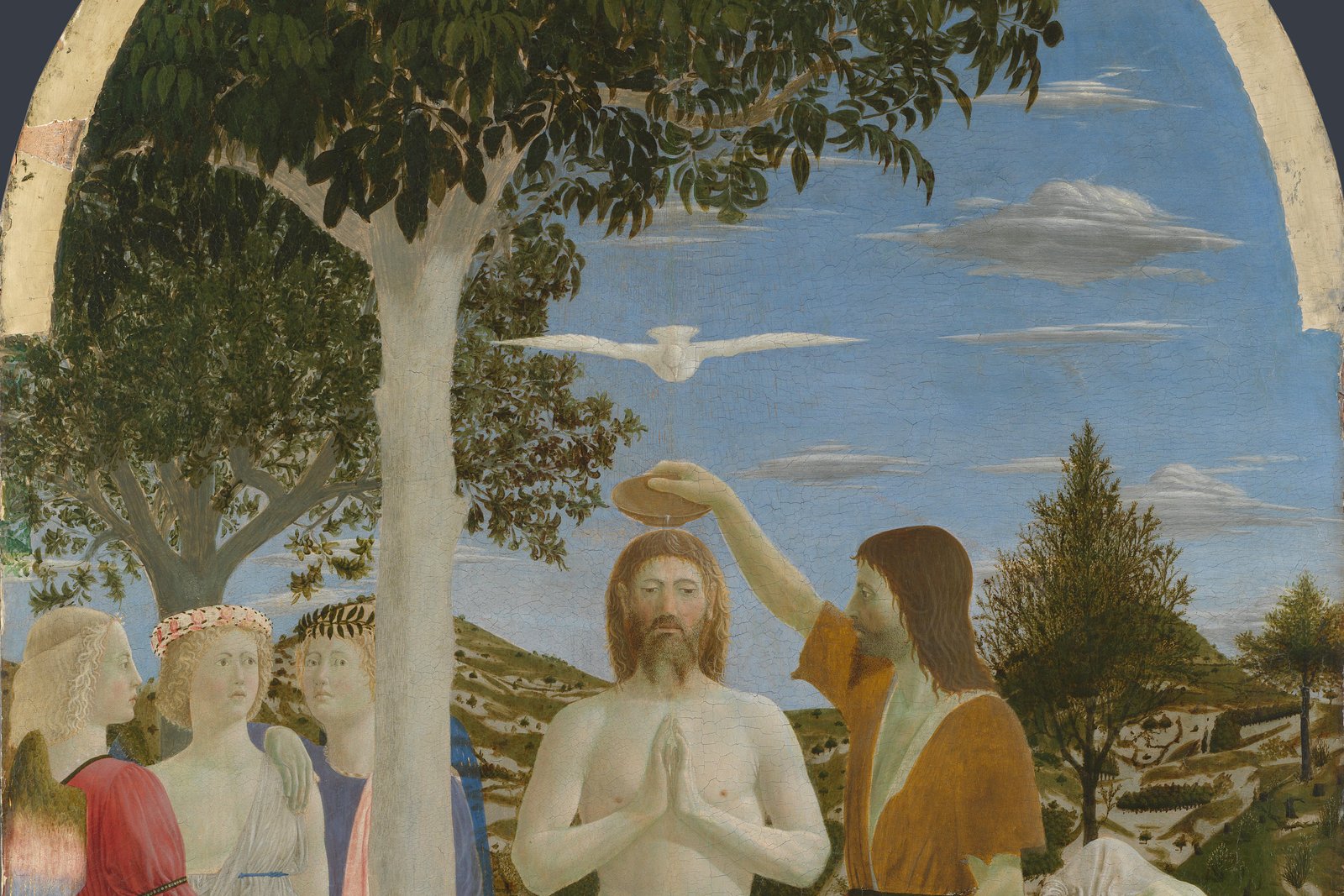
The primary theological meaning behind holy water is remembrance of Baptism. Catholic teaching holds that Baptism, using water "in the name of the Father, and of the Son, and of the Holy Spirit" (Matthew 28:19, the words of Christ's own commission to the apostles), washes away original sin and incorporates a person into the Church for the first time. Every subsequent use of holy water — blessing oneself on entering a church, sprinkling holy water during Mass, blessing a home — functions as a small echo of that foundational moment, a physical reminder of a spiritual reality that, for most Catholics, happened when they were too young to remember it directly.
This is why holy water fonts sit specifically at church entrances rather than scattered elsewhere in the building: the gesture of crossing oneself while stepping through the door deliberately marks the movement from ordinary space into the sacred space of the church, echoing the movement Baptism itself marks — from outside the Church into full membership within it.
Old Testament roots
Water used for ritual purification has deep roots in the Old Testament, well before Christian Baptism gave it its fullest Catholic meaning. The Book of Numbers describes an elaborate ritual involving "water for impurity" used to cleanse those who had contact with the dead (Numbers 19), and the prophet Ezekiel records God promising, "I will sprinkle clean water over you to make you clean; from all your impurities and from all your idols I will cleanse you." (Ezekiel 36:25, Douay-Rheims). Catholic tradition has long read passages like these as prefiguring Christian Baptism and, by extension, the Church's later sacramental use of blessed water more broadly — though the specific practice of holy water in stoups and homes developed gradually within the early and medieval Church rather than being laid out directly in Scripture itself.
How water is blessed
A priest or deacon blesses water using an approved liturgical rite found in the Church's official Book of Blessings. The prayer typically asks God to bless the water so that, wherever it is used and sprinkled, it may "drive away every power of the enemy" and call to mind the grace of Baptism. Some traditional forms of the blessing also include an exorcism of the water and the addition of a small amount of blessed salt, following older Roman Ritual customs, though simpler forms of the blessing are also widely and validly used today.
Once blessed, the water itself undergoes no physical change — it remains ordinary water in composition. What changes is its consecrated purpose: it has been set apart, through the Church's prayer, for use as a sacramental rather than for any ordinary function.
Everyday Catholic uses
Beyond the church-entrance stoup, holy water appears throughout Catholic devotional life. Priests use it to bless objects, homes, cars, and even pets on certain feast days. Many Catholic families keep a small bottle of holy water at home, using it to bless themselves or family members before a journey, during illness, or simply as part of evening prayer. It's also traditionally used to bless graves at burial and is sprinkled on a coffin during a funeral Mass, again pointing back to Baptism — a reminder that the person's life began, sacramentally, with water, and that Christian hope for the resurrection carries that same sign through to its end.
Some Catholics also use holy water as part of preparing a home altar, keeping a small font near a prayer corner as a simple, tangible way to bring this ordinary church custom into daily life at home.
Holy water in the wider Christian tradition
Blessed water is not a distinctly Catholic invention within Christianity as a whole. The Eastern Orthodox Churches maintain an equally rich tradition of blessed water, most visibly at the feast of Theophany (their commemoration of Christ's baptism in the Jordan, celebrated January 6), when priests bless large quantities of water in a rite called the Great Blessing of Waters — sometimes performed at a river, lake, or the open sea — and the faithful take that water home for the year ahead, a practice that closely parallels the Catholic custom of taking home holy water, even though the two traditions developed their own distinct rites and theological emphases over centuries of separate liturgical development. Many Protestant traditions, by contrast, use blessed or "living" water more sparingly or not at all, generally reflecting a broader theological difference over the role of sacramentals as a category — a difference rooted in the Reformation-era debates over which practices count as biblically warranted versus later Church development, a dispute well beyond the scope of holy water alone.
Common misunderstandings worth clearing up
Holy water is sometimes treated, in popular imagination, as though it works automatically or magically — able to ward off misfortune by its mere presence, independent of prayer or faith. Catholic teaching is explicit that this isn't how sacramentals function: unlike a sacrament, which the Church holds confers grace by the sacred rite itself when properly performed, a sacramental's effect depends on the disposition and faith of the person using it, working through the Church's intercessory prayer rather than through the water itself as some kind of independent spiritual force. Holy water is also sometimes confused with water blessed for other specific liturgical purposes, such as the water mixed with wine at Mass (which carries its own distinct blessing and meaning) — a reminder that even within Catholic practice, not every instance of blessed water serves an identical function.
Trivia
What officially makes water "holy water" in the Catholic Church?
Why is holy water placed at the entrance of Catholic churches?
Is holy water mentioned in the Bible?
What is the difference between holy water and the water used at Baptism?
Can Catholics keep holy water at home, and what is it used for there?
You May Also Like

Related Reading