The Brown Scapular of Our Lady of Mount Carmel: History and Meaning

A piece of a monk's habit, cut down for everyone
Long before it became something a layperson might wear under a shirt, the scapular was simply part of a monk's clothing. Carmelite friars, like many religious orders, wore a long panel of cloth over their habit, draped from the shoulders and hanging nearly to the floor front and back — practical, symbolic of the "yoke" of religious life, and originally nothing more exotic than a working garment. Over time, a much smaller version, just two palm-sized pieces of cloth joined by cords, was developed so that laypeople affiliated with the Carmelite spiritual family could wear a token version of that same habit and share, in a devotional sense, in the order's life and protection.
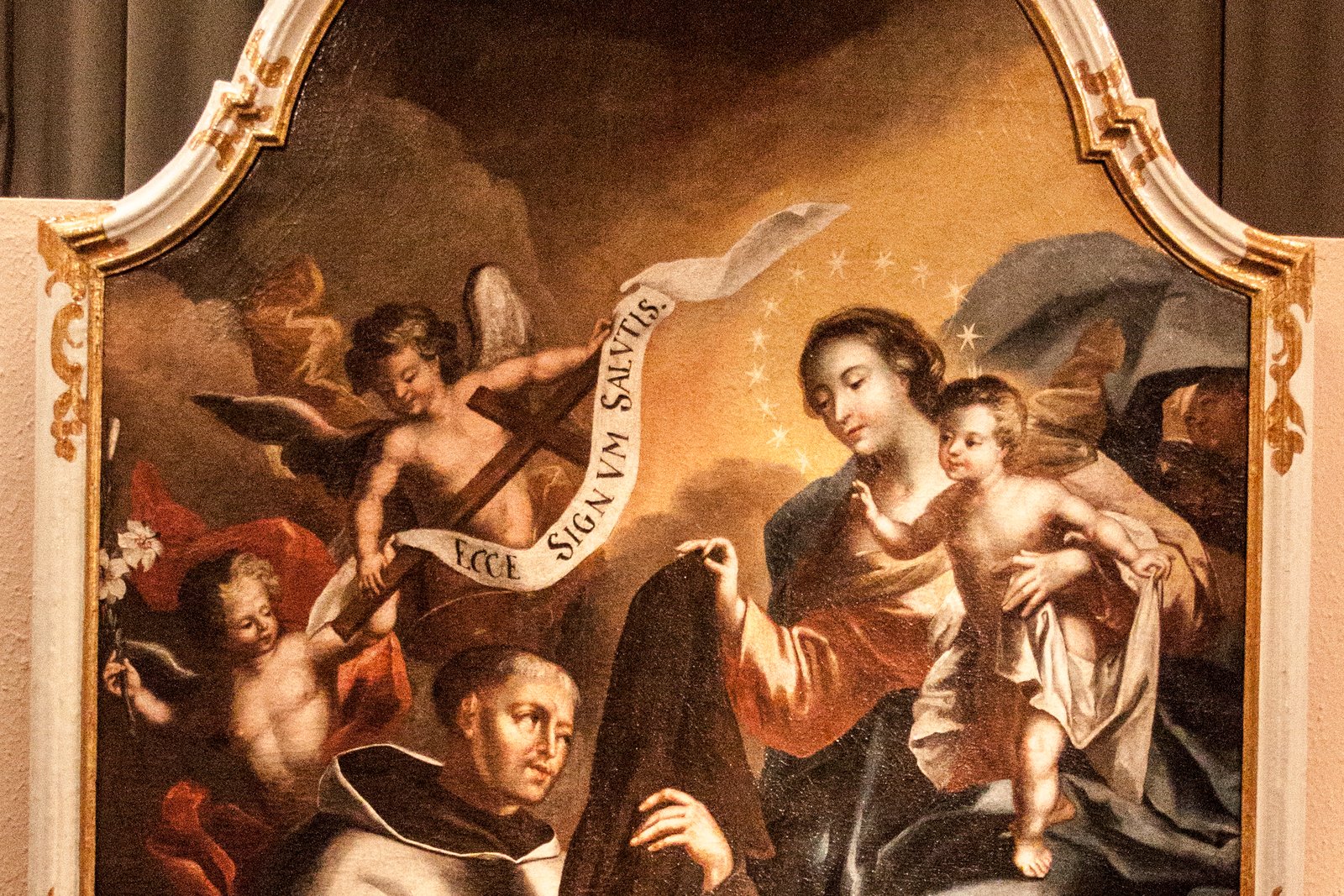
Manner of Arcangelo Salimbeni, Our Lady of Mount Carmel Gives the Scapular to Saint Simon Stock, 1535 — public domain
That smaller version — brown wool, worn under ordinary clothes — is the Brown Scapular known today, formally called the Scapular of Our Lady of Mount Carmel.
The vision of Simon Stock
The devotion's popular origin story centers on Saint Simon Stock, an English Carmelite who, according to tradition, served as prior general of the order in the thirteenth century. The account holds that on July 16, 1251, the Virgin Mary appeared to him holding a scapular and said: "Whosoever dies wearing this shall not suffer eternal fire," offering the garment as a sign of her special protection over the Carmelite order and, by extension, those devoted to her under the title of Mount Carmel.
Here honesty matters more than enthusiasm. This vision account does not appear in any document from Simon Stock's own lifetime or from the years immediately following his death around 1265. The earliest surviving references to it date from more than a century later, appearing in Carmelite records compiled in the late fourteenth and fifteenth centuries — a gap that historians of the order themselves acknowledge makes the story's precise historicity difficult to verify. This does not mean the tradition is false; it means it belongs to the category of pious tradition, cherished and formative within Carmelite spirituality, rather than a documented historical event with contemporary eyewitness support. The Church, characteristically, has allowed the devotion to flourish without requiring belief in the specific 1251 apparition as a condition of participating in it.
What the Church has actually approved
What the Church has consistently and repeatedly approved, across many centuries, is not the vision narrative itself but the scapular devotion — the practice of wearing the cloth as a sign of consecration to Mary and a reminder of one's baptismal commitment. Numerous popes have spoken warmly of the scapular; Pope John Paul II, who wore it privately throughout his life, spoke of it as a sign of "loving and constant presence" of Mary. This kind of papal encouragement operates at the level of devotional recommendation, distinct from a dogmatic teaching that would bind belief.
Catholics are free to wear the Brown Scapular without ever affirming that Simon Stock's vision happened exactly as later tradition describes it. What the Church asks of the devotion is simpler: that it be lived, not just worn — that the cloth serve as a physical nudge toward a Marian-centered Christian life, rather than functioning as a good-luck charm detached from any actual practice of faith.
How the scapular is worn and received
The proper way to begin wearing the Brown Scapular is through a brief rite called enrollment, traditionally performed by a priest (though in practice any properly instructed Catholic can enroll another under the faculties the Church extends broadly for this purpose). During enrollment, the cloth scapular is blessed and placed over the person's shoulders, and a short prayer is said committing the wearer to Mary's patronage. After this initial enrollment, wearing a blessed scapular medal, stamped with an image of Mary and the Sacred Heart of Jesus, is permitted as a practical alternative to the cloth for daily use.
Devotees are traditionally encouraged to pair the scapular with basic practices: prayer, participation in the sacraments, and a effort to live according to Christian teaching. The Carmelite spiritual tradition has always been explicit that the scapular is not a substitute for these things — it is a sign meant to accompany them.
The Sabbatine Privilege, and why the Church treats it cautiously
A related tradition, known as the Sabbatine Privilege, holds that Pope John XXII received a vision in which Mary promised to free from purgatory, on the Saturday after their death, souls who had worn the scapular faithfully, observed chastity according to their state in life, and recited certain prayers. This tradition rests on a papal bull, Sacratissimo uti culmine, whose authenticity has been questioned by historians for centuries — much like the Simon Stock vision, it lacks solid contemporary documentation tying it directly to John XXII's own pontificate. The Holy See has, over time, grown notably cautious about how this privilege is preached, warning against any framing that reduces it to a mechanical guarantee detached from a genuinely lived faith. Carmelite writers today generally present it, when they mention it at all, as an expression of hope in Mary's intercession for the faithful departed rather than as a fixed, automatic transaction — consistent with the Church's broader insistence that the scapular itself is a sign of grace, not a substitute for the sacramental life the Seven Sacraments actually provide.
A small habit's long life
Seven and a half centuries after a story of a vision to an English friar, millions of Catholics worldwide continue to wear two small squares of brown wool as a quiet, private form of devotion. Whatever one concludes about the precise historical roots of Simon Stock's vision, the scapular's staying power reflects something the Church has consistently affirmed regardless of the legend's details: that a small, physical, everyday sign of Marian devotion can shape how someone tries to live, one ordinary day at a time.
Trivia
What is the Brown Scapular?
What is the origin story of the Brown Scapular?
Does the Church require belief in the Simon Stock vision?
What does wearing the Brown Scapular mean?
How does someone properly begin wearing the Brown Scapular?
You May Also Like
Related Reading