What Is a Holy Card? History of a Pocket-Sized Devotion

A devotional object built for the pocket, not the wall
Most Catholic sacred art is meant to be looked at from a distance — a painting on a church wall, a stained-glass window, a statue in a niche. The holy card does the opposite. It's designed to travel: to sit folded into a coat pocket, pressed flat between the pages of a missal, or taped to the inside of a car's sun visor. Its whole purpose depends on being small enough to carry everywhere, which makes it one of the most intimate, least monumental forms of Catholic religious art — sized not for a congregation but for one person at a time.
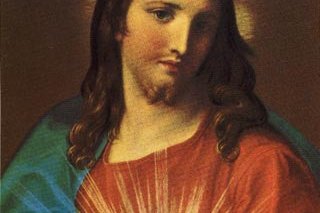
Pompeo Batoni, The Sacred Heart of Jesus, 1767 — public domain, Wikimedia Commons.
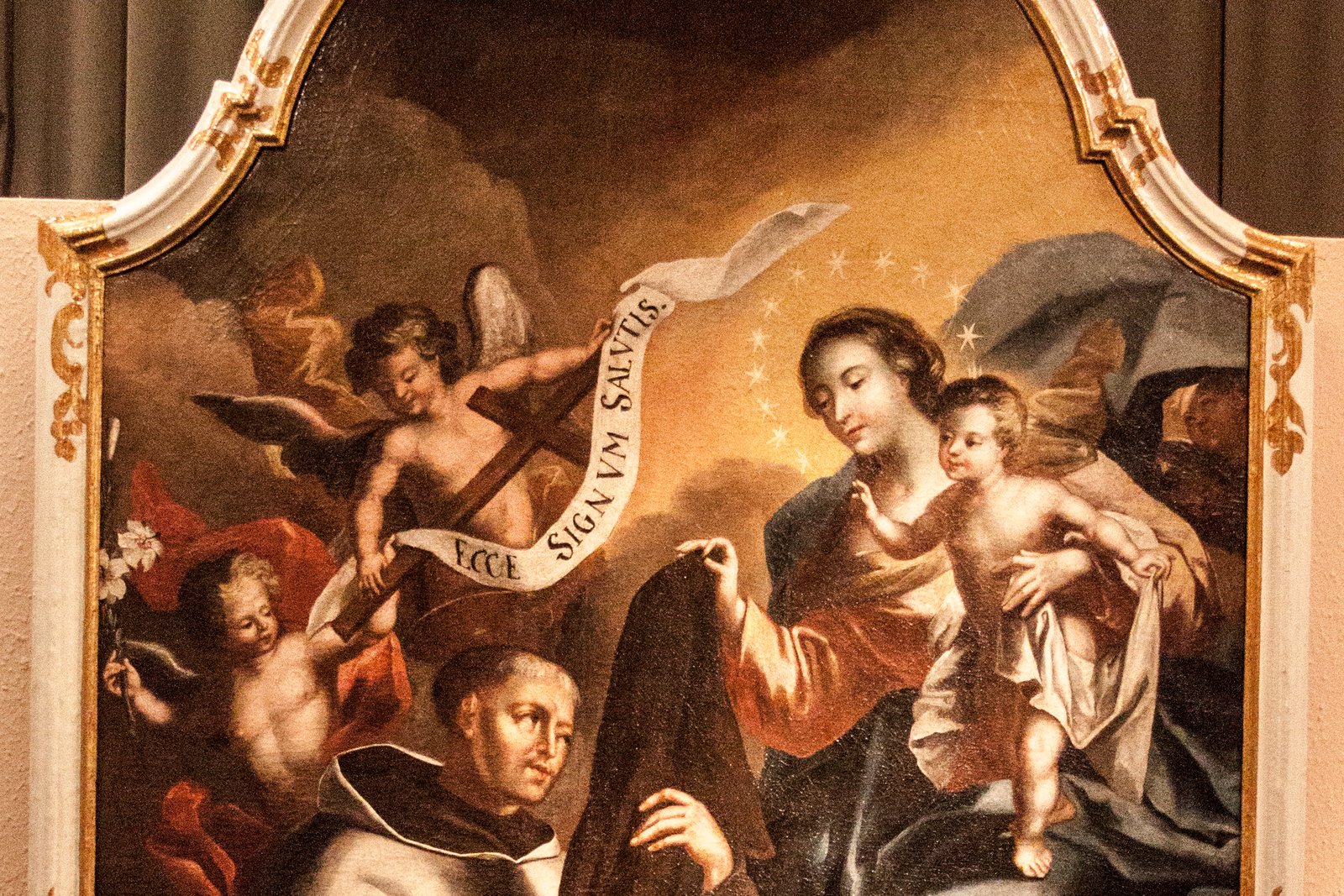
A typical holy card measures somewhere between the size of a standard playing card and a small bookmark, printed on card stock, with a devotional image — a saint, a scene from the life of Christ, Mary under one of her many titles, or a symbol like the Sacred Heart — filling most of one side. The reverse usually carries a short prayer, a Scripture verse, or, in the case of memorial cards, biographical details about a deceased person. Some are elaborately decorated with lace-paper borders and gilded edges; others are plain and inexpensive, printed by the thousands for parish distribution.
From woodcut to chromolithograph
The format's roots reach back to the 15th century, not long after the printing press made it possible to reproduce images cheaply and in quantity for the first time. Early devotional prints were simple woodcuts, often crude by later standards, but they served the same essential function later holy cards would: putting a recognizable sacred image into ordinary hands rather than reserving sacred imagery for the walls of churches and the libraries of the wealthy.
The format truly exploded in popularity during the 19th century, when a new printing technique called chromolithography made full-color reproduction dramatically cheaper. Publishing houses in France, Germany, and Italy in particular turned out millions of ornate, often sentimental holy cards featuring saints, the Sacred Heart, and Marian titles, frequently bordered with intricate cut lace-paper edges known as canivets. This period is often considered the golden age of the holy card, producing objects that are now collected as much for their artistic and historical value as for their devotional use.
The image most reproduced of all
Few images have appeared on more holy cards over the centuries than the Sacred Heart of Jesus — Christ depicted with his heart visible on his chest, often encircled by thorns and topped with a small flame or cross, a devotion that gained enormous popular momentum after the 17th-century visions reported by Saint Margaret Mary Alacoque. The Italian painter Pompeo Batoni's 1767 depiction of the Sacred Heart became one of the most widely copied devotional images in Catholic history, reproduced on holy cards, in parish churches, and in private homes for generations after his death, largely because it struck the visual balance holy-card publishers wanted: instantly recognizable, emotionally direct, and simple enough to reproduce at small scale without losing clarity.
Memorial cards and a name that outlives a face
One of the most enduring uses of the holy card format has nothing to do with a canonized saint at all. Memorial holy cards, printed with a deceased person's name, birth and death dates, and usually a prayer or Bible verse, became a standard part of Catholic funeral custom by the 19th century and remain common today. Handed out to mourners at a wake or funeral Mass, they serve a double purpose: a physical keepsake to remember the person, and a prompt to pray for the repose of that person's soul, consistent with Catholic teaching about prayer for the souls in purgatory. Many Catholics keep a small stack of these cards for years, tucked into a prayer book, as a quiet running record of people to remember.
Blessed, or simply meaningful
Unlike some sacramentals, a holy card carries no automatic blessing simply by virtue of its subject matter — its spiritual value comes from the image it presents and the prayer or memory it prompts, not from an inherent sacred status. Some holy cards are formally blessed by a priest, in the same way other devotional objects like a scapular or rosary might be, but an unblessed card, prayed with sincerely, functions just as well as a personal aid to devotion. This distinction matters for the same reason it matters with any sacramental: the object itself doesn't cause grace automatically, but it can dispose a person toward prayer and remembrance simply by being present and visible.
A tradition that hasn't really changed
What's notable about holy cards is how little the basic concept has shifted across five centuries of changing print technology. Woodcuts gave way to engravings, engravings to chromolithographs, chromolithographs to modern offset and digital printing — but the underlying idea has stayed remarkably constant: a small, portable, inexpensive image of something sacred, meant to be carried rather than hung, and handed from one person to another at exactly the moments — First Communions, confirmations, funerals, canonizations — when people most want a saint or a sacred image close at hand.
Trivia
What is a holy card?
When did holy cards first appear?
Why are holy cards given out at funerals?
Do holy cards have any special blessing or sacramental status?
Are holy cards still made today?
Related Reading