The Meaning of the Catholic Rosary Beads

A counting tool before it's anything else
Strip away the theology for a moment and a rosary is, functionally, a mechanical solution to a specific problem: how does someone track 53 Hail Marys, 6 Our Fathers, and assorted other prayers without constantly losing their place? The Rosary as a devotion has its own structure and history, but the beads themselves — the physical object — solve a much older, more universal problem that shows up across many world religions: prayer counting devices exist in Buddhism, Islam, and Hinduism as well, each independently arriving at some version of the same basic solution to the same basic problem of attention and memory.
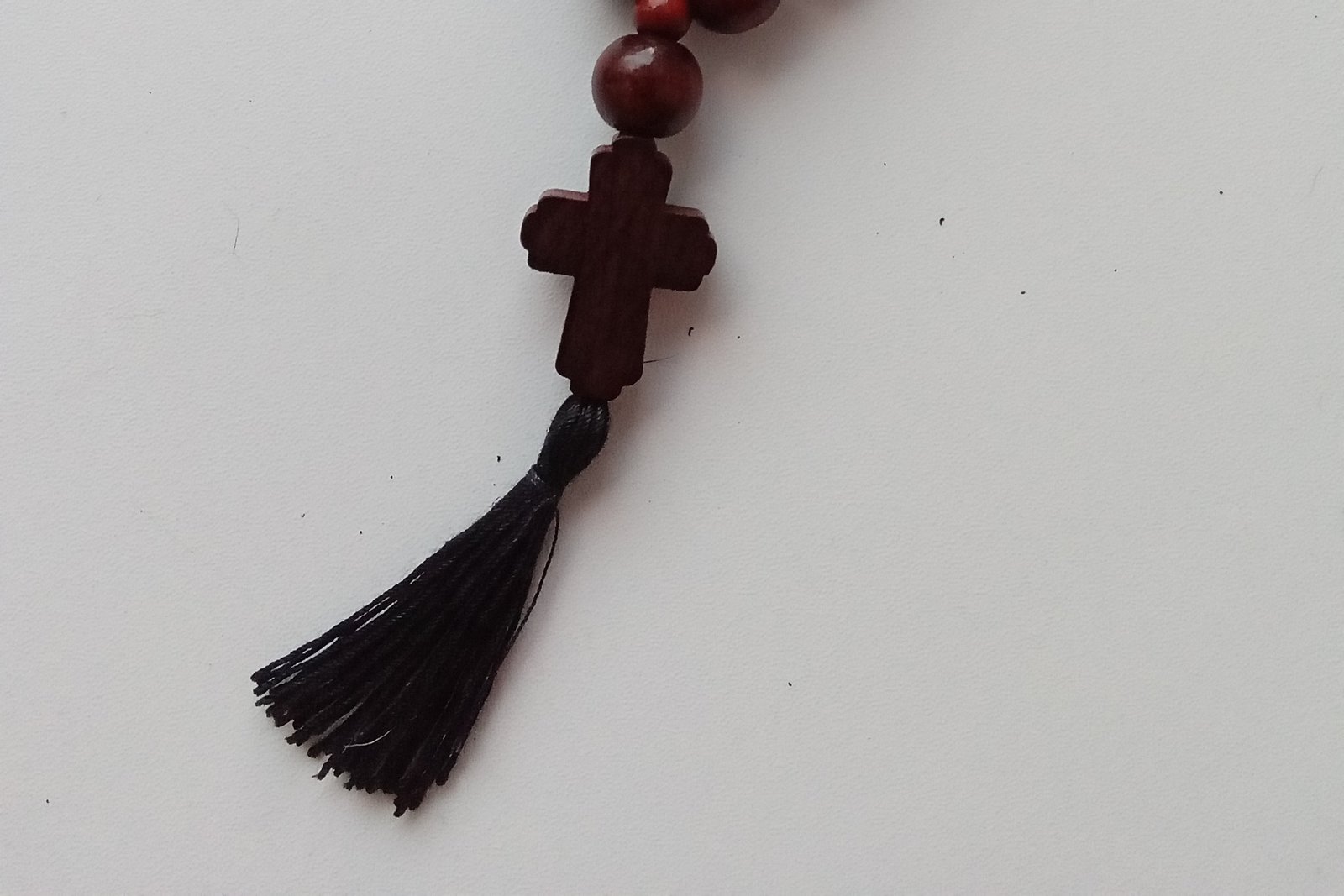
Photograph of wooden rosary beads — CC0.
The layout, piece by piece
A standard five-decade rosary has 59 beads arranged in a specific, fixed pattern. Starting from the crucifix at the tail end: one bead, then a group of three beads, then another single bead, before the loop opens into five decades — groups of ten small beads each — separated from one another by a single larger bead. A medal, often depicting Mary or a specific saint, typically sits at the point where the tail meets the loop, called the centerpiece.
Every bead corresponds to exactly one prayer: the small beads within each decade to Hail Marys, the larger separator beads to Our Fathers, with the Glory Be prayed at the end of each decade without its own dedicated bead. This one-to-one mapping is the entire genius of the design — a person's fingers, moving bead to bead, do the counting so the mind is free to focus on meditation rather than arithmetic.
Where the name comes from
"Rosary" derives from the Latin rosarium, meaning "rose garden" or "garland of roses" — a name most historians connect to a once-common devotional material: dried, compressed rose petals, sometimes formed directly into beads. Whether or not this material explanation is the full story, the name has stuck for centuries, and rose imagery remains closely associated with Marian devotion generally, tying the object's name to the prayer's strong traditional connection to the Virgin Mary.
Materials, then and now
Rosary beads have historically been made from whatever was available and, for wealthier Catholics, whatever conveyed status. Ordinary wood, carved olive pits, bone, and simple knotted cord were common for most people throughout history, while nobility and clergy sometimes used coral, amber, ivory, or precious gemstones. Modern rosaries are made from an even wider range of materials — glass, plastic, and metal are all common today — and none of these material choices carry any doctrinal weight; the Church has never specified a required material for a valid rosary.
Blessing: not required, but customary
A rosary does not need to be blessed for its prayers to "count" — an unblessed set of beads works identically for praying the Rosary as a blessed one. But having a rosary blessed by a priest is a long-standing, encouraged custom, since a blessed rosary becomes a sacramental, an object set apart through the Church's prayer to dispose the person using it toward grace. Historically, certain indulgences attached to Rosary devotion required the beads themselves to be blessed, which is part of why many Catholics still make a point of having a new rosary blessed before regular use, even though it isn't strictly required simply to pray with it.
Broken beads, and what — if anything — that means
A rosary that breaks carries no doctrinal significance in Catholic teaching; it isn't treated as an omen, a punishment, or a spiritual message. It's simply an object that has worn out through use or suffered an accident, the same as any other physical item. Many Catholics choose to repair a broken rosary rather than discard it, particularly if it carries sentimental value — a gift from a parent, a rosary carried through a difficult season of life. When a rosary is truly beyond repair, respectful disposal, similar to how Catholics traditionally handle other worn-out blessed objects, is a common but not obligatory custom; there's no formal Church requirement dictating how a broken rosary must be disposed of.
Smaller forms: rings and bracelets
Not every rosary takes the full 59-bead form. Single-decade rosary rings — a small ring with ten bumps or beads and a small cross, worn on a finger — and rosary bracelets have long been popular, particularly historically among soldiers, laborers, and travelers who needed something discreet and durable enough to wear rather than carry loose in a pocket. Praying a full Rosary on one of these smaller forms simply means cycling through it five times, once per decade, rather than moving continuously around a single longer loop.
Older and larger forms worth knowing
Before the now-standard five-decade rosary became dominant, Catholic devotion also used a larger, fifteen-decade version — sometimes still found today, particularly among religious orders with strong Marian devotion, such as the Dominicans, who trace much of the Rosary's historical development to their own tradition. Praying all fifteen decades in one sitting meant meditating on all fifteen traditional Mysteries of the Rosary in a single prayer session, rather than the five typically prayed on any given day of the week under the modern arrangement. Some older rosaries also include a small medal of Saint Benedict or other devotional medals worked into the chain near the centerpiece, a regional custom layering an additional sacramental onto the rosary itself. None of these variations changes what makes a rosary a rosary in the strict sense — the essential structure remains the decades of Hail Marys separated by Our Fathers — but they show that the now-familiar 59-bead loop most Catholics picture is one standardized form among a somewhat wider historical family of prayer-counting devices built around the same basic mechanism.
Praying the Rosary without any beads at all
Because the beads are a counting aid rather than a requirement, Catholic tradition has always permitted praying the Rosary without any physical rosary present — using one's fingers to count decades, for instance, a practice historically valuable for prisoners, soldiers in the field, or anyone caught without their beads. This flexibility underscores the same point that runs through the object's whole history: the beads exist to serve the prayer, freeing attention for meditation on the Mysteries rather than becoming an end in themselves, which is also why Church teaching places no doctrinal weight on the beads' specific material, appearance, or even, ultimately, their presence at all.
Trivia
How many beads does a standard Catholic rosary have?
Does a rosary need to be blessed by a priest to be used for prayer?
What materials are Catholic rosary beads traditionally made from?
What does it mean, devotionally, if a rosary breaks?
Is a one-decade rosary bracelet a real rosary?
Related Reading