The Basilica of San Vitale, Ravenna

A church built at the edge of two empires
The Basilica of San Vitale occupies an unusual position in the history of Western church architecture, standing at the hinge point between the fading Western Roman world and the rising Byzantine culture of Constantinople. Construction began around 526, under Ostrogothic rule, when Ravenna served as the capital of the Ostrogothic Kingdom that had succeeded the collapsed Western Roman Empire in Italy, funded initially by a wealthy local banker named Julianus Argentarius. Before the church was finished, however, the political situation shifted dramatically: the Byzantine emperor Justinian I, ruling from Constantinople, launched a campaign to reconquer Italy from the Ostrogoths, and Ravenna fell to Byzantine forces in 540. San Vitale was consecrated in 547, now completed under Byzantine rather than Ostrogothic patronage, and its finished form reflects that shift unmistakably — this is a building imprinted with the political transition that occurred during its own construction.
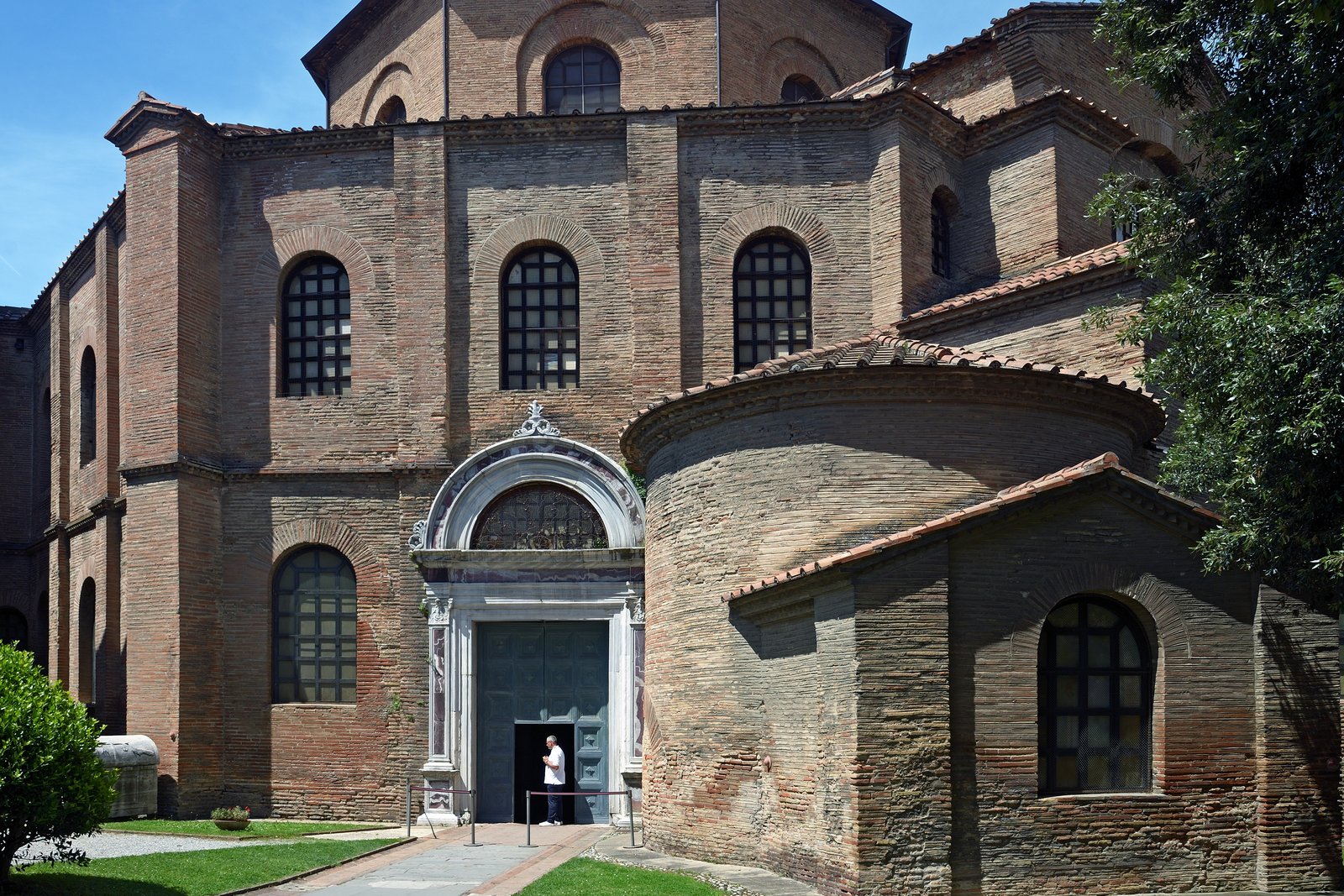
Photograph by Sconosciuto, Basilica of San Vitale, Ravenna, Italy — CC BY-SA 3.0, Wikimedia Commons.
Architecturally, San Vitale broke sharply from the elongated basilica-hall plan that dominated Western church building of the period, favoring instead a centralized octagonal design crowned by a dome, a form drawn directly from contemporary Byzantine architecture in Constantinople, particularly the nearly contemporary Church of Sts. Sergius and Bacchus there. This centralized plan, combined with its extensive interior mosaic decoration, made San Vitale one of the most direct architectural transplants of Byzantine imperial church design onto Italian soil, and it would go on to influence Western architecture for centuries afterward — most famously, Charlemagne is said to have modeled his Palatine Chapel at Aachen partly on San Vitale after seeing it during a visit to Ravenna.
The mosaics that define Byzantine art in the West
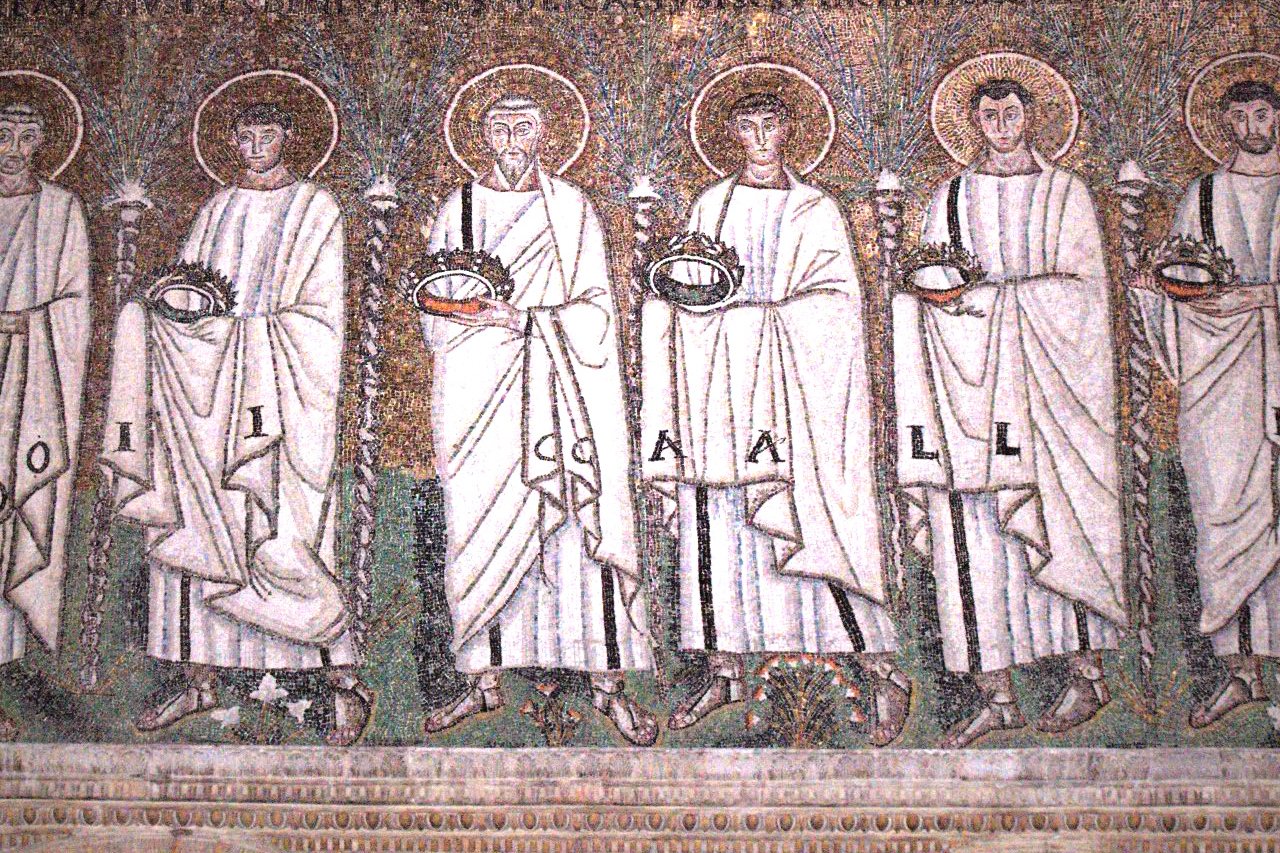
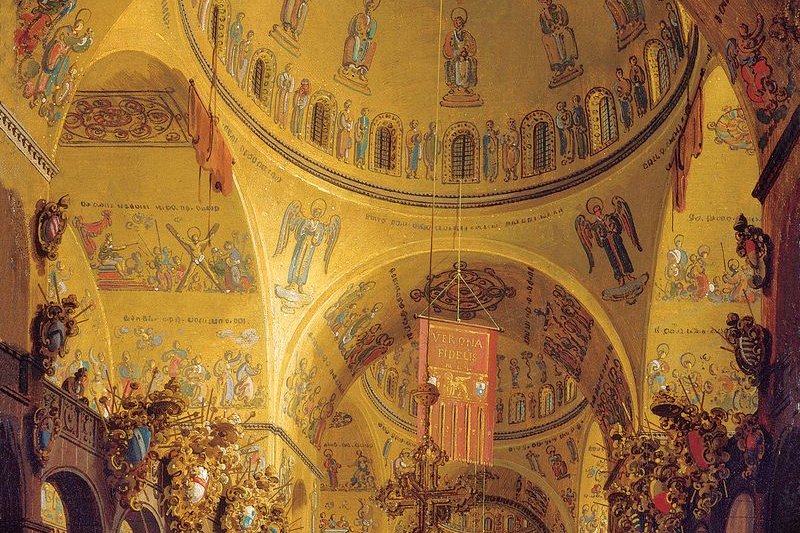
San Vitale's fame today rests overwhelmingly on its interior mosaics, widely regarded as among the finest surviving examples of Byzantine art anywhere outside Istanbul, and among the best-preserved sixth-century mosaics in the world. The most celebrated panels, set into the apse and completed around 547, depict Emperor Justinian and Empress Theodora, each shown in formal ceremonial dress at the head of a retinue of courtiers, soldiers, and clergy, offering liturgical vessels in a gesture symbolizing their patronage of the church and their authority over both secular and religious spheres. The figures are rendered with the flat, frontal, gold-ground style characteristic of mature Byzantine mosaic art — individualized faces set against an abstract, otherworldly background of shimmering gold tesserae, a visual language that would go on to define religious art across the Byzantine world for the following thousand years.
Beyond the imperial portraits, San Vitale's mosaic program covers the chancel and apse with an elaborate theological scheme depicting Old Testament sacrifice narratives — Abraham and the three angels, the sacrifice of Isaac, the offerings of Abel and Melchizedek — read by art historians as prefigurations of the Christian Eucharist being celebrated at the altar directly beneath them. The sheer technical sophistication of the mosaic work, using thousands of individually placed glass tesserae angled to catch and reflect available light, represents one of the high points of the entire Byzantine mosaic tradition, comparable in artistic ambition to the surviving mosaics of Hagia Sophia in Constantinople itself.
Survival through isolation
Much of what makes San Vitale's mosaics so exceptional is simply that they survived at all, in a period when comparable Byzantine art elsewhere suffered enormous losses — through the iconoclastic controversies that destroyed vast quantities of religious imagery within the Byzantine Empire itself during the 8th and 9th centuries, through the Fourth Crusade's sack of Constantinople in 1204, and through the general ravages of war, conquest, and neglect across the following centuries. Ravenna's relative political and military marginality after the Byzantine period — it never regained the imperial significance it briefly held under Justinian — paradoxically protected its churches from the kind of destruction and forced renovation that erased so much comparable art elsewhere in the Mediterranean world.
A monument recognized and protected today
The Basilica of San Vitale is one of eight Early Christian monuments in Ravenna collectively recognized as a UNESCO World Heritage Site in 1996, a designation that reflects the city's extraordinary and unusually concentrated survival of fifth- and sixth-century mosaic art. The church remains consecrated and in occasional liturgical use, though its primary role today is as one of Italy's most visited monuments of Early Christian and Byzantine art, drawing scholars, art historians, and visitors from around the world to stand beneath the same golden mosaics that greeted worshippers there nearly 1,500 years ago.
San Vitale is also unusual among Ravenna's churches for its centralized, octagonal floor plan, closer in form to Byzantine churches built in Constantinople itself than to the basilica-style rectangular naves more typical of church architecture in the Western Roman world — a design choice that further underscores how directly this particular building looked east for its architectural, as well as its artistic, inspiration, even while standing on Italian soil.
Trivia
Why does the Basilica of San Vitale have famous mosaics of Justinian and Theodora if he never visited Ravenna?
What architectural style is the Basilica of San Vitale, and why is it unusual for a Western church?
How old are the mosaics inside San Vitale?
Why is Ravenna considered a major center of Byzantine art in Italy?
Is the Basilica of San Vitale a UNESCO World Heritage Site?
Related Reading