Milan Cathedral (Duomo di Milano)

An Archbishop's Ambition and a Prince's Money
Milan already had two smaller cathedrals — one for winter use, one for summer, an arrangement common in some medieval Italian cities — when Archbishop Antonio da Saluzzo decided in 1386 that the city needed a single, vastly larger church worthy of its growing wealth and prestige. The timing mattered: Milan under the ambitious Visconti family, particularly the newly installed Duke Gian Galeazzo Visconti, was consolidating power across northern Italy, and a cathedral on an unprecedented scale served the family's political interests as much as the archbishop's religious ones. Visconti personally funded much of the early construction and even donated the rights to the Candoglia marble quarries, ensuring a steady supply of the distinctive pale pink-veined stone that gives the cathedral its unusual coloring.
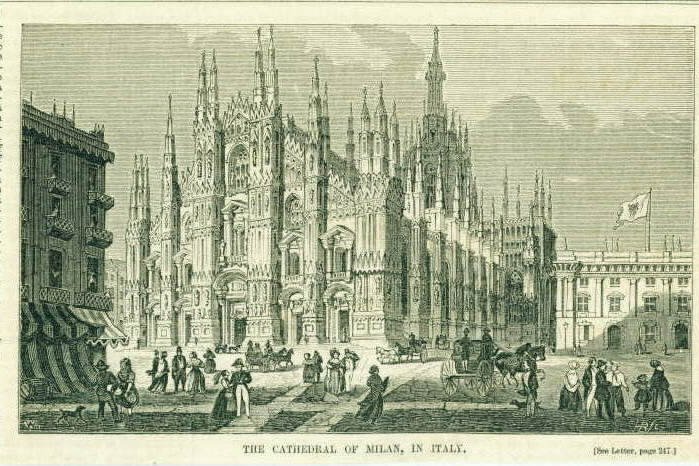
The Art Journal, The Cathedral of Milan, in Italy, 1856 — public domain.
Construction proceeded under a shifting cast of Italian, French, and German master builders and architects across the following decades, a genuinely international collaboration unusual for the period. The result was a building in the Flamboyant Gothic style — closer in spirit to the great cathedrals of northern France than to most Italian churches of the era, which by the late 14th century were increasingly turning toward early Renaissance forms. That deliberate choice of an older, more elaborate Gothic vocabulary is part of why the cathedral's exterior, with its dense forest of spires, pinnacles, and statues, looks so different from other major Italian churches of its period.
A Building That Took Six Centuries
The cathedral's main structure was substantially complete and in liturgical use by the 15th and 16th centuries, but the building was never really "finished" in the way most churches are. Work on the facade in particular dragged across the following centuries, interrupted by shifts in taste, funding shortages, and changes in political fortune. Napoleon, during his occupation of northern Italy, ordered the facade completed in a Neoclassical-Gothic hybrid style in the early 19th century, giving much of the front its final form. Even so, sculptural and decorative details continued to be added well into the 20th century — the very last of the cathedral's great bronze doors, on the west facade, was only installed in 1965, meaning the building's construction timeline spans nearly 600 years from first stone to final door.
That span makes Milan Cathedral one of the most sustained architectural projects in Christian history, worked on continuously — with interruptions — across the late medieval, Renaissance, Baroque, Napoleonic, and modern eras, each leaving its own mark on different parts of the structure.
The Holy Nail and the Rite of the Nivola
High in the cathedral's apse, invisible from the floor except for a small red light, rests one of Milan's most treasured relics: the Sacro Chiodo, or Holy Nail, traditionally venerated as one of the nails used in Christ's crucifixion. Tradition connects the relic to Saint Helena, the mother of the Roman emperor Constantine, who is said to have discovered relics of the True Cross in Jerusalem in the 4th century; Saint Ambrose, the influential bishop of Milan in the late 4th century, is credited with bringing a nail relic to the city and having it fashioned into a bit for Constantine's horse before it eventually came to rest in the cathedral.
Once a year, in a centuries-old ceremony known as the Rite of the Nivola (from the Italian for "cloud," referring to the ornate cloud-shaped mechanical lift used to raise the archbishop to retrieve it), the relic is lowered for veneration by the faithful before being returned to its high resting place — a tradition the Church treats as an object of long-standing popular devotion rather than a scientifically verified artifact, in keeping with how the Church generally handles relics of this age and provenance.
A Forest of Statues
Few buildings anywhere match the sheer density of sculpture covering Milan Cathedral. An estimated 3,400 statues — saints, biblical figures, historical personages, allegorical figures, and grotesques — populate its exterior and interior, alongside 135 gargoyles and roughly 700 additional figures decorating its 135 spires, giving the building its distinctive silhouette of a stone forest rising against the Lombard sky. Crowning the tallest spire, some 350 feet above the piazza, stands the Madonnina, a gilded copper statue of the Virgin Mary installed in 1774 that became so beloved a civic symbol that Milan long observed an informal rule against building anything taller — a tradition eventually set aside as the city's modern skyline grew, though a smaller replica of the statue is still placed atop new skyscrapers as a gesture of respect.
The Roof and the View
Unlike most Gothic cathedrals, whose rooftops are largely inaccessible or reserved for maintenance crews, Milan Cathedral's roof has long been open to visitors, who climb — by stairs or elevator — up among the forest of spires and flying buttresses to walk along marble terraces at close range to the statues and pinnacles usually seen only from the piazza far below. On a clear day the view extends across the Lombard plain toward the Alps, and the walkway offers an unusually intimate look at the sheer density of carved detail covering the building, from grotesque waterspouts to saints rendered in poses invisible from street level. This openness has made the roof one of the cathedral's most distinctive visitor experiences, unusual among the great cathedrals of Europe.
A Building Still Under Care
Even with construction formally finished, Milan Cathedral has never stopped requiring active restoration. The Veneranda Fabbrica del Duomo, the historic body responsible for the cathedral's maintenance since the 14th century, continues a rolling program of cleaning and repairing the building's marble, replacing eroded statues with careful copies while preserving originals in the cathedral's museum, and monitoring the structure's stability against the effects of pollution, weathering, and time — a reminder that a building six centuries in the making requires a comparably long-term commitment simply to endure.
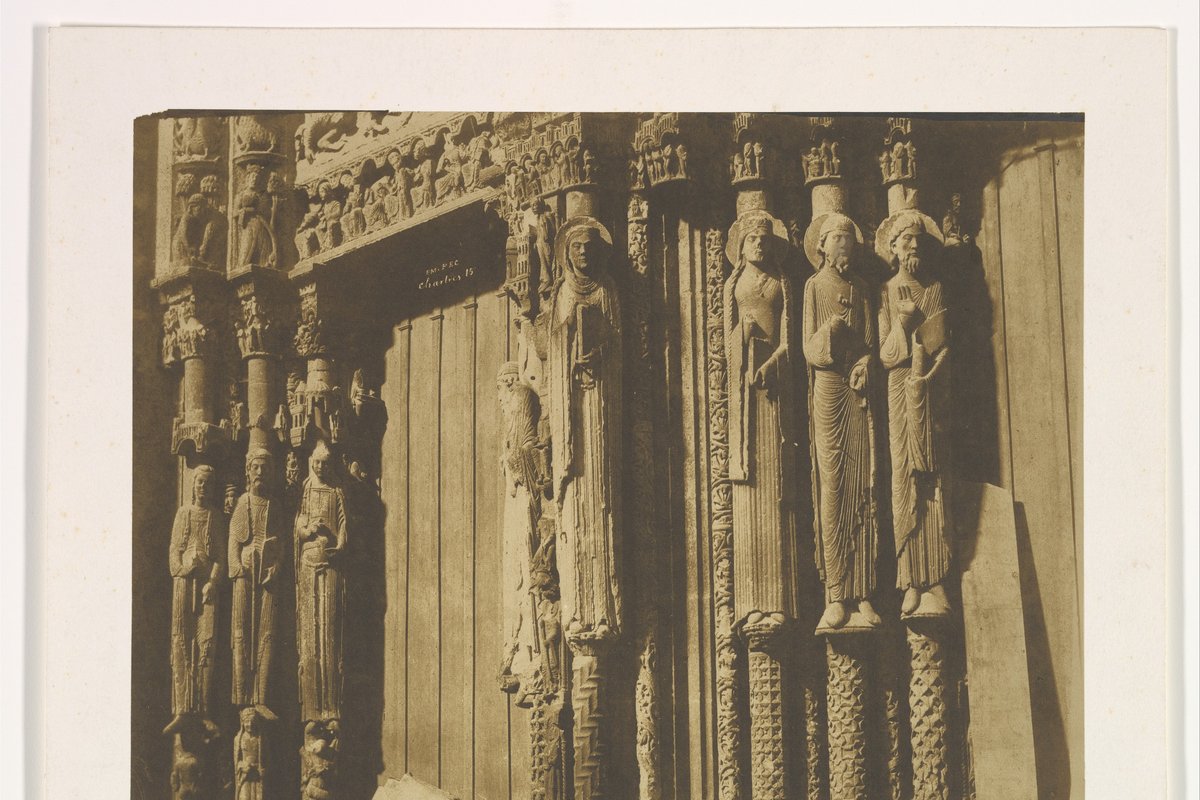
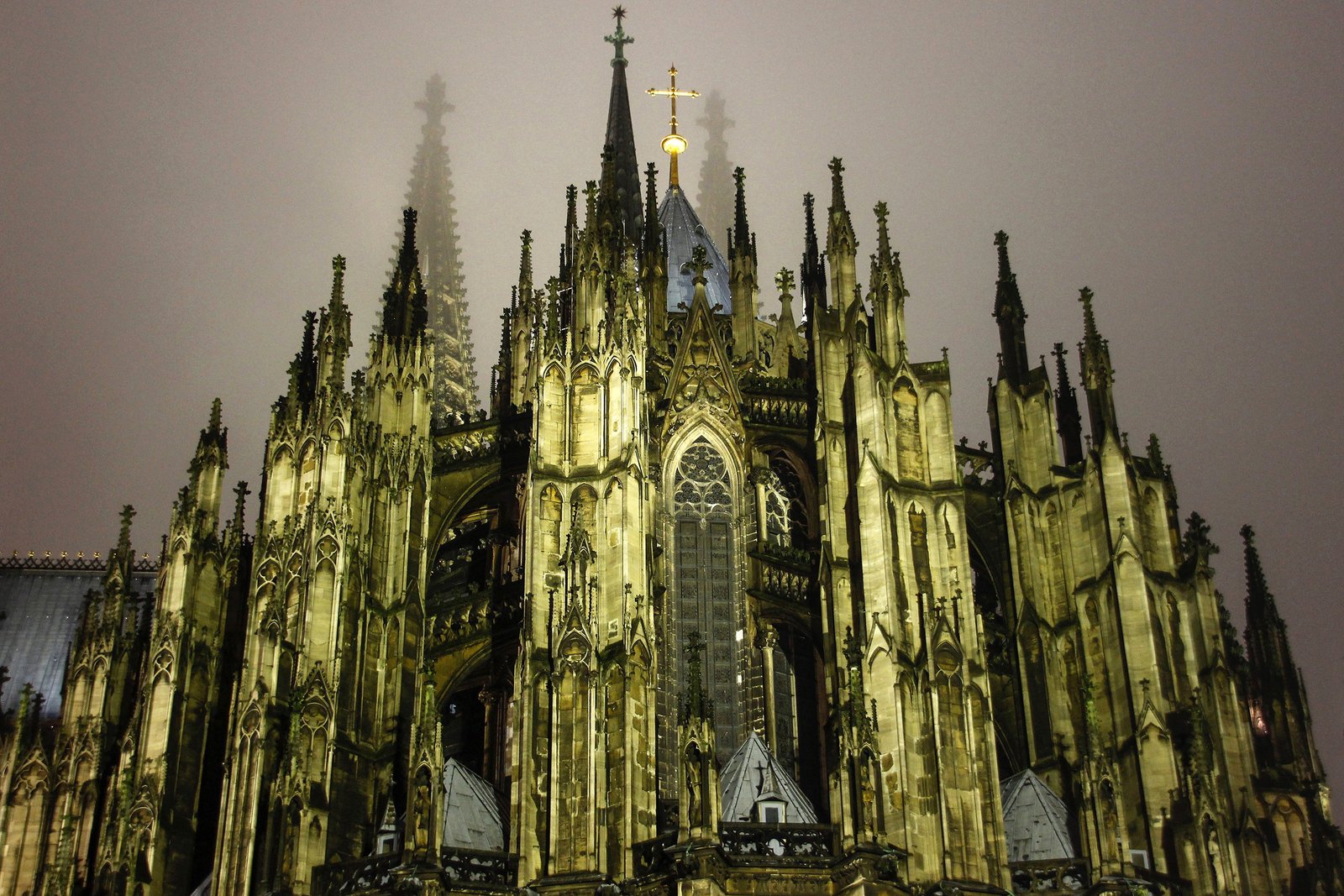
For other examples of centuries-spanning Gothic cathedral projects, see Chartres Cathedral and Cologne Cathedral, whose 632-year construction timeline rivals Milan's own.
Trivia
How long did it take to build Milan Cathedral?
What is the Holy Nail kept inside Milan Cathedral?
How many statues does the Duomo di Milano have?
Who is the Madonnina on top of Milan Cathedral?
What architectural style is Milan Cathedral built in?
Related Reading