Monreale Cathedral, Sicily

A royal cathedral built in a hurry
Monreale Cathedral, formally the Cathedral of Santa Maria Nuova, was commissioned in 1174 by King William II of Sicily, and construction moved with striking speed for a building of its ambition — the main structure and much of its mosaic decoration were largely complete within roughly a decade, an unusually fast timeline that historians attribute to William's determination to establish Monreale as a major religious center quickly, and to the practical need to complete both the cathedral and its attached Benedictine abbey as swiftly as possible. Sicily in the 12th century was ruled by Normans who had conquered the island from Byzantine and Arab control over the preceding century, and William inherited a kingdom whose population, administration, and artistic culture remained deeply mixed among Latin Christian, Byzantine Greek Christian, and Arab Muslim communities — a diversity the Norman kings generally tolerated and even actively drew upon rather than suppressed.
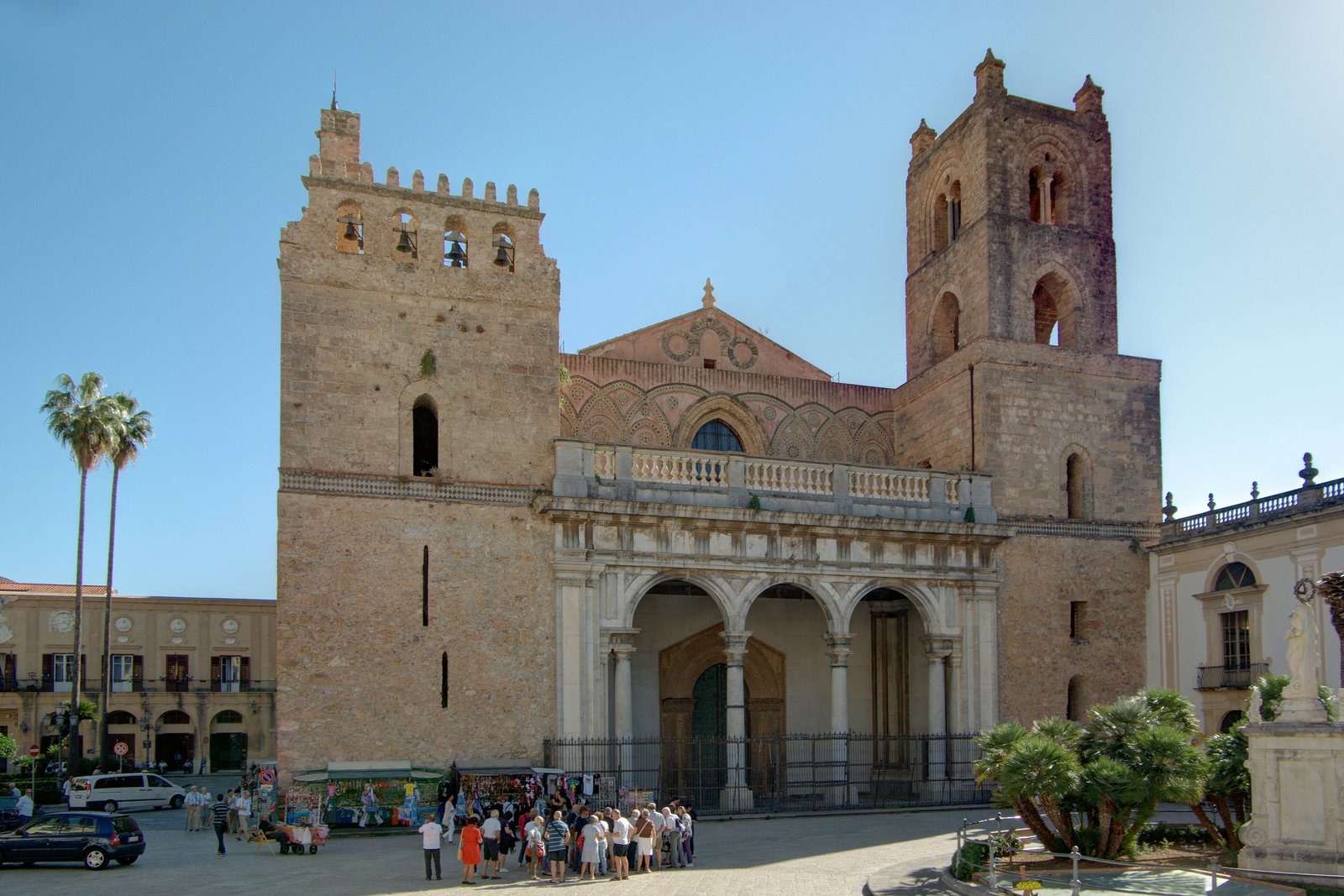
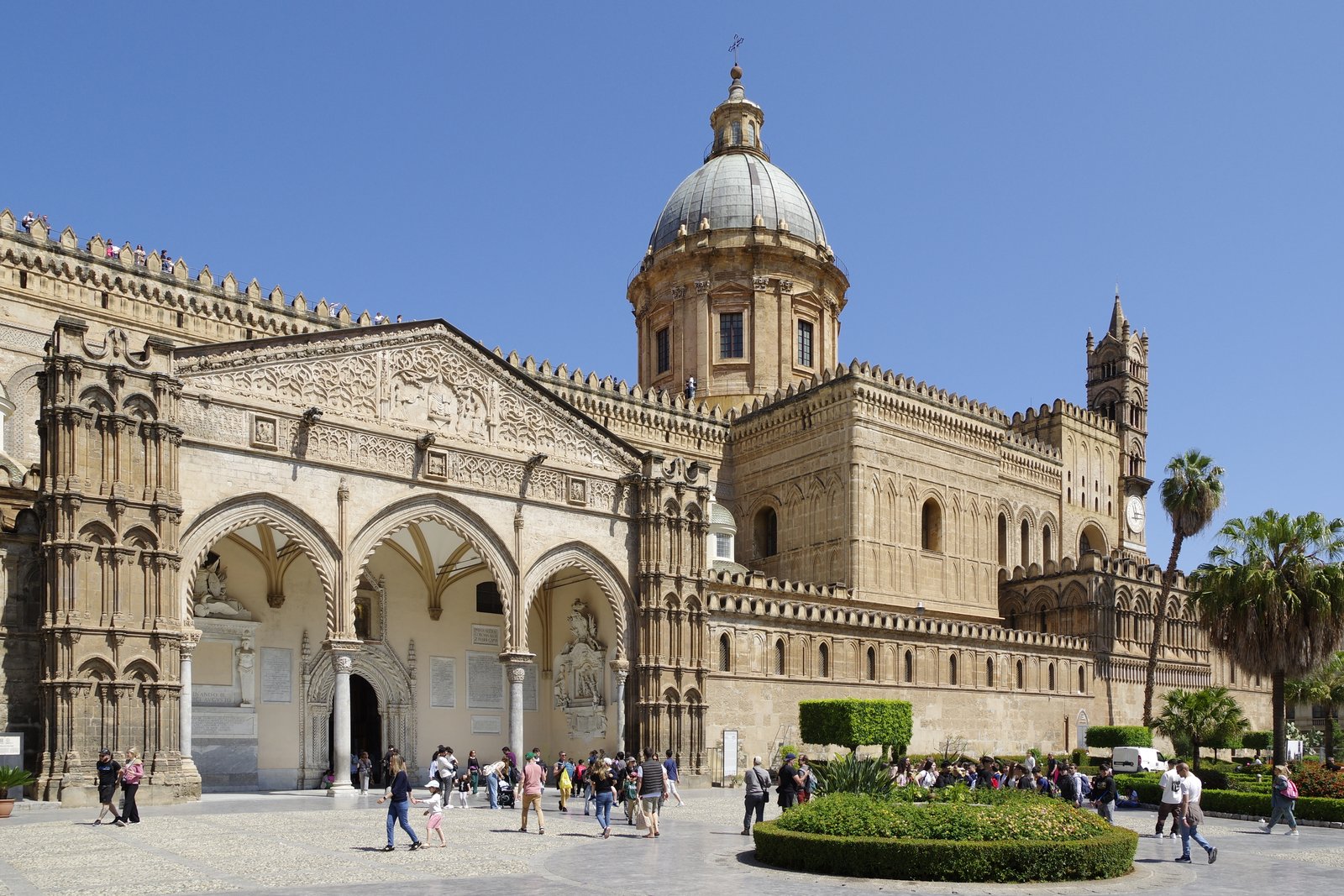
Photograph by Berthold Werner, Monreale Cathedral exterior, Sicily — CC BY-SA 3.0, Wikimedia Commons.
That multicultural inheritance shows directly in Monreale's construction: the underlying architectural plan reflects Western Romanesque church-building traditions, but William imported skilled Byzantine mosaicists, likely from Constantinople or Byzantine-influenced workshops in southern Italy, to execute the cathedral's mosaic program, while local and imported Islamic craftsmen carved much of the cathedral's decorative stonework and, especially, the elaborate columns of its cloister. The result is a building historians now describe using the term Norman-Arab-Byzantine architecture — not simply a Western church with some exotic decoration added, but a genuine fusion of three distinct artistic traditions working in close collaboration.
An almost unbroken sheet of gold
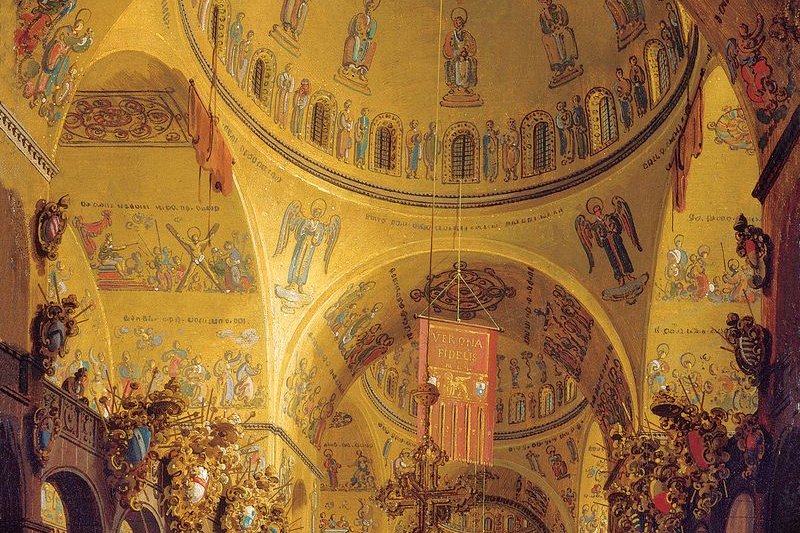
What overwhelms most visitors entering Monreale for the first time is the sheer completeness of its mosaic coverage — an estimated 68,000 square feet of gold-ground mosaic spread across the nave, aisles, transepts, and apse, among the largest single expanses of Byzantine-style mosaic decoration surviving anywhere in the world, rivaling and in sheer area exceeding comparable programs at Ravenna's Basilica of San Vitale or at Palermo's own royal churches. The mosaic narrative begins with the Creation account from Genesis in the upper registers of the nave and moves through the major events of the Old and New Testaments, culminating in the cathedral's central apse, where an enormous image of Christ Pantocrator — Christ depicted as ruler and judge of the universe, one hand raised in blessing, the other holding a book inscribed with a Gospel passage — dominates the entire eastern end of the building, a composition scaled to be visible and overwhelming from every point in the vast nave below.
An Islamic-crafted cloister
Attached to the cathedral, the surviving cloister of the original Benedictine monastery represents one of the finest achievements of Sicilian Romanesque architecture, built around a large rectangular garden court bordered by 228 paired columns, no two capitals identical, carved with a dazzling range of ornament — foliage, biblical narrative scenes, geometric interlace, and abstract patterns showing clear technical and stylistic debts to contemporary Islamic craftsmanship, some columns further decorated with inlaid stone mosaic in geometric patterns directly paralleling contemporary work in the Muslim world. The cloister functions today as one of the most tangible surviving records of how thoroughly Islamic artistic technique had been absorbed into Sicilian Christian architecture within a century of Norman conquest — craftsmen who, in many cases, likely remained Muslim themselves while working on commission for a Christian king and cathedral.
Recognized, and still a living cathedral
Monreale Cathedral, along with several related Norman-era monuments in and around Palermo, was inscribed as a UNESCO World Heritage Site in 2015 under the title "Arab-Norman Palermo and the Cathedral Churches of Cefalù and Monreale," a designation recognizing the group collectively as an outstanding and unrepeated example of medieval cultural synthesis. The cathedral remains the seat of the Archdiocese of Monreale and continues to hold regular services, even as it draws large numbers of visitors specifically to see its mosaics, standing today, alongside Palermo Cathedral nearby, as one of the defining monuments of Sicily's uniquely layered medieval religious and artistic history.
Visitors today can also climb onto the cathedral's roof terraces, reached by a narrow stairway built into the structure itself, for a close-up view of the exterior apse decoration and a wide panorama across the Conca d'Oro valley toward Palermo and the sea beyond — a vantage point that, on a clear day, makes obvious why William II chose this particular hilltop site for his kingdom's most ambitious church. The town of Monreale that grew up around the cathedral remains, to this day, defined almost entirely by the building at its center, its narrow streets, small museums, and family-run trattorias largely oriented around the steady flow of pilgrims and visitors the mosaics have drawn for over eight centuries, from medieval travelers on the road between Palermo and the island's interior to modern-day tour buses arriving daily from the coast.
Trivia
Why does Monreale Cathedral have so much gold mosaic covering its interior?
What does 'Norman-Arab-Byzantine' architecture mean, and why is Monreale a prime example?
What is depicted in Monreale Cathedral's mosaics?
Is the cloister at Monreale part of the cathedral?
Why did King William II choose to build such an ambitious cathedral at Monreale?
Related Reading