The Holy House of Loreto: A Cottage Said to Have Flown

A plain house inside an ornate basilica
Walk into the Basilica della Santa Casa in Loreto, a small town on Italy's Adriatic coast, and the contrast is immediate. The basilica itself, built up over centuries starting in the fifteenth, is an imposing structure of marble, frescoes, and elaborate Renaissance and Baroque decoration. And there, at its heart, sits something almost jarringly plain: a small stone cottage, its rough, undecorated walls looking as though they belong in a different building entirely — because, according to the tradition surrounding the site, they were built somewhere else altogether, in Nazareth, roughly two thousand years ago.
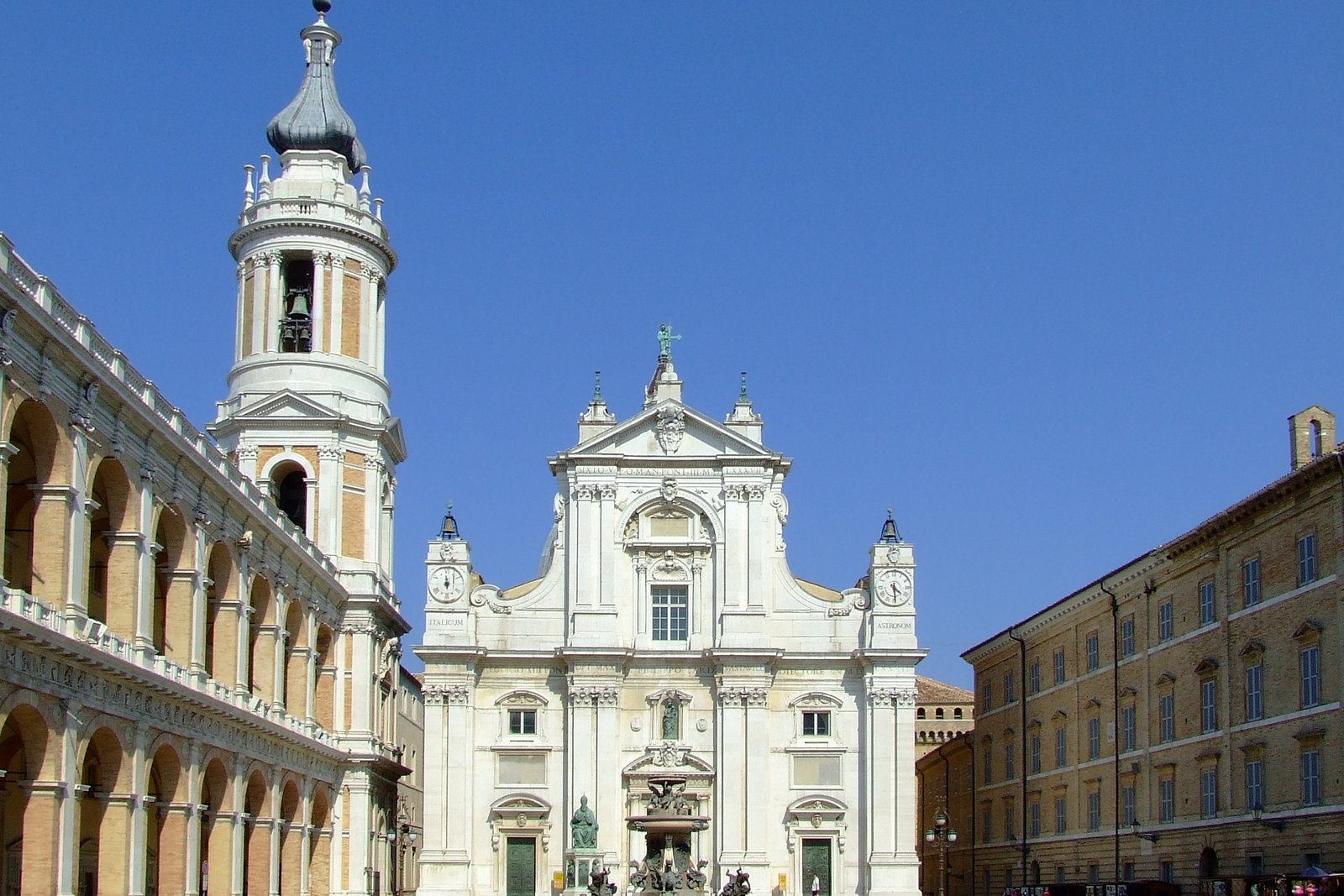
Photograph, 2012 — CC BY-SA 2.5 (no fully public-domain source of comparable quality was found after an extensive search).
Pilgrims have been coming to Loreto for the same reason for over seven centuries: to venerate what is held by devout tradition to be the actual house where the Virgin Mary was born and raised, where the angel Gabriel appeared to her at the Annunciation, and where — after the Holy Family's return from Egypt — Jesus spent much of his hidden life at Nazareth.
From Nazareth to Loreto, according to legend
The most widely known version of how the house arrived in Italy describes a miraculous transportation. As the story developed and spread from around the end of the thirteenth century, angels carried the house through the air, first to Tersatto in present-day Croatia in 1291, and then, a few years later in 1294, across the Adriatic Sea to a laurel grove near Loreto, from which the town is thought to take its name (lauretum, Latin for laurel grove).
The timing given in the tradition isn't accidental to the story as it's been told: 1291 was the year Acre, the last major Crusader stronghold in the Holy Land, finally fell to Mamluk forces, effectively ending nearly two centuries of Crusader presence in the region. In the traditional account, the house's departure from Nazareth is tied directly to the loss of Christian protection over the holy sites there — as though heaven itself relocated Mary's home rather than leave it unguarded.
What historians propose instead
Alongside the devotional tradition, a number of historians have proposed a more earthbound explanation, developed particularly from research into medieval documents in the twentieth century: that the stones making up the house were not flown by angels but physically transported by ship, arranged by a noble Byzantine family named Angeli — a name meaning "angels" in Greek, which some scholars suggest may have contributed to the later legend of angelic transport through a kind of linguistic conflation over time. This family, possibly connected to the Angelos dynasty that had ruled as Byzantine emperors, would have had both the resources and plausible motive to move stones associated with a venerated holy site out of a region falling to Mamluk conquest.
It's worth being precise about how the Church treats these competing explanations. Neither the miraculous account nor the historical relocation theory has ever been declared binding Catholic doctrine. The Church has consistently approved and encouraged devotion at Loreto — multiple popes across centuries have visited, prayed there, and granted the shrine special liturgical status — while leaving the specific mechanism of the house's arrival as a matter for pious belief and ongoing historical inquiry rather than settled dogma.
The house that shaped a title for Mary
The devotion at Loreto didn't stay confined to the shrine itself. Out of centuries of pilgrimage there grew the title "Our Lady of Loreto," now one of the invocations included in the Litany of Loreto, a long-standing prayer of Marian titles (such as "Mother of God" and "Queen of Peace") traditionally recited in May and October devotions across the Catholic world. Pope Sixtus V raised Loreto's status further in the sixteenth century, and later popes continued to visit and endow the shrine, including Saint John XXIII and Saint John Paul II, both of whom prayed there before consequential moments of their pontificates. In 2019, Pope Francis extended the shrine's reach even further by placing the feast of Our Lady of Loreto, celebrated December 10, on the General Roman Calendar for the universal Church — a level of official recognition relatively few local shrines ever receive, and one that reflects how deeply the devotion had already taken root well beyond Italy.
The Holy House also fits into a broader pattern among the Church's most visited Marian shrines, several of which pair a single humble, unadorned object or space — a spring, a cloak, a plain room — with the surrounding grandeur pilgrims later built around it. The Grotto of Massabielle at Lourdes follows a similar shape: an unremarkable rock outcropping that became the center of an enormous basilica complex, precisely because what mattered to pilgrims was never the architecture but the plain place where something believed to be sacred once happened.
A shrine that reaches into the twentieth century
The devotion attached to Loreto found an unusually modern extension in 1920, when Pope Benedict XV formally declared Our Lady of Loreto the patroness of aviators and air travelers — a designation that draws directly on the house's legendary flight through the air, linking a medieval tradition to the still-young technology of powered flight. It's a patronage that has stuck: air forces, airline associations, and aviation chapels in various countries continue to invoke Our Lady of Loreto by name.
Archaeological studies of the house's construction have added their own layer to the story — examinations of the stone and mortar have noted building techniques and materials consistent with first-century construction methods used in the region of Nazareth, details that don't prove the traditional account but have been cited by defenders of the tradition as at least compatible with it. What draws pilgrims to Loreto today, though, isn't primarily a debate over construction methods or medieval shipping records. It's the same plain, small room that has drawn them for over seven hundred years — a space tradition holds witnessed the single most consequential yes in Christian history, wherever its stones actually began their journey.
Trivia
What is the Holy House of Loreto believed to be?
How does tradition explain the house's journey from Nazareth to Italy?
Is there a more historical explanation for how the house's stones reached Italy?
Has the Church officially endorsed the flying-house tradition?
What is the Holy House of Loreto the patron shrine of?
Related Reading