The Grotto of Saint Peter, Antioch

A cave above one of antiquity's great cities
In the first century, Antioch ranked among the largest and most important cities of the Roman world, a major hub of trade, culture, and administration in the eastern Mediterranean, third in size and prominence within the empire behind only Rome and Alexandria. It was also, from the very earliest years of Christianity, one of the most significant centers of the new movement's spread beyond its Jewish origins in Jerusalem — a role the Acts of the Apostles documents directly, recording that believers scattered by persecution after Stephen's death carried the message to Antioch, where a substantial and increasingly diverse community of Jewish and Gentile converts took shape.
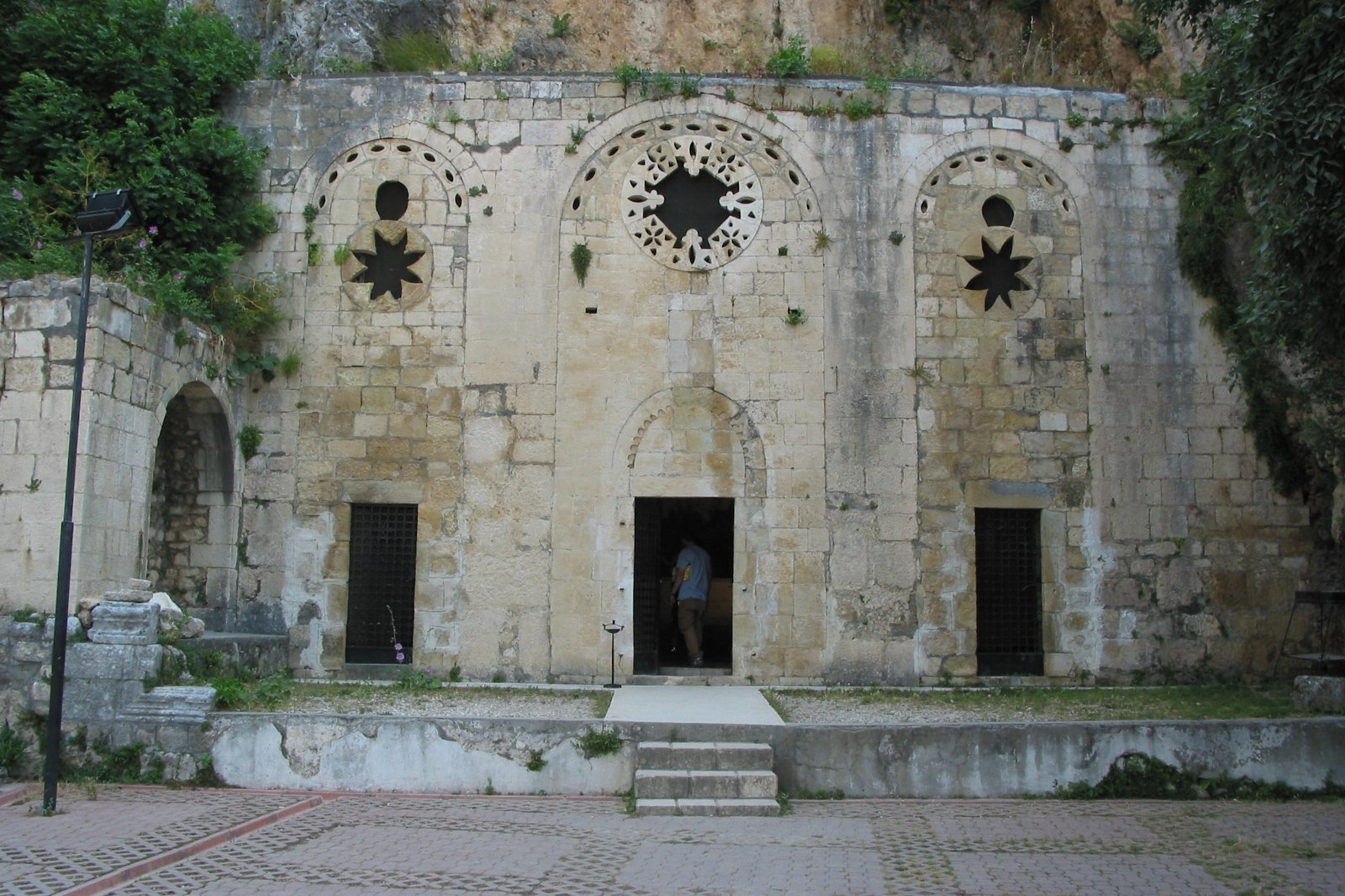
Photograph by Volkan Hatem, Antioch Saint Pierre Church, Antakya, 2003 — CC BY 2.5, Wikimedia Commons.
That community's significance is marked by one particularly notable detail Acts records: "it was in Antioch that the disciples were first called Christians" (Acts 11:26), a naming that scholars generally understand as originating from outsiders describing this new, religiously distinct group rather than as a title the believers chose for themselves initially. Whatever its precise origin, the label stuck, and Antioch's role as the place where it first appears gives the city a permanent, textually documented significance in the early history of the Christian movement.
A cave associated with Peter's leadership
High tradition, though not direct New Testament narrative, holds that a small cave carved into the mountainside overlooking ancient Antioch served as a meeting place for this early Christian community, and that Peter the Apostle himself led the church there for a period before traveling on, eventually, to Rome, where later tradition holds he died as the city's first bishop. The New Testament itself does confirm meaningful ties between Peter and Antioch's Christian community — Paul's letter to the Galatians records a notable dispute between the two apostles that took place specifically at Antioch, over the question of Jewish dietary customs and table fellowship between Jewish and Gentile believers, a passage that at minimum confirms Peter's genuine, documented presence and authority within the Antiochene church during this formative period.
The specific tradition identifying Peter as Antioch's first bishop, and this particular cave as a site connected to his leadership there, developed within later Church memory and hagiographic writing rather than appearing explicitly in the biblical text itself. Readers should understand this distinction: Peter's connection to Antioch and this cave rests on a genuinely old and continuous tradition honored by the Church, but it is not the same category of claim as the directly documented New Testament events themselves.
A modest cave, later given a grand facade
For most of its early history, the cave functioned as an unadorned, practical meeting space — carved directly into natural rock, low-ceilinged and modest in scale, entirely unremarkable in its physical form apart from the community that gathered there. Its transformation into a formally marked and architecturally distinguished site came many centuries later, during the Crusader period, when Western European Crusader forces held Antioch and the surrounding region from 1098 until the city's fall to Mamluk forces in 1268.
Crusader builders constructed the cave's now-distinctive carved stone facade during this period, giving the previously unadorned grotto entrance a formal architectural presence for the first time, consistent with the broader Crusader practice of monumentalizing sites they identified with significant biblical and early Christian history throughout the region. The facade underwent further restoration in the nineteenth century, carried out by Capuchin friars who had taken on responsibility for the site's maintenance under directives connected to Pope Pius IX, giving the cave church much of its present external appearance.
An enduring, active site of pilgrimage
The Grotto of Saint Peter has survived the many political and religious transitions that reshaped the wider Antioch region over nearly two thousand years — Roman, Byzantine, Crusader, Mamluk, and Ottoman rule in turn, followed by the modern Turkish state that governs the area, now known as Antakya, today. Through all of these changes, the cave has retained recognition as a significant Christian site, and it continues to function as an active place of worship, most notably hosting an annual Mass each year on June 29, the feast day of Saints Peter and Paul, drawing Christian pilgrims and clergy to mark the occasion at one of the oldest continuously recognized Christian worship sites in the world.
The wider Antakya region suffered severe damage during a major earthquake in February 2023, which devastated much of the modern city and damaged numerous historic structures throughout the area; the grotto itself, carved into solid rock and set apart from the dense modern urban fabric below, was reported to have survived largely intact, underscoring, in a literal physical sense, the same durability that has preserved this small cave's significance across nearly two millennia of the region's often turbulent history.
The site's continued recognition also reflects Antioch's own remarkable place in early Church history more broadly: it was here, according to the Acts of the Apostles, that the community first organized itself as a distinct body large and visible enough to earn its own name, sending out missionaries including Paul and Barnabas whose journeys would carry the faith far beyond the city's walls — a legacy the small cave church still quietly represents today.
Trivia
What is the Grotto of Saint Peter in Antioch?
Why is Antioch significant in early Christian history?
Did Saint Peter actually lead the church at Antioch?
When was the cave church's facade built?
Is the Grotto of Saint Peter still used for worship today?
You May Also Like

Related Reading