The Catacombs of Rome

A burial problem, not a hiding place
The popular image is a familiar one: Roman soldiers patrolling the streets above while a persecuted Christian community huddles together in the dark tunnels below, holding secret Masses by torchlight, safe from discovery. It's a vivid picture, and it's largely a myth. The primary and overwhelming purpose of the Roman catacombs was never concealment — it was burial.
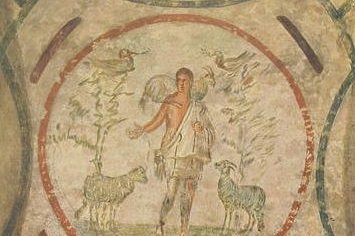
Fresco of the Good Shepherd, Catacomb of Priscilla, Rome, 3rd-4th century (photo published 1903) — public domain.
Roman law forbade burial within the city walls, a practical sanitary rule that applied to everyone, not just Christians. Wealthy Romans of any religion could afford private burial plots or mausoleums along roads leading out of the city. Christians, drawn heavily from lower and middle social classes and holding to a theology that treated the body as something to be respectfully interred rather than cremated (the more common Roman practice), needed an affordable, expandable solution. The soft volcanic rock, called tufa, that underlies much of the land around Rome turned out to be ideal for digging — easy enough to excavate with hand tools, yet stable enough to hold its shape once tunneled. Christian communities, often working with land donated by wealthier converts, began carving multi-level networks of narrow corridors lined with burial niches, expanding them steadily as the community grew.
Where the "hiding" idea actually comes from
The myth of Christians living in hiding underground has real roots, just not accurate ones. Nineteenth-century popular fiction and religious art — sometimes deliberately sentimental, sometimes simply working from limited archaeological knowledge — leaned hard into the idea of the catacombs as a refuge, and the image stuck in the popular imagination far more firmly than the archaeological record ever supported it. Modern historians and archaeologists studying the catacombs point out that using them as a long-term hideout would have made little practical sense: Roman authorities largely knew where burial sites were located, since burial was itself a public, licensed activity even for a technically illegal religion, and an underground tunnel network is a poor place to defend or escape from if discovered.
What is true is more modest: during specific, acute moments of persecution, Christians may occasionally have used catacombs for a funeral rite conducted quickly and quietly, or as a brief place of gathering around the tomb of a martyr. But that is a far cry from communities living underground for extended periods, which the evidence does not support as ordinary practice.
The catacombs' real drama lies elsewhere: in what they preserve about how ordinary early Christians thought about death itself. Inscriptions throughout the tunnels favor hopeful, understated language — phrases wishing the dead peace, or describing them as sleeping "in Christ" — a marked contrast to the more fatalistic epitaphs common in contemporary pagan Roman burial. That quiet confidence, carved into stone by grieving families two thousand years ago, tells a more honest story about the early Church's convictions than any tale of secret hideouts ever could.
The Catacombs of Callixtus
Among the many catacomb networks around Rome, the Catacombs of Callixtus hold particular historical weight. Established in the second century under the direction of Pope Zephyrinus and administered by the man who would become Pope Callixtus I, the site grew into an official cemetery of the Roman Church — extending, by some estimates, roughly 20 kilometers of tunnels across several underground levels. Its most significant feature is the Crypt of the Popes, a chamber containing the burial inscriptions of several third-century pontiffs, making it one of the most important surviving records of the early institutional Church.
The Catacombs of Priscilla
Sometimes called the "Queen of the Catacombs" for the richness of its art, the Catacombs of Priscilla take their name from a wealthy Roman noblewoman who is traditionally credited with donating the land on which they were dug. Among their frescoes is what many scholars consider the earliest surviving depiction of the Virgin Mary — a simple painted image, faded by nearly two thousand years, that nonetheless represents a remarkable point of origin for one of the most reproduced subjects in the history of Christian art.
Priscilla's tunnels also contain the "Greek Chapel," a small burial room decorated with scenes drawn from both the Old and New Testaments — Noah in the ark, the sacrifice of Isaac, the raising of Lazarus — painted in a cycle that scholars read as an early visual catechism, using familiar biblical rescue stories to comfort mourners with the promise of resurrection. It's a reminder that these spaces were never purely functional; the families who commissioned this artwork wanted their dead surrounded by images of hope, not just names and dates.
Rediscovery and what remains
Active burial in the Roman catacombs tapered off by around the early fifth century, as Christianity's legal status changed and above-ground burial became normal practice. Many catacombs were subsequently forgotten, buried under centuries of soil and vegetation, occasionally looted for relics during the Middle Ages, until renewed archaeological interest — particularly from the nineteenth century onward — brought systematic excavation and study back to the sites. Today several catacombs, including Callixtus and Priscilla, are open to the public under the oversight of the Vatican's Pontifical Commission for Sacred Archaeology, offering a direct, physical connection to the earliest generations of Roman Christianity — not as a hideout, but as a cemetery that quietly recorded, in stone and fresco, how that community actually lived, worshipped, and honored its dead.
Trivia
Did early Christians hide in the catacombs during persecution?
Why did Christians bury their dead underground instead of above ground?
What are the most famous catacombs in Rome?
How extensive are the Roman catacombs?
Are the Roman catacombs still used for burials today?
Related Reading