Capernaum: The Town Jesus Called Home

The town where Jesus lived
When the Gospel of Matthew wants to explain where Jesus based his public ministry, it doesn't say Jerusalem, and it doesn't say Nazareth, the town where he grew up. It says Capernaum: "He left Nazareth and went to live in Capernaum by the sea, in the region of Zebulun and Naphtali," (RSV-CE, Matthew 4:13). That single verse marks a real shift in the Gospel narrative — Capernaum becomes, in effect, Jesus's operational home for the bulk of his Galilean ministry, the place he returned to between journeys and the setting for more recorded miracles than any other single town in the Gospels.
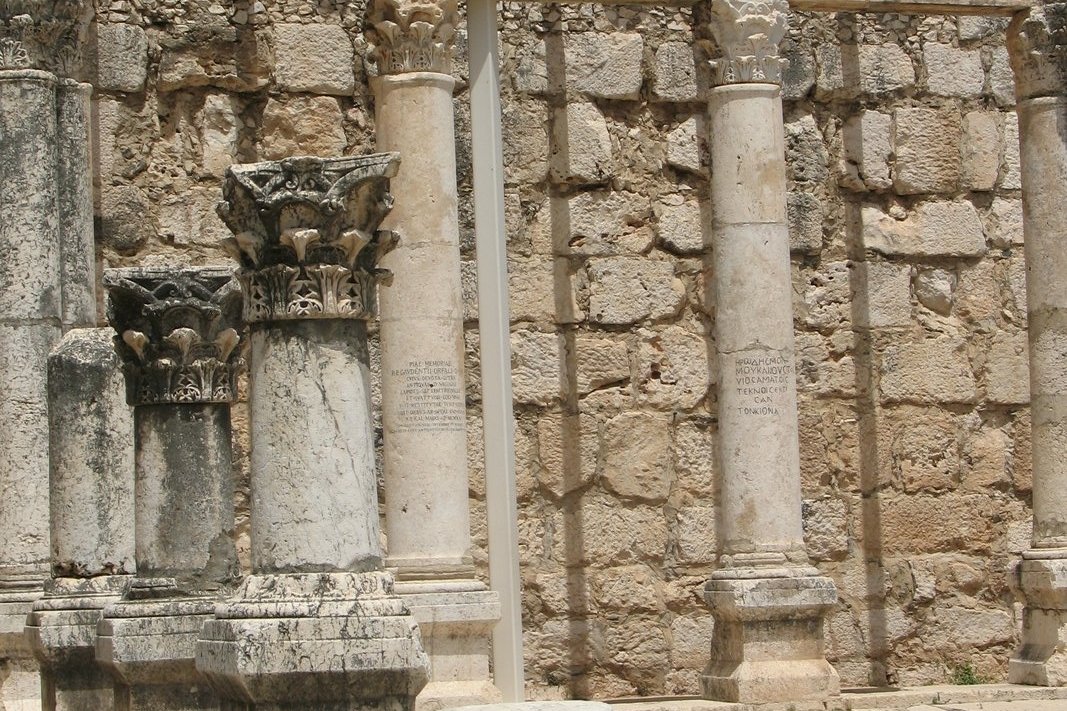
Photograph by James Emery, Capernaum synagogue ruins, 2007 — CC BY 2.0, Wikimedia Commons.
The town itself was a modest fishing settlement on the northern shore of the Sea of Galilee, positioned on a trade route and customs crossing, which explains the Gospels' mention of a tax-collector's post there — the post where, according to Matthew's own account, Jesus called him to become a disciple. Capernaum's population in the first century has been estimated by archaeologists at only around 1,500 people, a detail that makes the concentration of Gospel activity centered there all the more striking.
Peter's town, and Peter's house
Capernaum was also home to Simon Peter and his brother Andrew, fishermen on the Sea of Galilee before Jesus called them to leave their nets and "become fishers of men." Archaeological excavation conducted through the twentieth century uncovered, beneath the remains of a later octagonal Byzantine church, a first-century house that shows signs of having been converted into a gathering space for Christian worship remarkably early — with graffiti and inscriptions from as far back as the second century invoking Jesus and Peter by name. While certainty about any specific ancient house is always somewhat provisional, the layered archaeological and textual evidence has led most scholars and the Franciscan custodians of the site to identify this house with reasonable confidence as Peter's, and by extension a place Jesus himself likely stayed during his time in the town.
The Gospels describe Jesus healing Peter's mother-in-law of a fever in this house (Mark 1:29-31), among other episodes, reinforcing the tradition that this modest fisherman's home became something like an informal headquarters for Jesus's early ministry in Galilee.
A synagogue, and a place of teaching
Capernaum's synagogue holds a similarly layered history. The Gospel of Mark records Jesus teaching there with an authority that astonished the people present, "not as the scribes" (Mark 1:22), and it was reportedly in this synagogue that he delivered part of the discourse on the Bread of Life recorded in John 6. The striking white limestone synagogue whose ruins are visible at the site today was actually built later, generally dated by archaeologists to the fourth or fifth century, constructed directly over the foundations — visible in black basalt stone beneath — of an earlier synagogue that would have stood in Jesus's own time.
That layering is itself meaningful: it shows a continuous, centuries-long tradition of the same sacred ground being used for worship, rebuilt and expanded even as the town's population and fortunes shifted. The later synagogue's elaborate carved stonework, featuring floral and geometric patterns along with some depictions of ritual objects, made it one of the more architecturally significant ancient synagogues discovered anywhere in the region.
Miracles remembered, and a warning given
Beyond the healing of Peter's mother-in-law, the Gospels situate a striking number of Jesus's recorded miracles in or near Capernaum: the healing of a centurion's servant (Matthew 8:5-13), the healing of a paralyzed man lowered through a roof by his friends (Mark 2:1-12), and the casting out of an unclean spirit in the synagogue itself (Mark 1:21-28), among others. The density of these episodes in a single small town is one reason Capernaum has sometimes been described, informally, as the town of Jesus's miracles.
Yet the Gospels also record a pointed warning directed at the town. Despite everything witnessed there, Jesus rebukes Capernaum for its failure to repent, warning that "you will be brought down to Hades" for its unresponsiveness compared to the pagan cities of Tyre and Sidon (Matthew 11:23-24). Christian commentators have long read this passage as a sobering statement about privilege and accountability — that proximity to extraordinary revelation carries its own weight of responsibility.
From ruins to pilgrimage site
Capernaum's decline came gradually. Archaeological and historical evidence suggests the town persisted for centuries after the New Testament period before being finally abandoned sometime around the eleventh century, its exact final years not precisely documented. It lay largely forgotten until systematic excavation began in the late nineteenth and early twentieth centuries, work that gradually uncovered the synagogue ruins, the residential quarter, and the house identified with Peter.
Today the site is cared for chiefly by the Franciscan Custody of the Holy Land, which built a modern church, elevated on stilts, directly above the excavated remains of the traditional site of Peter's house — allowing visitors to look down through a glass floor at the ancient foundations below while standing in a contemporary place of worship. A separate section of the site, containing the White Synagogue ruins, is maintained by the Greek Orthodox Church nearby. Capernaum remains one of the most consistently visited stops on Christian pilgrimage itineraries through the Galilee, valued precisely because so much of what is seen there connects, layer upon layer, back to the town the Gospels describe as the place Jesus called home.
Trivia
Why is Capernaum important in the Gospels?
Was Capernaum the hometown of Saint Peter?
What ruins can visitors see at Capernaum today?
Did Jesus say anything notable about Capernaum itself?
Is Capernaum still an inhabited town today?
You May Also Like
Related Reading