Palermo Cathedral: Eight Centuries of Sicilian History in Stone

Built on a site with a layered past
Palermo Cathedral, dedicated to the Assumption of the Virgin Mary, was begun in 1185 under Walter Ophamil, the English-born Archbishop of Palermo, at a moment when Norman rulers governed Sicily and were actively investing in monumental church architecture across the island to assert their dynasty's wealth and Christian legitimacy. The site itself carried a layered religious history stretching back centuries before the Normans arrived: earlier structures on or near the location had included a Christian basilica in the Byzantine period, later converted into a mosque during the roughly two centuries of Islamic rule over Sicily that preceded the Norman conquest in the 11th century. The Normans demolished the existing mosque to clear ground for their new cathedral, though a handful of architectural fragments bearing Arabic inscriptions survive within the current building, quiet physical traces of the site's Islamic-era history embedded within its Christian successor.
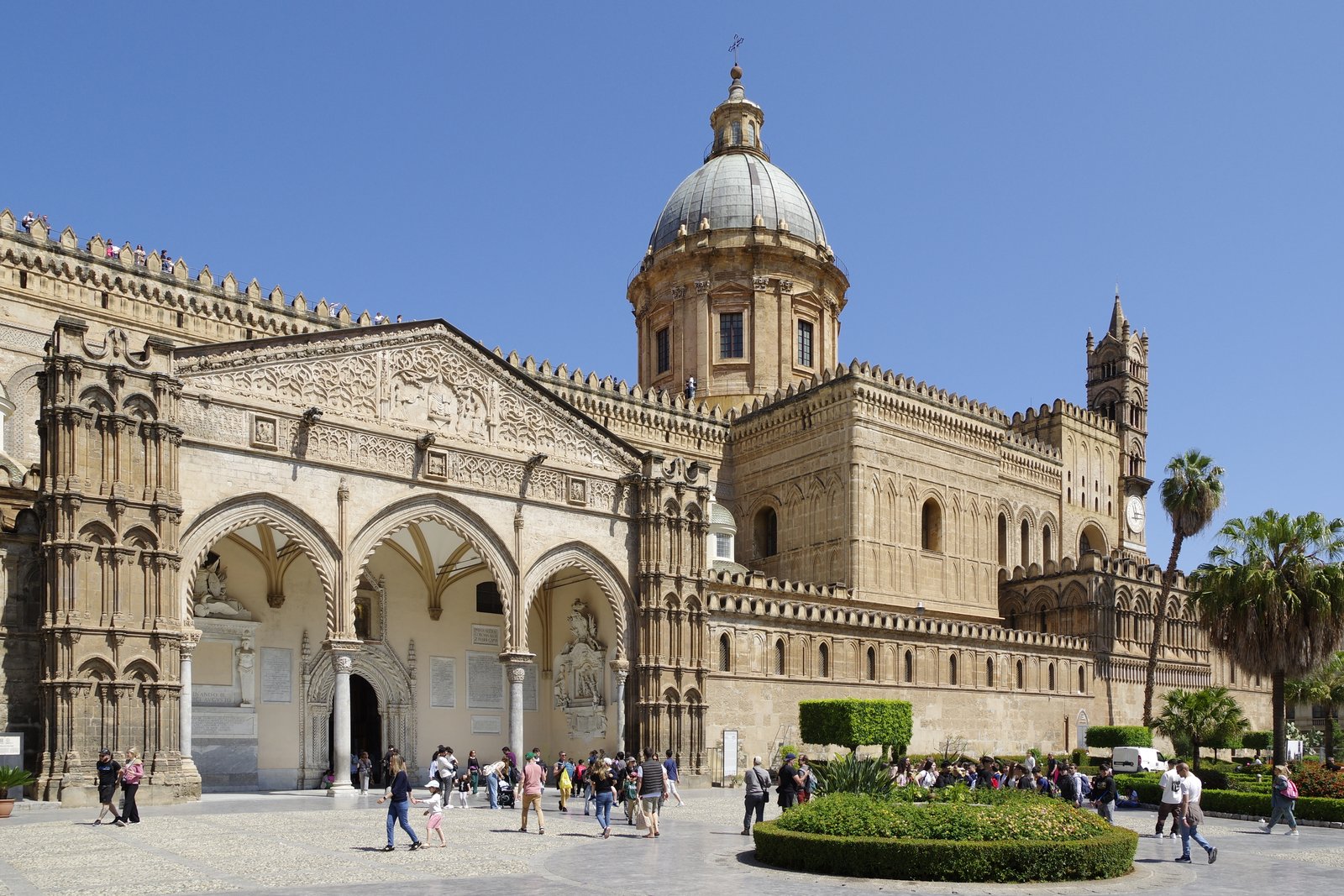
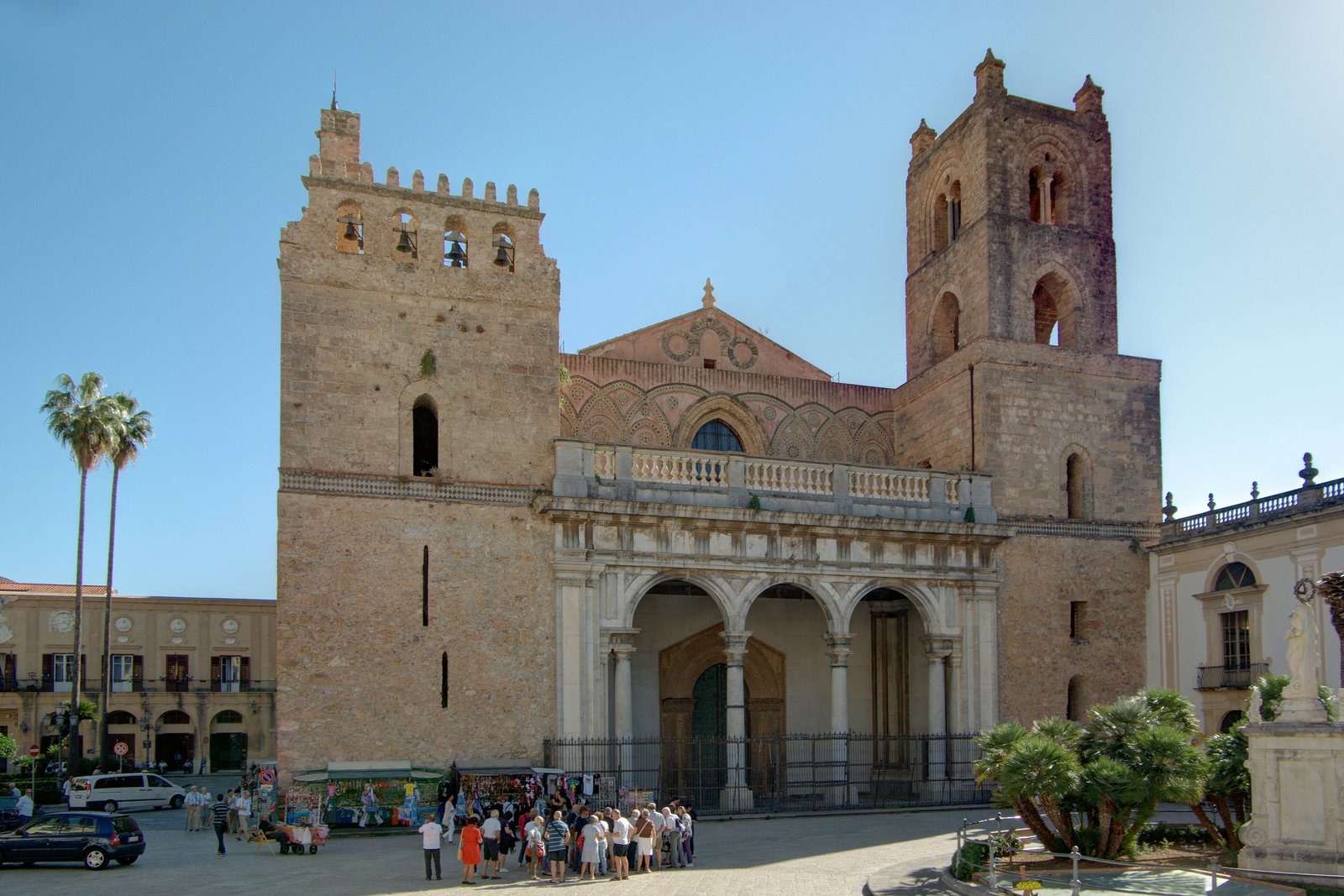
Photograph by Berthold Werner, Palermo Cathedral exterior, Sicily — CC BY-SA 4.0, Wikimedia Commons.
The cathedral as first completed in the late 12th and early 13th centuries reflected the Norman-Romanesque style typical of the era's major Sicilian churches — heavy fortress-like massing, blind arcading, and geometric decorative patterning along the exterior walls showing clear influence from the same Norman-Arab-Byzantine artistic synthesis visible at nearby Monreale Cathedral, built at almost exactly the same period under a rival branch of the same royal family.
Centuries of continuous alteration
Unlike a cathedral built within a single unified campaign, Palermo's has never really stopped changing. Gothic side chapels and elaborate portals were added during the 14th and 15th centuries, layering pointed-arch Gothic detail onto the original Norman-Romanesque core. The most dramatic and, to many later critics, most controversial intervention came at the very end of the 18th century, when the architect Ferdinando Fuga carried out a sweeping Neoclassical remodeling completed in 1801, adding a large dome and substantially reworking the cathedral's interior in a style entirely foreign to its Norman origins. The result today is a building where visitors can trace nearly eight centuries of shifting architectural taste across a single structure — a quality some architectural historians have found jarring and others have come to appreciate precisely as an honest, unconcealed record of the building's long life, rather than a later restoration's attempt to impose false stylistic unity.
Royal tombs beneath the cathedral floor
Palermo Cathedral holds one of medieval Europe's most historically significant collections of royal tombs, gathered within a dedicated chapel near the building's entrance. Here rest, among others, King Roger II, the first Norman king of Sicily, whose reign in the 12th century established the kingdom that would go on to build much of the island's great Norman-era architecture; Emperor Henry VI, the Holy Roman Emperor who acquired the Sicilian crown through marriage; and Emperor Frederick II, Henry's son, one of the most powerful and intellectually remarkable rulers of the medieval period, whose court at Palermo became a celebrated center of science, poetry, and cross-cultural exchange between Christian, Muslim, and Jewish scholars. The tombs themselves, several carved from imperial porphyry — a deep purple-red stone historically reserved for the highest ranks of Roman and Byzantine royalty — represent one of the most concentrated surviving collections of medieval royal funerary art anywhere in Europe.
The city's beloved patroness
A separate chapel within the cathedral is dedicated to Saint Rosalia, a 12th-century noblewoman who, according to tradition, retreated to a life of solitary prayer in a cave on Monte Pellegrino overlooking Palermo. She is venerated today as the patron saint of Palermo, largely on the strength of a tradition holding that her intercession — following the reported rediscovery of her relics — helped end a devastating plague that struck the city in 1624. Her annual feast, the Festino di Santa Rosalia each July, remains one of Palermo's largest civic and religious celebrations, drawing crowds throughout the historic city center in a tradition that has continued for nearly four centuries.
A cathedral still central to Palermo life
Palermo Cathedral, together with Monreale Cathedral and several related Norman-era monuments, was inscribed as a UNESCO World Heritage Site in 2015, recognized for the exceptional fusion of Western, Byzantine, and Islamic artistic and architectural traditions achieved across the group. The cathedral remains the seat of the Archdiocese of Palermo and continues to hold regular services, standing today as both an active center of Sicilian Catholic life and, in its patchwork of architectural styles, a uniquely legible physical record of the many cultures and dynasties that have shaped Sicily across eight centuries.
Beneath the nave, a crypt holds the tombs of several archbishops and, notably, a number of Sicily's Norman and Hohenstaufen rulers, including Roger II and Frederick II, whose porphyry sarcophagi remain among the cathedral's most visited features for anyone tracing the island's medieval royal history rather than its religious art alone — a reminder that Palermo Cathedral has functioned, across its long history, as much as a royal mausoleum as a house of worship.
Trivia
Why does Palermo Cathedral look so architecturally mismatched?
Which historical rulers are buried at Palermo Cathedral?
Was Palermo Cathedral originally a mosque?
What is the Chapel of Saint Rosalia, and why is it important to Palermo?
Is Palermo Cathedral part of a UNESCO World Heritage Site?
Related Reading