The National Shrine of Saint Elizabeth Ann Seton, Emmitsburg

From New York society to a Maryland farmhouse
Elizabeth Ann Bayley was born in 1774 into a prominent Episcopalian family in colonial New York, a world of social standing far removed from the rural Maryland valley where she would eventually build her life's work. She married William Magee Seton in 1794, and the couple had five children before financial ruin and William's declining health from tuberculosis forced a desperate trip to Italy in search of a warmer climate and a cure. William died in Livorno in 1803, leaving Elizabeth a widow in a foreign country, and it was during that period of grief and dislocation, cared for by a Catholic Italian family, that she first encountered the Catholic faith that would reshape the rest of her life.
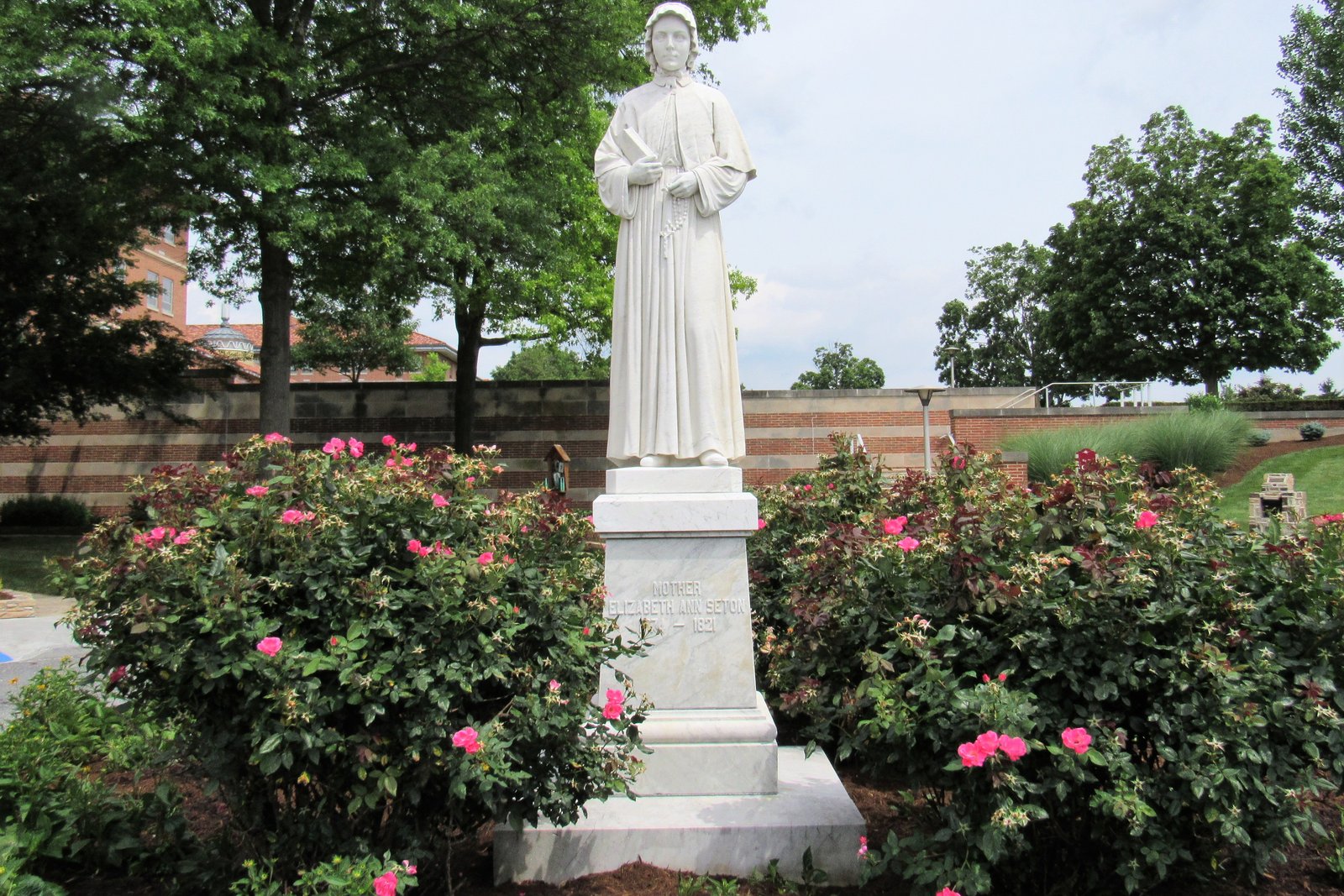
Photograph by Farragutful, National Shrine of St. Elizabeth Ann Seton, Emmitsburg, Maryland, 2017 — CC BY-SA 4.0, Wikimedia Commons.
Elizabeth converted to Catholicism in 1805 after returning to New York, a decision that cost her much of her former social standing and strained relationships with family and friends in the strongly Protestant milieu of the city's elite. Facing both social isolation and continued financial hardship as a widowed mother of five, she accepted an invitation from Baltimore's Catholic community and, in 1808, moved south to open a school — the beginning of a vocation that would take clearer shape the following year when she relocated her small emerging community to the rural town of Emmitsburg in the mountains of western Maryland.
Building a community and a school from nothing
Seton arrived in Emmitsburg in 1809 with a handful of companions who shared her vision of a religious life dedicated to both prayer and practical service, particularly through education. The group settled first in a small fieldstone farmhouse — modest even by the standards of the time — that came to be known simply as the Stone House, before moving into a larger building nearby, the White House, as their community and their ambitions grew. There, Seton formally established the Sisters of Charity of Saint Joseph, adapting the rule of the French Daughters of Charity to fit the particular circumstances of the American frontier Church, and became its first superior.
Alongside the new religious community, Seton opened Saint Joseph's Academy and Free School, offering education to both paying students and those unable to pay — an approach that historians widely regard as the founding institution of the American Catholic parochial school system, a network that would eventually grow to educate millions of American Catholic children over the following two centuries. Seton herself wrote much of the young community's rule and educational curriculum, drawing on both her own experience raising five children and the practical realities of building an institution with minimal resources in a rural frontier setting.
Sanctity forged in personal loss
Seton's years at Emmitsburg were marked as much by sorrow as by achievement. Two of her own daughters died during this period, and she buried several of her Sisters as well, all while continuing to lead her growing community and expand its educational and charitable work. She died at Emmitsburg in January 1821, at just forty-six years old, having spent barely more than a decade building what would become a lasting institution within American Catholic life — the Sisters of Charity she founded eventually gave rise to several distinct religious congregations across the United States, all tracing their origin to her work in this one Maryland valley.
Devotion to Seton grew steadily in the decades after her death, and the long process toward formal recognition of her sanctity moved through the stages of beatification before culminating on September 14, 1975, when Pope Paul VI canonized her — making Elizabeth Ann Seton the first person born within the territory of what is now the United States to be declared a saint of the Catholic Church, a milestone of particular significance for a still-young American Catholic community.
A shrine preserving her original ground
The National Shrine of Saint Elizabeth Ann Seton today occupies the same ground in Emmitsburg where she lived and worked, preserving both the original Stone House and the White House as historic sites open to visitors, alongside a basilica church, museum, and visitor center built in the decades following her canonization. Her remains rest in a reliquary within the shrine's basilica, and the site continues to draw pilgrims, students of American Catholic history, and members of the religious congregations that descend from her original Sisters of Charity.
The shrine sits within a few miles of another significant American religious and educational landmark, Mount St. Mary's University, itself founded in the same period and drawing on the same wave of early nineteenth-century American Catholic institution-building that Seton's own work exemplified. Together, the surrounding valley preserves an unusually intact physical record of how American Catholic religious and educational life took root in the young republic — grounded, in this particular case, in the determination of one widowed mother who arrived with almost nothing and built an institution that would outlive her by two centuries.
Trivia
Who was Saint Elizabeth Ann Seton?
Why is the shrine located in Emmitsburg, Maryland?
What did Elizabeth Ann Seton accomplish at Emmitsburg?
When was Elizabeth Ann Seton canonized?
Can visitors still see where Seton lived and is buried?
Related Reading