The Basilica of Saint Francis of Assisi

A monument built fast, and built to honor a tomb
Francis of Assisi died in 1226, and the Church moved with unusual speed afterward: he was canonized just two years later, in 1228, by Pope Gregory IX — the same pope who laid the foundation stone for the basilica that same year. The Lower Church was largely finished by around 1230, when Francis's body was transferred there, and construction continued upward with the Upper Church, completed by 1253. The whole project, in other words, was raised within a single generation of Francis's death, while people who had actually known him were still alive to see it rise over his grave.
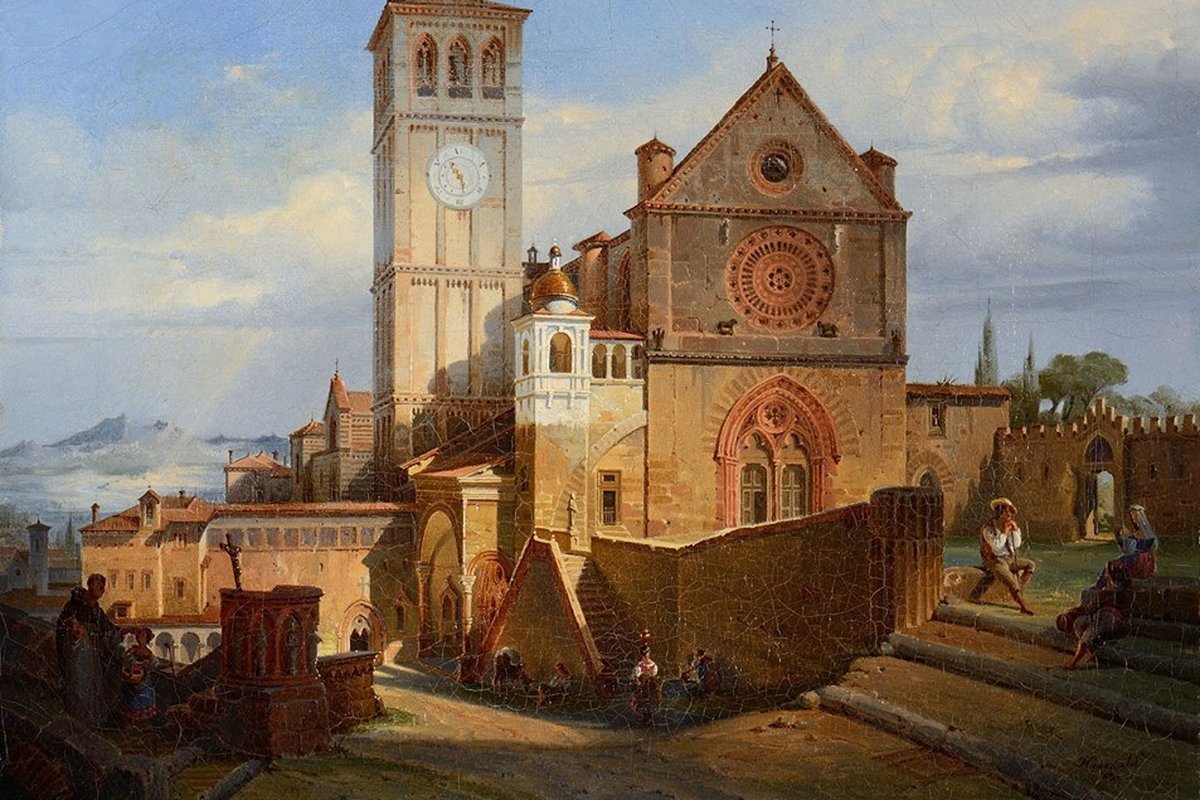
Max Albert Hauschild, Basilica di San Francesco Assisi, 1836 - public domain.
The building sits on a hillside on the western edge of Assisi, on ground that was reportedly nicknamed "Hell's Hill" before construction began, since it had once been used for executions — a detail tradition frames as part of the site's transformation, turning a place associated with death and punishment into one of Christendom's most visited pilgrimage destinations. The friar Elias of Cortona, one of Francis's own early companions and, by then, minister general of the Franciscan order, oversaw the ambitious building project, and it was Elias who pushed hardest for a monument on this scale — a decision that put him at odds with other friars who felt it betrayed the poverty Francis himself had lived and preached. That internal disagreement over how, or whether, to memorialize Francis in stone and fresco would resurface again and again in Franciscan history over the following centuries.
Two churches, one building
What makes the basilica architecturally distinctive is that it isn't one church but two, stacked directly on top of each other. The Lower Church is low-ceilinged, dim, and cave-like by design — its heavy Romanesque architecture and shadowed side chapels create an intimate, almost subterranean feeling appropriate to its purpose as the space built closest to Francis's tomb, which rests in a crypt beneath it.
The Upper Church, by contrast, opens upward into a bright, soaring Gothic space, one of the earliest and most influential examples of Gothic architecture built in Italy. Large stained glass windows and a single wide nave were designed explicitly to hold large fresco cycles telling Francis's story on a monumental scale, unbroken by the multiple small chapels found below.
Both churches suffered serious damage in a 1997 earthquake that struck Umbria, killing four people inside the basilica itself, including two Franciscan friars and two officials assessing the structure, when part of the Upper Church's vaulted ceiling collapsed during aftershocks. Sections of the Cimabue frescoes and other decoration were destroyed outright, reduced to thousands of fragments that conservators spent years painstakingly sorting and, where possible, reassembling. The basilica reopened less than two years later, in November 1999, an unusually fast recovery for a monument of this scale and importance that reflected both the urgency Italy placed on restoring it and the resources poured into the effort from around the world.
The frescoes that changed how painting worked
The Upper Church's fame rests heavily on its fresco cycle of 28 scenes from the life of Saint Francis, painted around 1297 to 1300. For centuries, this cycle was attributed entirely to the Florentine painter Giotto di Bondone, and it remains popularly known as "Giotto's frescoes" even today. Since the early 20th century, art historians have increasingly questioned that single attribution — current scholarship generally credits the work to several painters, sometimes referred to as the Master of the Legend of St. Francis and collaborators, working alongside or after Giotto rather than as his work alone.
Whoever painted them, the frescoes marked a turning point in Western art. Rather than the flat, symbolic figures typical of earlier Byzantine-influenced painting, the Assisi cycle depicts Francis's life with a new sense of physical space, individualized gesture, and emotional realism — qualities that would define Italian painting for the following two centuries. Along the walls of the transept, the earlier Florentine painter Cimabue contributed his own frescoes around the same period, making the Upper Church a rare place to see the transition between two eras of Italian art side by side.
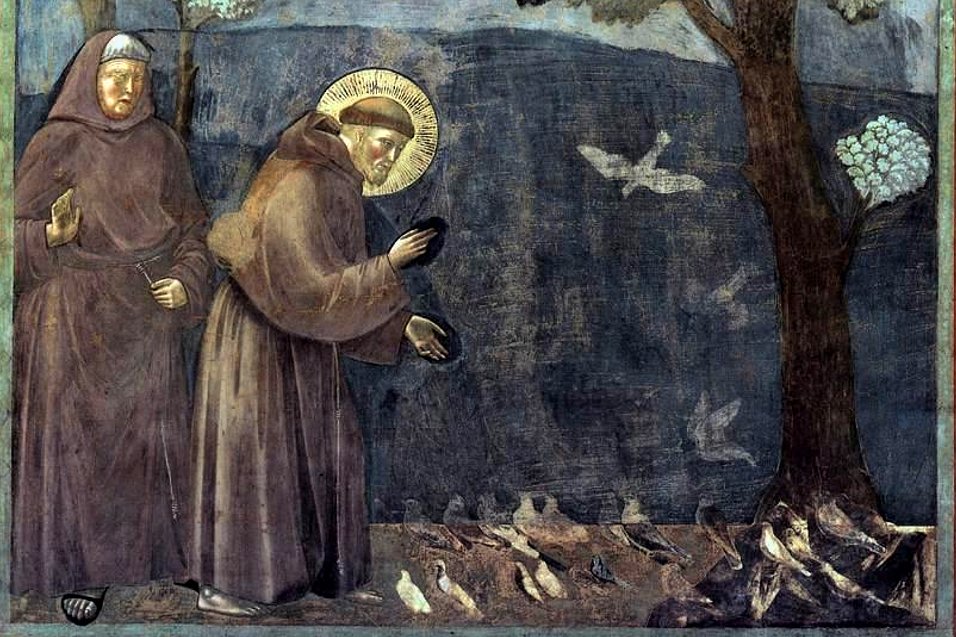
The individual scenes are worth knowing by name, since they're often reproduced separately in art history texts: the cycle opens with a simple layman honoring Francis by laying his cloak before him, moves through Francis's renunciation of his father's wealth, his preaching to the birds, his reception of the stigmata late in life, and closes with his death and the posthumous miracles that followed. That final emphasis on miracles after death matters for a specific reason — medieval canonization required documented posthumous miracles as part of the formal case for sainthood, and the frescoes function partly as visual testimony to exactly that evidence, not simply as devotional storytelling.
A pilgrimage site still shaped by Francis himself
The basilica has drawn pilgrims continuously since the 13th century, and it remains one of the most visited religious sites in Italy, alongside its role as the head church of the Franciscan order Francis founded. Anyone who wants the fuller story of the man the basilica was built to honor — his conversion, his embrace of poverty, and the movement that grew out of both — can read more in our article on Saint Francis of Assisi himself.
There's an irony many visitors and historians alike have noted: Francis preached radical poverty and famously forbade his followers from building anything grand, yet the church built to honor him became one of the most artistically ambitious buildings of its century. The basilica's defenders have generally read this less as a contradiction than as the Church's own way of expressing what it believed Francis's life was worth — a monument not to wealth, but to the enduring pull of a man who owned almost nothing.
Trivia
When was the Basilica of Saint Francis of Assisi built?
Why does the basilica have two separate churches?
What are the Giotto frescoes in the Basilica of Saint Francis?
Is Saint Francis of Assisi actually buried in the basilica?
Related Reading