The Archbasilica of St. John Lateran

The cathedral tourists skip
Rome has more churches per square mile than almost any city on earth, and it's easy for even attentive visitors to leave without ever setting foot in the most important one. St. Peter's Basilica draws the crowds — it's inside Vatican City, built over the tomb tradition holds is Saint Peter's own, and it hosts the ceremonies broadcast to the world. But rank in the Catholic Church runs by a different logic than fame. The Pope's actual cathedral — the church that holds his chair as Bishop of Rome, the office from which everything else in his authority flows — is the Archbasilica of St. John Lateran, standing apart from the Vatican, on the far side of the city.
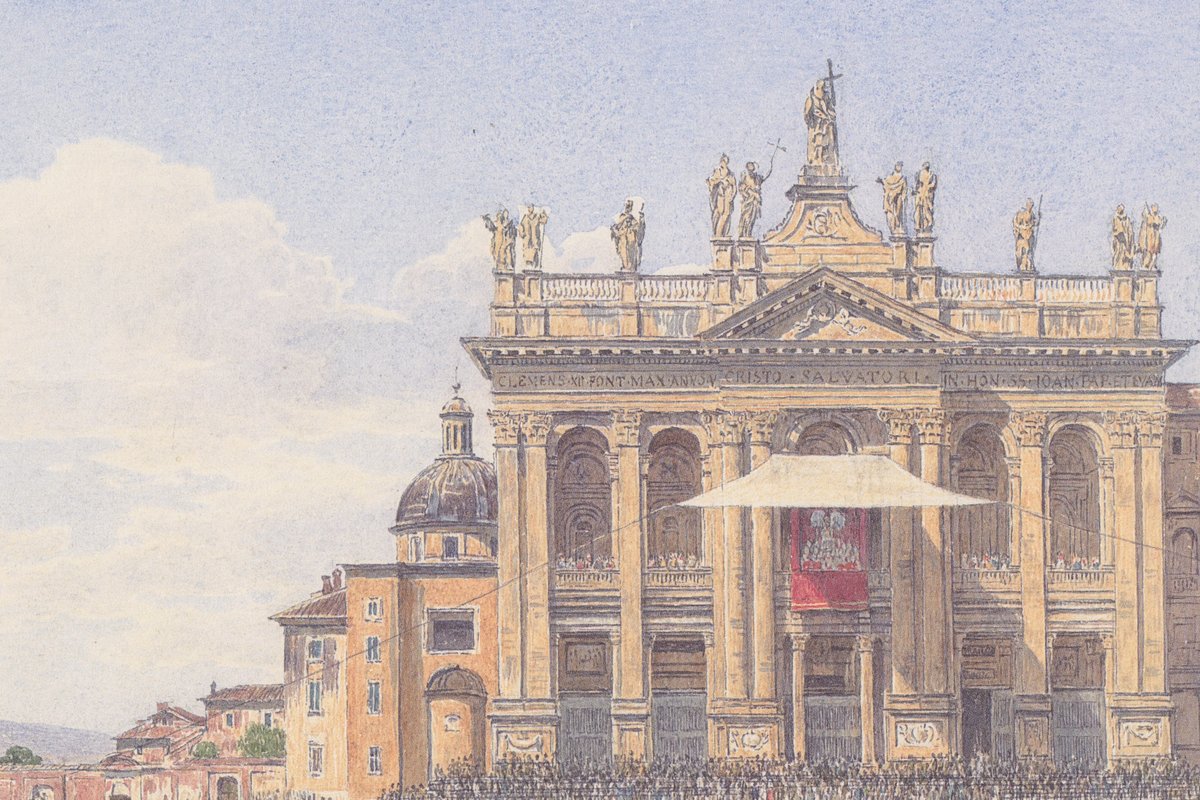
Jakob Alt, The Basilica of San Giovanni in Laterano in Rome, 1835 - public domain.
What makes a church a "cathedral"
The distinction matters because a cathedral, in Catholic terms, is not simply a grand or important church — it's specifically the church that holds a bishop's cathedra, his official chair, the seat from which he teaches and governs his diocese. Every bishop has exactly one. The Pope is Bishop of Rome before he is anything else in Church governance, and his cathedra sits in St. John Lateran, not St. Peter's. St. Peter's, by contrast, is built over the apostle's traditional burial place and functions as the Vatican's own basilica — extraordinarily important, but not, technically, the Pope's cathedral.
Older than St. Peter's, and built from a confiscated estate
St. John Lateran's claim to seniority rests on more than a technicality — it is also, by most accounts, the oldest of Rome's great churches. Its site once belonged to the Laterani, a wealthy Roman family, before the property came into imperial hands and was donated by the Emperor Constantine to Pope Miltiades in the early 4th century, shortly after Christianity's legalization ended centuries of persecution. That gift allowed the Church, for the first time, to build a large public basilica in Rome rather than worship in private homes or catacombs — making the Lateran basilica the first Christian church built openly in the city, roughly a decade before construction began on the original St. Peter's.
An inscription on the church's facade still announces its rank in Latin: Omnium urbis et orbis ecclesiarum mater et caput — "Mother and Head of All Churches in the City and the World." That title is not decorative flattery; it reflects the Lateran's formal precedence over every other Catholic church on earth, St. Peter's included, a status the Church has maintained continuously since the basilica's founding, even through the centuries when the popes themselves lived in Avignon rather than Rome.
That precedence isn't merely symbolic, either. Each new pope, following ancient custom, formally takes possession of the Lateran basilica in a ceremony distinct from his installation at St. Peter's, precisely because it is here, not at the more famous Vatican basilica, that he is installed as Bishop of Rome in the fullest juridical sense. The popes lived beside the Lateran, in the adjoining palace, for roughly a thousand years — through the entire first millennium of Church history and beyond — meaning that for most of Christian history, this was quite literally where the papacy resided and governed from, not the Vatican hill at all.
A dedication that grew over time
The basilica's full and official name today is the Basilica of the Most Holy Savior and of Saints John the Baptist and John the Evangelist in the Lateran. Its earliest dedication was to Christ the Savior alone; the two Saints John were added to its patronage later, in connection with a baptistery built alongside the church and a Benedictine community that took John the Baptist as patron. The building has been rebuilt and restored many times after fires, earthquakes, and the long absence of the papacy during the Avignon period, and the version standing today owes much of its interior to a 17th-century renovation by Francesco Borromini — but its rank, unlike its architecture, has never changed.
The adjoining Lateran Baptistery deserves its own mention, since it's traditionally regarded as the model for baptisteries across the Christian world. Built with an octagonal plan — eight sides symbolizing, in early Christian numerology, the "eighth day" of new creation inaugurated by Christ's resurrection — it established an architectural pattern that later baptisteries throughout Italy and beyond consciously imitated for centuries, making the Lateran complex influential in ways that go well beyond the main basilica building itself.
The Holy Door and the tradition of the Jubilee
St. John Lateran also carries a role that comes to public attention only once every quarter-century or so: like St. Peter's and Rome's two other major papal basilicas, it has its own Holy Door, opened by the Pope at the start of a Jubilee Year and walled shut again at its close. Pilgrims who pass through it, along with the doors of the other three papal basilicas, traditionally seek the indulgences the Church attaches to a Holy Year. The basilica's adjoining Lateran Palace, once the residence of the popes for roughly a thousand years before the papacy's move to the Vatican, only adds to the sense that this quieter, less-visited church carries more institutional weight than its lower profile among tourists would suggest.
For anyone drawn to the story of Saint Michael the Archangel or to Rome's other great churches, St. John Lateran rewards the detour: it's the building where, in a real institutional sense, the whole structure of the Catholic Church still begins.
Trivia
Is St. John Lateran the same as St. Peter's Basilica?
Why is St. John Lateran called the mother and head of all churches?
When was St. John Lateran founded?
Who is St. John Lateran dedicated to?
Related Reading