The Royal Monastery of Santa María de Guadalupe, Spain

The original Guadalupe
Set against the wooded hills of the Villuercas mountains in Extremadura, in west-central Spain, the Royal Monastery of Santa María de Guadalupe is easy to overlook amid the much greater modern fame of its Mexican namesake — yet this is the shrine that gave that later devotion its name. It's important to be clear and careful about this relationship from the outset: the Guadalupe monastery in Spain and the Basilica of Our Lady of Guadalupe in Mexico City are two separate shrines, with separate histories, separate venerated images, and separate apparition traditions. What connects them is that the Spanish devotion to Mary under the title "Guadalupe" was already well established and had already spread throughout the Spanish world by the time of the reported 1531 apparition to Juan Diego near Mexico City, and the name attached itself to that new devotion as a result — not because the two apparitions or images are the same event or object.
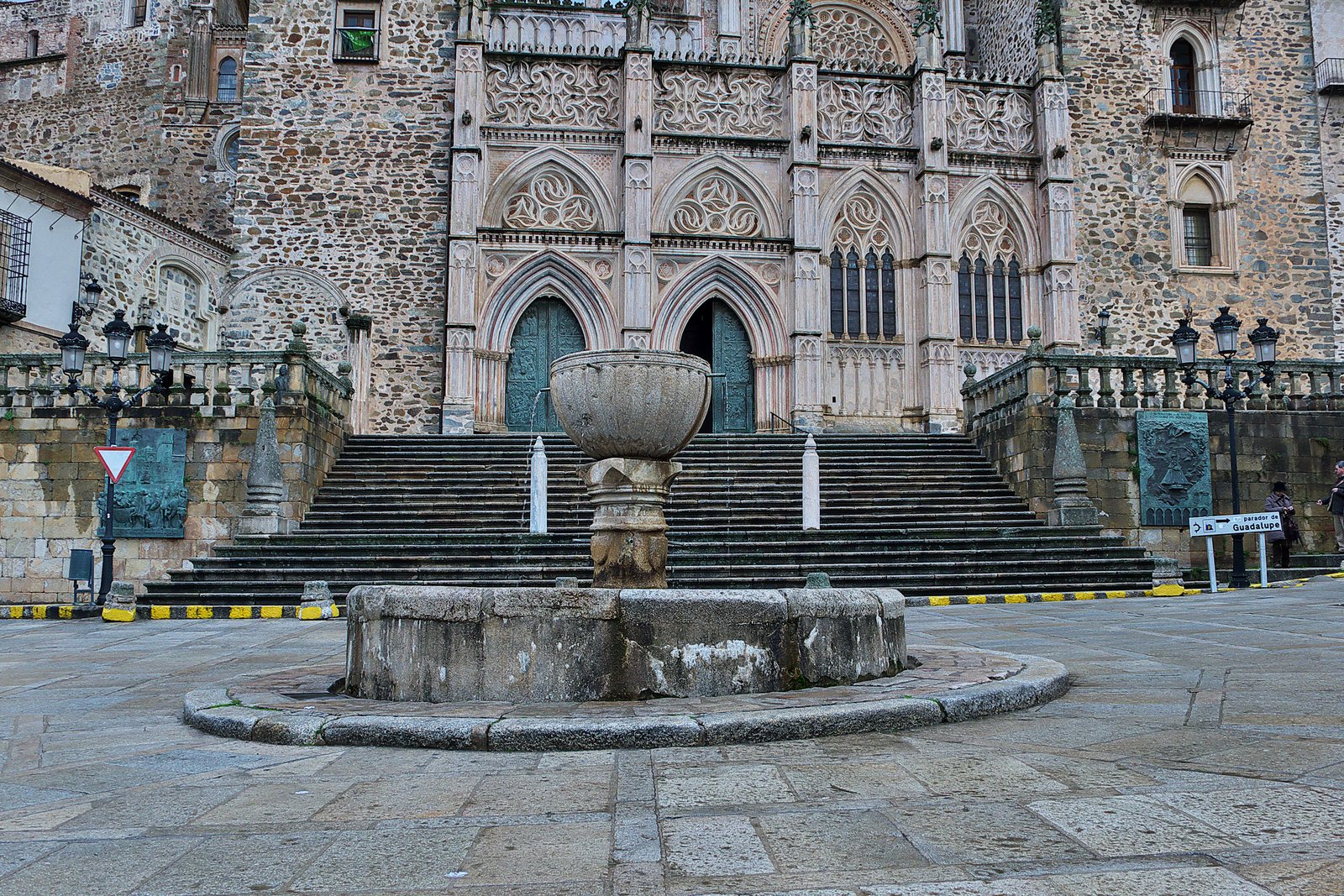
Photograph by José Luis Filpo Cabana, Royal Monastery of Santa María de Guadalupe, Cáceres, Spain — CC BY 3.0, Wikimedia Commons.
According to the monastery's own founding tradition, a shepherd named Gil Cordero discovered a statue of the Virgin Mary buried near the banks of the Guadalupe River sometime in the late thirteenth or early fourteenth century, after Mary reportedly appeared to him and directed him to the location. Devotional tradition further holds that the statue had been hidden there centuries earlier, around 711, by Christians fleeing the Muslim conquest of the Iberian Peninsula, protecting it from destruction during the upheaval of that period. As with many medieval discovery narratives of this kind, the precise historical details are difficult to verify independently and belong more properly to pious tradition than to documented fact — but the discovery, whatever its exact circumstances, is what set in motion the shrine's growth over the following centuries.
Growth under the Hieronymites
A small hermitage grew up quickly around the site of the discovery, and royal patronage soon followed — Spanish monarchs, beginning with Alfonso XI of Castile in the fourteenth century, took a direct interest in the shrine, crediting a Marian intervention with a decisive military victory and subsequently supporting the site's expansion. In 1389, the monastery was placed under the care of the Hieronymite order, also known as the Order of Saint Jerome, a monastic order that had particular prominence in medieval Spain, and under Hieronymite stewardship Guadalupe grew into one of the wealthiest and most influential monasteries in the country, a major center of learning, medicine, and craftsmanship as well as pilgrimage.
The monastery complex that resulted, much of which survives today, blends Gothic, Mudéjar (the distinctive Christian-Islamic architectural style native to medieval Spain), and later Renaissance elements into a fortress-like whole — its thick walls and towers reflecting both defensive necessity in a still-contested medieval frontier region and the sheer scale of wealth and ambition the shrine had accumulated by the fifteenth and sixteenth centuries.
Guadalupe and the bridge to the Americas
Guadalupe's historical significance extends well beyond Spain's own borders because of its close ties to the earliest years of Spanish transatlantic exploration. Christopher Columbus is recorded as having visited the monastery, reportedly to give thanks following his first voyage across the Atlantic, and in 1496 he had two men from the Caribbean — often identified as Taíno — baptized at Guadalupe, an early and historically significant instance of the encounter between the Spanish Catholic world and the peoples of the Americas playing out at this specific shrine.
That connection helps explain how devotion to "Our Lady of Guadalupe" traveled to the New World in the first place, carried by explorers, colonizers, and missionaries who already knew the shrine and its Marian title from home. When reports of a Marian apparition began circulating around Mexico City in 1531, the devotion that grew from those reports adopted the same well-known Spanish Marian title — resulting, over the following centuries, in the Mexican Guadalupe becoming vastly more widely known worldwide than the original Spanish shrine that lent it the name.
The monastery today
The Hieronymites' long stewardship of Guadalupe ended in the nineteenth century amid Spain's broader anti-clerical suppressions of religious orders, and the monastery passed through a period of decline before Franciscan friars took over its care in 1908, a role they continue today. UNESCO recognized the site's exceptional historical and architectural significance in 1993, inscribing it as a World Heritage Site for its blend of architectural styles and its pivotal historical role connecting medieval Spain to the beginning of Spanish presence in the Americas.
Pilgrims and visitors still come to Guadalupe today, drawn both by its own venerated statue — a dark-toned image kept, like several of Europe's other famous Black Madonnas, in an ornate chapel setting — and by the extraordinary layered history embedded in its walls, from a shepherd's reported discovery seven centuries ago to its quieter but genuine role in the earliest encounters between Spain and the Americas.
Trivia
Is the Guadalupe monastery in Spain the same as the Basilica of Guadalupe in Mexico?
How did the Spanish shrine at Guadalupe begin?
What order has cared for the monastery historically?
Why was Guadalupe historically important to Spanish exploration of the Americas?
Is the Guadalupe monastery in Spain a UNESCO World Heritage Site?
Related Reading