Montserrat Abbey

A mountain shaped like its own name
Montserrat rises abruptly out of the Catalan countryside northwest of Barcelona, its silhouette unlike almost anything else in the surrounding landscape — a long ridge of conglomerate rock eroded over millions of years into a row of separated, tooth-like peaks. The name itself is Catalan for "saw-toothed mountain," a description so literal that anyone seeing the skyline for the first time understands immediately where it came from. Built directly into this dramatic rock face, roughly 2,400 feet above the valley floor, sits a Benedictine monastery that has drawn pilgrims to the mountain for close to a thousand years.
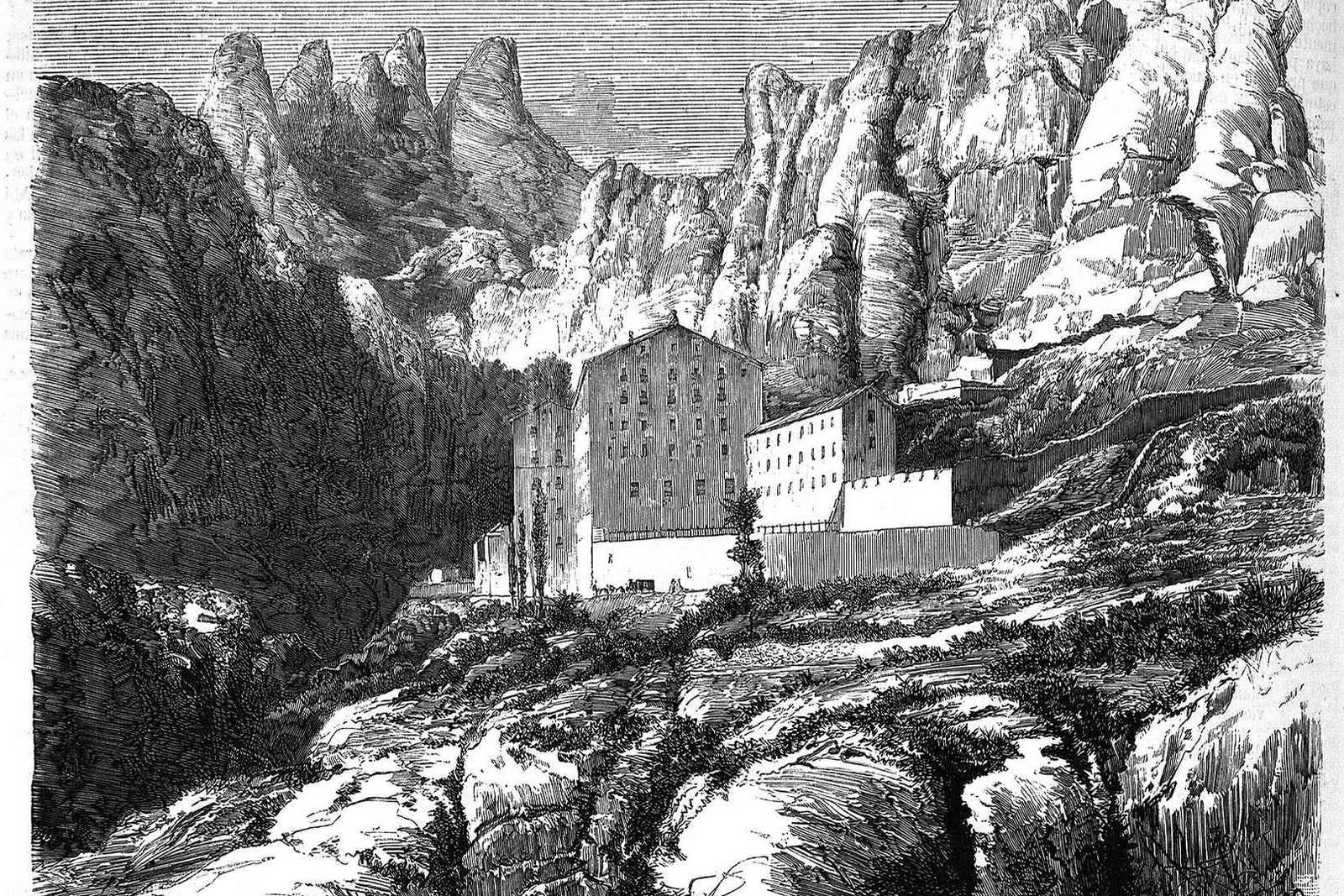
El Museo Universal, 1860 — public domain.
Monks who chose an unlikely place to settle
Hermits are recorded living on Montserrat's slopes even before the monastery itself was formally founded, drawn by the mountain's remoteness and its dramatic setting. Several small hermitages, some dedicated to different saints, dotted the higher reaches of the mountain across the medieval centuries, and ruins of a few are still visible today for hikers willing to climb beyond the main abbey complex. Benedictine monks — followers of the sixth-century monastic rule associated with Saint Benedict of Nursia, which structured daily life around prayer, manual work, and communal living — established a formal community at Montserrat in the 11th century, building around an existing devotion to a statue of Mary already associated with the mountain.
Over the following centuries, the monastery grew into one of Catalonia's most significant religious institutions, accumulating land, pilgrims, and royal patronage from the counts of Barcelona and later the kings of Aragon. It wasn't spared from history's disruptions, though — the abbey suffered serious damage during the Napoleonic Wars in the early 19th century, when French troops looted and burned much of the complex, and again during the Spanish Civil War in the 20th century, when the monastery found itself caught in the broader conflict between the Republican government and Catalan nationalist sentiment on one side and Franco's forces on the other. Both times, the community rebuilt rather than abandoning the site, a persistence that mirrors the mountain's own unyielding, weathered rock.
La Moreneta, "the little dark one"
At the spiritual center of Montserrat is a small wooden statue of Mary and the child Jesus, dating to around the 12th century, known affectionately in Catalan as La Moreneta — "the little dark-skinned one" — for the dark tone of the wood. It belongs to the broader tradition of Black Madonnas found across medieval Europe, and it's venerated today as the patroness of Catalonia. The statue is displayed behind the basilica's main altar, and pilgrims climbing to see it traditionally queue to touch or kiss the golden orb held in the Virgin's right hand, inscribed with the Latin words "Nigra sum sed formosa" ("I am dark but beautiful," drawn from the Song of Songs).
The night Ignatius of Loyola laid down his sword
Montserrat holds a particular significance in Jesuit history. In 1522, Ignatius of Loyola — a Spanish nobleman and soldier recovering from a serious leg wound and in the midst of a dramatic spiritual reawakening — made his way to the abbey. There, tradition holds, he made a lengthy general confession and symbolically laid his sword and dagger before the statue of the Virgin, setting aside his old identity as a soldier before continuing on to nearby Manresa, where he would spend close to a year in prayer and penance and begin drafting the Spiritual Exercises, the structured program of meditations that would go on to shape Jesuit spirituality for centuries. Within two decades, that same conversion process would lead to the founding of the Society of Jesus. It's worth noting this episode rests on early Jesuit biographical tradition rather than an eyewitness account written at the exact moment it happened, though it's treated as a foundational moment in Ignatius's own spiritual narrative, and Jesuits have continued to visit Montserrat as a kind of pilgrimage to their order's own origin point.
Symbol of Catalan identity
Montserrat's importance in Catalonia goes beyond the purely religious. Through periods when Catalan language and culture faced political suppression — most notably under Franco's dictatorship in the mid-20th century, when public use of the Catalan language was restricted — the monastery quietly became a refuge for Catalan cultural life, with monks continuing to publish, preach, and pray in Catalan even when doing so elsewhere carried political risk. That history has made the mountain and its abbey a symbol not only of Marian devotion but of Catalan identity more broadly, and the sanctuary remains a common destination for both religious pilgrimage and secular civic pilgrimage alike, with visits from public figures marking major national occasions.
A living monastery, not a museum
Montserrat remains an active Benedictine community today, not simply a historical site preserved for visitors. The monks maintain the Escolania de Montserrat, a boys' choir with roots reaching back centuries, widely counted among the oldest continuously active boys' choirs in Europe, which still sings daily for pilgrims visiting the basilica. Visitors today can reach the abbey by road or by a funicular railway that climbs directly up the mountainside, and many continue on foot past the monastery itself to the higher hermitage of Sant Jeroni, near the mountain's summit, for a wider view over the Catalan countryside below. The combination of dramatic natural setting, an ancient venerated image, and an unbroken monastic community continues to draw both religious pilgrims and general visitors up the mountain in large numbers each year.
Trivia
Why is the mountain called Montserrat, and where is it located?
What is La Moreneta, and why is it significant?
What connection does Montserrat have to Saint Ignatius of Loyola?
How old is the Benedictine community at Montserrat?
Is Montserrat still an active monastery today?
Related Reading