El Escorial

A vow, kept at enormous scale
El Escorial's origins are usually traced to a battlefield vow. Philip II reportedly promised to build a monastery dedicated to Saint Lawrence after a Spanish victory at the Battle of Saint Quentin in 1557, which happened to fall on that saint's feast day. Whether the vow is precisely historical or partly legend, what followed was unmistakably real: construction of a vast complex near Madrid began in 1563, under the initial direction of architect Juan Bautista de Toledo. When Toledo died in 1567, his assistant Juan de Herrera took over and carried the project through to substantial completion by 1584, developing along the way a distinctive architectural style — geometric, restrained, almost mathematically precise — that came to be called "Herrerian" in his honor and went on to shape Spanish architecture for generations.
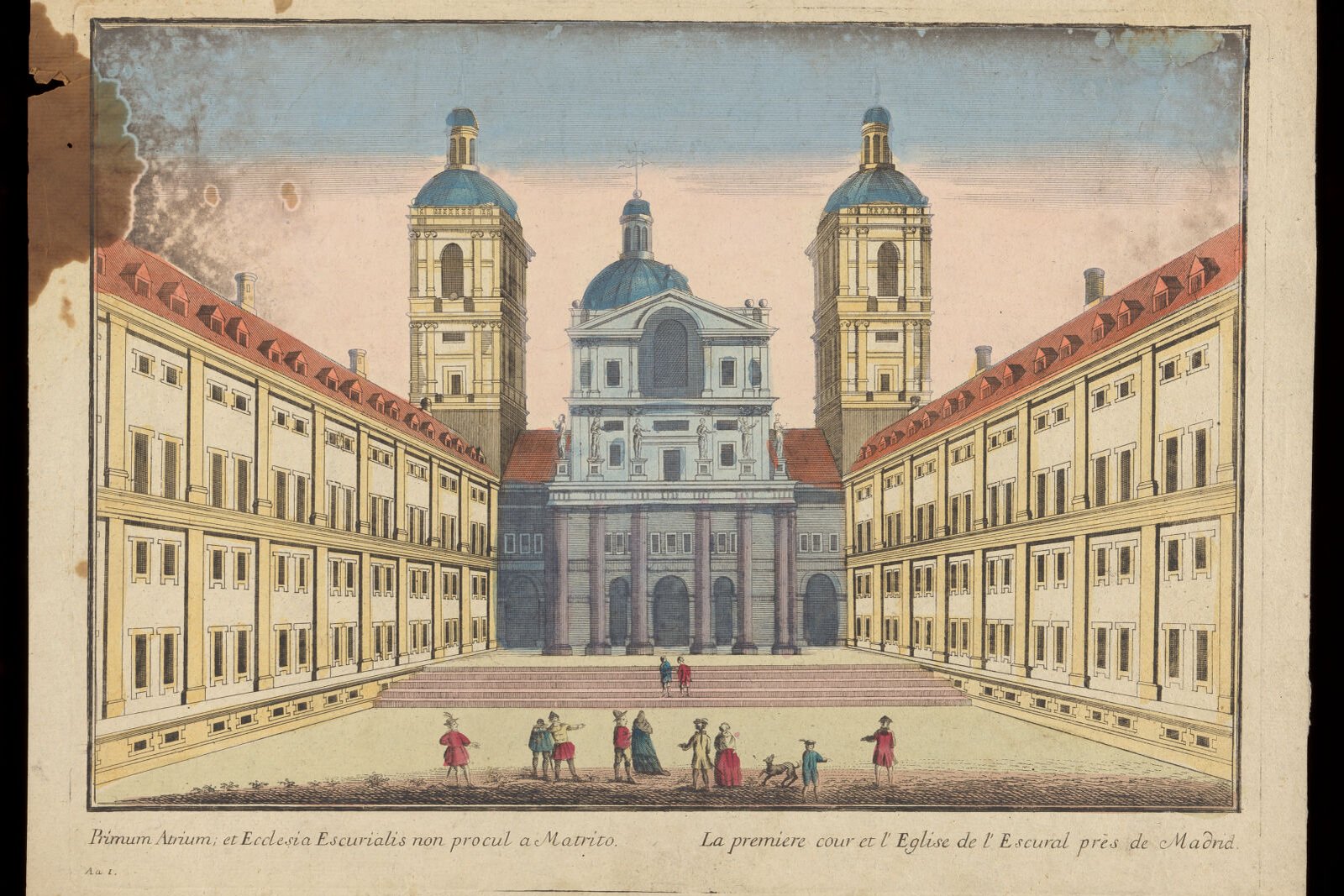
"Monastery of El Escorial, Madrid: Courtyard of the Kings, and the basilica," coloured etching, 18th century, Wellcome Collection — public domain.
Four institutions under one roof
What makes El Escorial genuinely unusual isn't just its size, but its combination of purposes. Philip fused four separate functions into a single continuous complex: a working Hieronymite monastery, staffed by monks whose ongoing duty was to pray for the souls of the Spanish royal dynasty; a royal palace, with living quarters from which the king governed a global empire; a grand basilica serving as the complex's religious centerpiece; and a royal pantheon, the burial place of the Spanish monarchy itself.
The relationship between these pieces was deliberately, almost obsessively symbolic. Philip's own private apartments were positioned immediately above the basilica's high altar, connected by a small window that let him observe Mass from his bed during his final illness without leaving his room. Below the altar, in turn, lay the crypt housing his ancestors and descendants. The arrangement placed the living king physically between the altar of God above and the tombs of his royal line below — an architectural statement about the monarchy's place between heaven and history that few other buildings in Europe attempt so literally.
Austerity as a statement
Compared to the ornate palaces of many of his royal contemporaries — the Alhambra's intricate Islamic-era decoration in Granada, for instance, or the elaborate French royal residences of the period — El Escorial's exterior is strikingly plain. Its walls are built from grey granite, its lines rigidly geometric, its facades almost entirely free of decorative flourish. Historians generally read this restraint as intentional on two levels: it reflected Philip's own famously austere personal piety, and it echoed the more disciplined religious temperament of the Counter-Reformation, the Catholic Church's broader effort to respond to the Protestant Reformation with renewed rigor and seriousness rather than ostentation.
The severity is not absolute, however — step inside, and the library in particular offers a striking contrast, its vaulted ceiling covered in vividly painted frescoes above shelves of rare manuscripts in Arabic, Hebrew, Greek, and Latin, a reminder that austerity of exterior form didn't mean an absence of scholarly or artistic ambition within.
A floor plan shaped like a gridiron
The connection to Saint Lawrence runs deeper than the dedication and the battle date — it shows up in the building's very footprint. Lawrence, an early Roman deacon and martyr, was according to tradition put to death on a gridiron, an iron grill used for roasting, and El Escorial's overall ground plan is widely described as echoing that shape: a large rectangular grid of courtyards and buildings, with a tower at each corner standing in for the gridiron's legs. Historians debate exactly how deliberate this symbolism was versus how much later observers have read into a practical, grid-like layout, but the association between the saint's method of martyrdom and the building's plan has stuck for centuries and remains part of how the site explains itself to visitors today.
Philip II was also an avid, even obsessive, collector of relics, and he channeled a significant part of that devotion into El Escorial specifically. He assembled one of the largest relic collections in Christendom at the time — reportedly thousands of individual items, from bone fragments to reliquary busts — and had much of it housed within the basilica and its side chapels, turning the building into not just a royal mausoleum but a kind of treasury of the communion of saints, gathered under one roof alongside the monarchy's own dead.
A pantheon for an empire
Beneath the basilica lies the Pantheon of the Kings, an octagonal crypt built specifically to hold the remains of Spanish monarchs. Nearly every Spanish king from Charles I — better known outside Spain as the Holy Roman Emperor Charles V — onward is buried there, making El Escorial the central royal mausoleum of the Spanish monarchy for more than four hundred years, a role it continues to serve today. Separate chambers nearby hold the remains of royal children and other family members, reflecting the same careful, almost bureaucratic sense of order that defines the building's architecture as a whole.
A monument to one king's vision
El Escorial was added to the UNESCO World Heritage List in 1984, recognized both for its architectural significance and for the unusually complete way it expresses the religious and political worldview of the monarch who built it. Few buildings anywhere manage to combine governance, worship, scholarship, and burial into a single coherent structure, and fewer still do it with the kind of restrained, deliberate severity Philip II and his architects chose. It remains, more than four centuries later, one of the clearest physical expressions of a single ruler's vision ever built in stone.
Trivia
What is El Escorial, exactly?
Who designed El Escorial?
Why is El Escorial's architecture described as austere?
Who is buried at El Escorial?
Can visitors see the library at El Escorial?
Related Reading