The Shrine of the Holy Face, Manoppello

A face on a cloth that shouldn't work
The image at the center of the Basilica of the Holy Face in Manoppello, a small town in Italy's Abruzzo region, presents an immediate visual puzzle. The cloth bearing the face is extraordinarily thin and fine — so fine that light passes through it, and the image is visible, in mirror form, from the reverse side as well as the front. Conservators and researchers who have examined the cloth closely have found no clear evidence of paint pigment sitting on the surface in the way an ordinary painted image would, which has fueled decades of speculation, scientific inquiry, and no small amount of overstated claims about how the image came to exist.
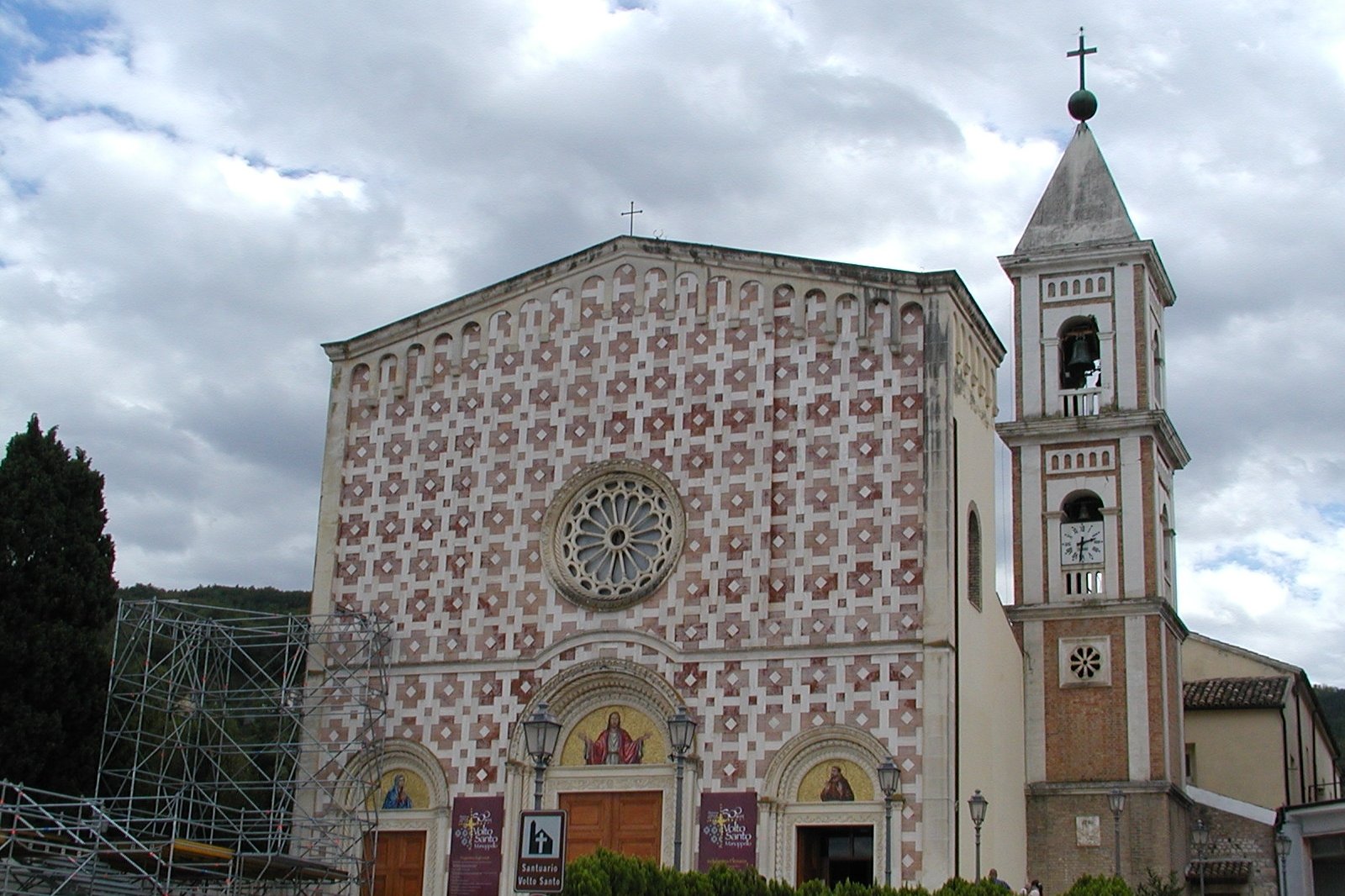
Shrine of the Holy Face, Manoppello, Italy (Ra Boe / Wikipedia, CC BY-SA 2.5, Wikimedia Commons)
What the shrine holds, whatever its ultimate origin, is a devotional image of real and long-standing significance to the town and to the many pilgrims who visit it. The Capuchin friars who now care for the relic have done so since the seventeenth century, maintaining both its physical preservation and the basilica built to house it, completed in the twentieth century to accommodate growing pilgrim numbers around what had, for centuries before that, been a much more modest local shrine.
The disputed connection to Veronica's Veil
The claim that draws the most attention to Manoppello — and the one that deserves the most careful handling — is the proposal that its cloth is the same relic long associated with Saint Veronica, the woman whose legendary encounter with Christ on the road to Calvary, wiping his face with her veil and receiving an imprint of it in return, became a fixture of Catholic devotional tradition, particularly the Stations of the Cross. A cloth long venerated in Rome under the name of Veronica's Veil is documented as having been kept and displayed at St. Peter's Basilica for centuries, but historical records indicate it went missing or became unaccounted for at some point around the early sixteenth century, and its subsequent fate has never been conclusively established.
Some researchers, most prominently a small number of scholars and clergy who have studied the Manoppello cloth intensively since the late twentieth century, have argued that the two objects — the Roman veil that disappeared and the cloth that surfaced in Manoppello around 1506 — are one and the same, pointing to the rough overlap in timing and to features of the image itself. This identification has attracted considerable popular and media attention, including support from some individual churchmen. It has not, however, been established as settled historical fact, nor has the Catholic Church issued an official, binding determination on the matter. Serious historians who have examined the question note that the physical and documentary evidence connecting the two objects remains circumstantial, and that plausible alternative explanations for the Manoppello image's origin have not been ruled out. The honest position, and the one this article takes, is that the connection to Veronica's Veil is a live, disputed hypothesis rather than a confirmed identification — a distinction the shrine itself, to its credit, is generally careful to maintain in its own official materials.
Arrival in a small Abruzzese town
The traditional account of the cloth's arrival in Manoppello holds that in 1506 an unidentified pilgrim brought it to the town and left it with a local family before vanishing, an origin story that — like many relic traditions across medieval and early modern Europe — is difficult to verify against independent documentary evidence from before that point. What can be traced with somewhat more confidence is the cloth's more recent custodial history: it passed between local families and a nearby church before the Capuchin order took over its care in the mid-seventeenth century, a stewardship that has continued to the present.
One detail that has drawn particular scientific interest is the proposed material of the cloth itself. Some researchers have suggested it may be byssus, an extremely fine and historically prized fabric sometimes called sea silk, produced from the filaments certain mollusks use to anchor themselves to rocks. Byssus was prohibitively expensive and technically very difficult to work with in ancient and medieval times, and it does not readily accept paint in the way ordinary linen or cotton does — a property researchers have cited as part of why the image's exact method of creation remains scientifically unresolved, rather than as proof of any specific supernatural origin.
The shrine today
Manoppello's basilica received significant papal recognition when Pope Benedict XVI visited the shrine in 2006, an important gesture of attention toward a relic that had, for much of its history, remained a relatively obscure regional devotion outside Abruzzo itself. That visit, along with growing scholarly and media interest over recent decades, has considerably raised the shrine's profile and pilgrim numbers.
Visitors today can view the Volto Santo displayed in an ornate frame within the basilica, and the town has developed a modest pilgrimage infrastructure to support the steady flow of visitors drawn by both devotion and simple curiosity about one of Christian relic history's more genuinely unresolved questions — a rare case where honest scholarly uncertainty, rather than settled tradition, is itself a significant part of the story.
Trivia
What is the Holy Face of Manoppello?
Is the Manoppello image the same as Veronica's Veil?
What does the Catholic Church officially say about the Manoppello image's authenticity?
How did the cloth arrive in Manoppello?
What material is the Holy Face image on, and why is that significant?
Related Reading