Subiaco: The Cave Where Benedictine Monasticism Began

A young man's flight from Rome
Around the year 500 AD, a young student named Benedict abandoned his studies in Rome and walked into the mountains east of the city, looking for nothing more than to be left alone. According to the account written a generation or two later by Pope Saint Gregory the Great in his Dialogues — the primary and, for long stretches of Benedict's life, only surviving source — Benedict had grown disgusted by the vice and moral decay he witnessed in Roman society, and chose deliberate withdrawal over continuing on the path his family and education had set for him.
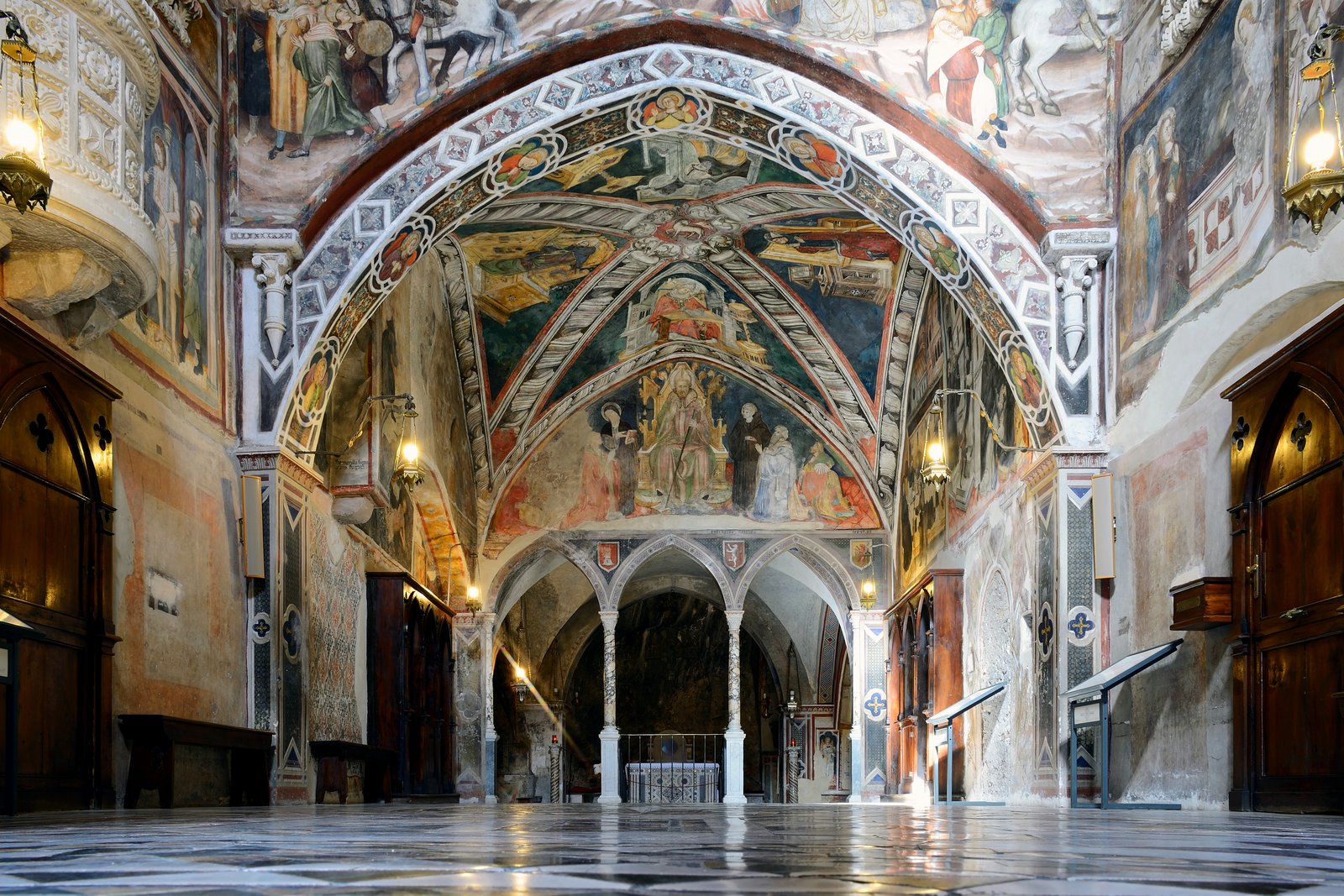
Photograph by Livioandronico2013, frescoed interior of the Sacro Speco monastery, Subiaco, 2015 — CC BY-SA 4.0, Wikimedia Commons.
He settled in a narrow, rocky cave above the town of Subiaco, in the valley of the Aniene River, with no intention of being noticed by anyone. A monk from a nearby community, Romanus, discovered him there and, respecting his desire for solitude while still ensuring his survival, began lowering bread to him on a rope through a small opening in the rock above the cave, ringing a bell to signal when it was ready. For roughly three years, by Gregory's account, Benedict lived this way — alone, largely unknown, wrestling privately with temptation and, according to the tradition surrounding this period, once rolling in a patch of nettles and briars to overcome a particularly strong temptation of the flesh, a detail preserved in devotional tradition rather than as documented historical fact.
From hermit to founder
Benedict's solitude didn't last. Shepherds discovered him, word spread of a holy man living in the cave, and disciples began to gather, drawn by his evident holiness and, soon enough, by miracles Gregory's account attributes to him. Rather than remain a solitary hermit, Benedict organized the growing community into twelve separate small monasteries in the valley around Subiaco, each housing about twelve monks under a superior, with Benedict himself overseeing all of them.
This arrangement at Subiaco represents Benedict's first practical experiment in structured communal monastic life — the laboratory, in effect, where the ideas he would later codify in his famous Rule began to take shape through direct experience of what worked and what didn't in guiding a community of men toward a shared life of prayer and labor. Not every early attempt succeeded: Gregory's account also describes an episode in which monks from one of these communities, resentful of Benedict's discipline, allegedly attempted to poison him, and Benedict, upon realizing what had happened, left to found what would become his most famous monastery at Monte Cassino instead.
The cave enclosed in stone
The cave Benedict once inhabited alone is still there, and it's still the spiritual heart of Subiaco — though it's no longer exposed to the mountainside. Starting in the twelfth century, and continuing through the thirteenth and fourteenth, a monastery was built directly into the cliff face of Monte Taleo, wrapping the cave in a series of chapels, staircases, and terraces stacked vertically against the rock, so that the entire complex — known today as the Sacro Speco, or "holy cave" — seems to grow organically out of the mountain itself rather than having been built beside it.
Inside, the walls are covered with frescoes dating from the thirteenth through fifteenth centuries, painted by generations of largely anonymous monastic artists, depicting scenes from Benedict's life alongside one of the earliest known portraits of Saint Francis of Assisi, painted from life or close to it during a visit he reportedly made to Subiaco in the early thirteenth century — a portrait notable for showing Francis without the halo and stigmata later iconography would universally add.
A community that shaped the printed word
Subiaco's significance didn't end with the medieval period. One of the original twelve monasteries Benedict founded in the valley, Santa Scolastica — named for Benedict's twin sister, herself a founder of women's monastic life — became, in 1465, the site of the very first printing press operated anywhere in Italy. Two German monks, trained in techniques developed by associates of Johannes Gutenberg, set up the press there just a decade after Gutenberg's original innovation in Mainz, printing some of the earliest books produced on Italian soil.
Why Subiaco still matters
Subiaco rarely draws the crowds that flock to Monte Cassino or Rome's major basilicas, and that relative quiet suits its character well. What began here wasn't a grand architectural statement but a young man's retreat from the world, followed by the slow, incremental discovery of what a shared monastic life required — trial, failure, adjustment, and eventually a Rule so balanced and humane in its approach to prayer, labor, and community life that it would go on to shape the entire structure of Western monasticism for the next fifteen hundred years. The cave is still there, still enclosed in stone, still the place monastic historians point to when they want to identify exactly where that long history began.
Trivia
Who founded the monastery at Subiaco?
What is the Sacro Speco and why is it significant?
When was the current monastery structure built?
How did Benedict end up living alone in a cave near Subiaco?
What connection does Subiaco have to the printing press?
You May Also Like
Related Reading