The Nativity in Renaissance Art: Reinventing the Manger

From symbol to scene
Earlier medieval depictions of the Nativity tended toward the schematic: a small, stylized manger, a haloed Christ Child rendered at an oddly adult scale, figures arranged in flat, symbolic rows more concerned with theological clarity than physical plausibility. Renaissance painters, working through the fifteenth and sixteenth centuries against a backdrop of renewed interest in naturalistic observation, classical architecture, and mathematical perspective, transformed the subject almost completely. The manger became a specific, physically convincing place — weathered wood, scattered straw, sometimes crumbling ancient stonework — populated by figures whose faces, hands, and postures suggested real individuals reacting to an extraordinary event unfolding in front of them, rather than symbolic placeholders arranged for doctrinal legibility.
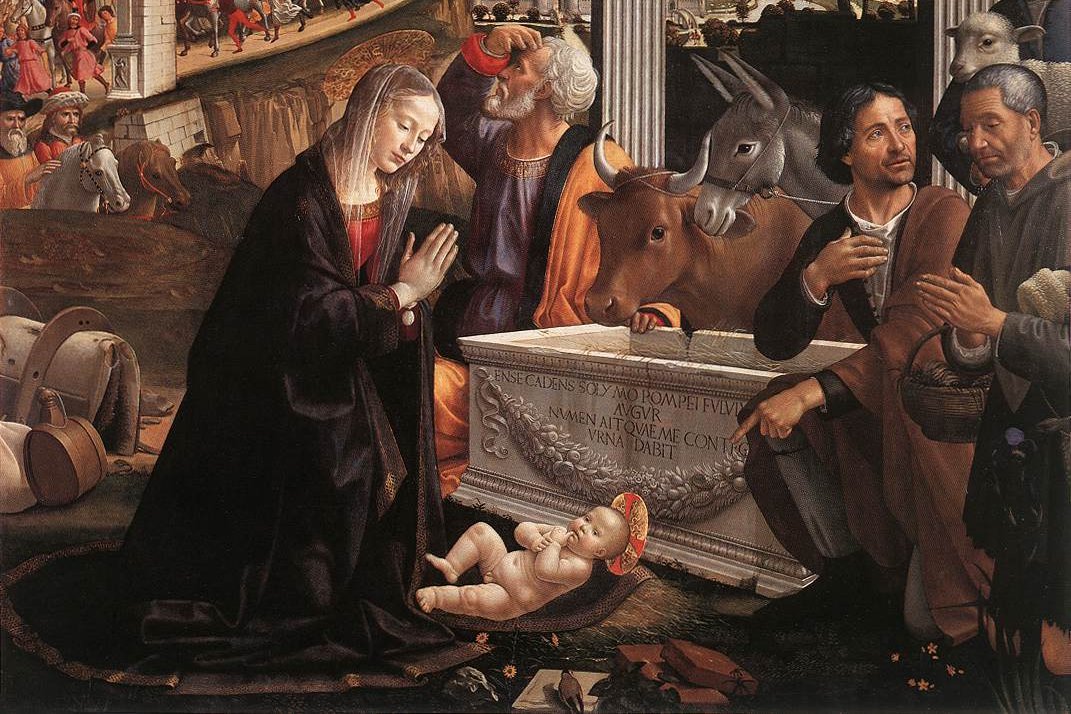
Domenico Ghirlandaio, "Adoration of the Shepherds," 1485, Sassetti Chapel, Santa Trinita, Florence — public domain.
Ruins with a purpose
One of the most distinctive Renaissance innovations was setting the Nativity amid the ruins of classical Roman architecture — broken columns, crumbling arches, sometimes an actual ancient sarcophagus repurposed as the manger itself. This was never simply decorative. Renaissance viewers, deeply immersed in a cultural moment recovering and reinterpreting classical antiquity, read these ruins as a pointed theological statement: the old pagan order, literally crumbling in the background, giving way to the new Christian era being born in the scene's foreground. Domenico Ghirlandaio's Adoration of the Shepherds, painted in 1485 for the Sassetti Chapel in Florence's Santa Trinita, makes this connection unusually explicit — the manger is an actual ancient Roman sarcophagus, inscribed with an invented Latin epitaph referring to a pagan figure supposedly killed by a spear, a detail contemporary viewers would have recognized as foreshadowing Christ's own eventual death by a spear-wound at the Crucifixion.
Shepherds who look like they walked in from the fields
Luke's Gospel describes ordinary shepherds "living in the fields and keeping the night watch over their flock" (Luke 2:8, NABRE) who are told of Christ's birth by an angel and hurry to see the child for themselves. Renaissance painters increasingly leaned into the ordinariness of these witnesses, painting shepherds with weathered, individualized faces, worn work clothes, and postures of genuine astonishment or humble reverence — a far cry from the more generic, uniform figures of earlier medieval art. Ghirlandaio's shepherds in the Sassetti Chapel are a good example: rough-looking rural men, one with visibly dirty bare feet, kneeling with an unmistakable sincerity that would have felt recognizably human to a fifteenth-century Florentine viewer, closing the emotional distance between a divine event and an ordinary observer.
Light as theology
A recurring and increasingly popular device across Renaissance and later Nativity paintings was making the infant Christ himself the primary source of illumination in the scene, his body radiating a soft glow that lit the surrounding faces of Mary, Joseph, and the shepherds from below or nearby, rather than relying on an external light source like a lamp, fire, or open sky. Beyond its striking visual effect, the device carried real theological weight, subtly identifying the newborn Christ with light itself, echoing the Gospel of John's description of Christ as "the light of the world" and "the true light" that "enlightens everyone" (John 1:9). This treatment, developed with particular influence from Netherlandish painting, would go on to become one of the most recognizable conventions of Nativity imagery for centuries afterward.
Two feasts, two scenes
Renaissance workshops frequently distinguished between two related but separate Nativity subjects: the Adoration of the Shepherds, drawn from Luke 2:8-20 and showing local shepherds arriving shortly after the birth, and the Adoration of the Magi, drawn from Matthew 2:1-12 and showing the wealthier foreign visitors, traditionally numbered at three, who arrived later bearing gold, frankincense, and myrrh. The two subjects offered painters different opportunities — the Magi scene allowed for lavish costume, exotic retinue, and courtly spectacle well suited to wealthy patrons who commissioned altarpieces for private family chapels, while the Adoration of the Shepherds leaned toward humility, rural simplicity, and intimate emotional directness. Many artists painted both subjects multiple times across their careers, adapting the underlying formula to each patron's particular commission. Readers interested in the wider visual tradition these paintings belong to can find more in our guide to Catholic sacred art.
Joseph at the margins
Saint Joseph appears in nearly every Renaissance Nativity, but almost always positioned at the scene's edge or in its background, frequently depicted as notably older than Mary and somewhat physically withdrawn from the central action around the Christ Child. This placement reflected the period's prevailing theological emphasis on Mary's unique, central role in the Incarnation, with Joseph's presence read primarily as protective and supporting rather than active. Some painters used Joseph's positioning to add a note of quiet, contemplative humanity to the scene — a tired, watchful older man, sometimes shown dozing or resting after a long journey, grounding the otherwise miraculous event in recognizable human fatigue.
A subject that never stopped evolving
By the close of the Renaissance, the Nativity had been thoroughly transformed from a symbolic diagram into one of European painting's richest opportunities for combining landscape, architecture, portraiture, and theological meaning within a single scene. Painters across Italy and Northern Europe kept returning to it precisely because it offered so much room for innovation within a single, universally recognized subject — proof that even the most familiar sacred stories could still surprise viewers, generation after generation, when painters found a genuinely new way of looking at them.
Trivia
Why do so many Renaissance Nativity paintings show classical ruins instead of a stable?
What is the difference between an Adoration of the Shepherds and an Adoration of the Magi?
How did Renaissance painters change how light was used in Nativity scenes?
Why does Ghirlandaio's Adoration of the Shepherds include a Roman sarcophagus?
Did Renaissance Nativity paintings usually include Saint Joseph prominently?
Related Reading