Leonardo da Vinci's The Last Supper

A commission for a Dominican dining hall
Around 1495, Leonardo da Vinci was working in Milan under the patronage of Duke Ludovico Sforza when he was commissioned to paint a mural on the north wall of the refectory at the Convent of Santa Maria delle Grazie — the room where the resident Dominican friars ate their daily meals. The subject was a natural fit for a monastery's dining hall: the Last Supper, the meal Christ shared with his twelve apostles the night before his Crucifixion, during which — as the Gospel of Matthew records — he told them plainly, "one of you will betray me" (Matthew 26:21, RSV-CE), setting off a wave of confusion and denial around the table. This is the same biblical event examined in more theological depth in The Last Supper and the Institution of the Eucharist; this article focuses instead on Leonardo's specific painting — how he built it, why it nearly disappeared, and what makes its composition so enduringly studied.
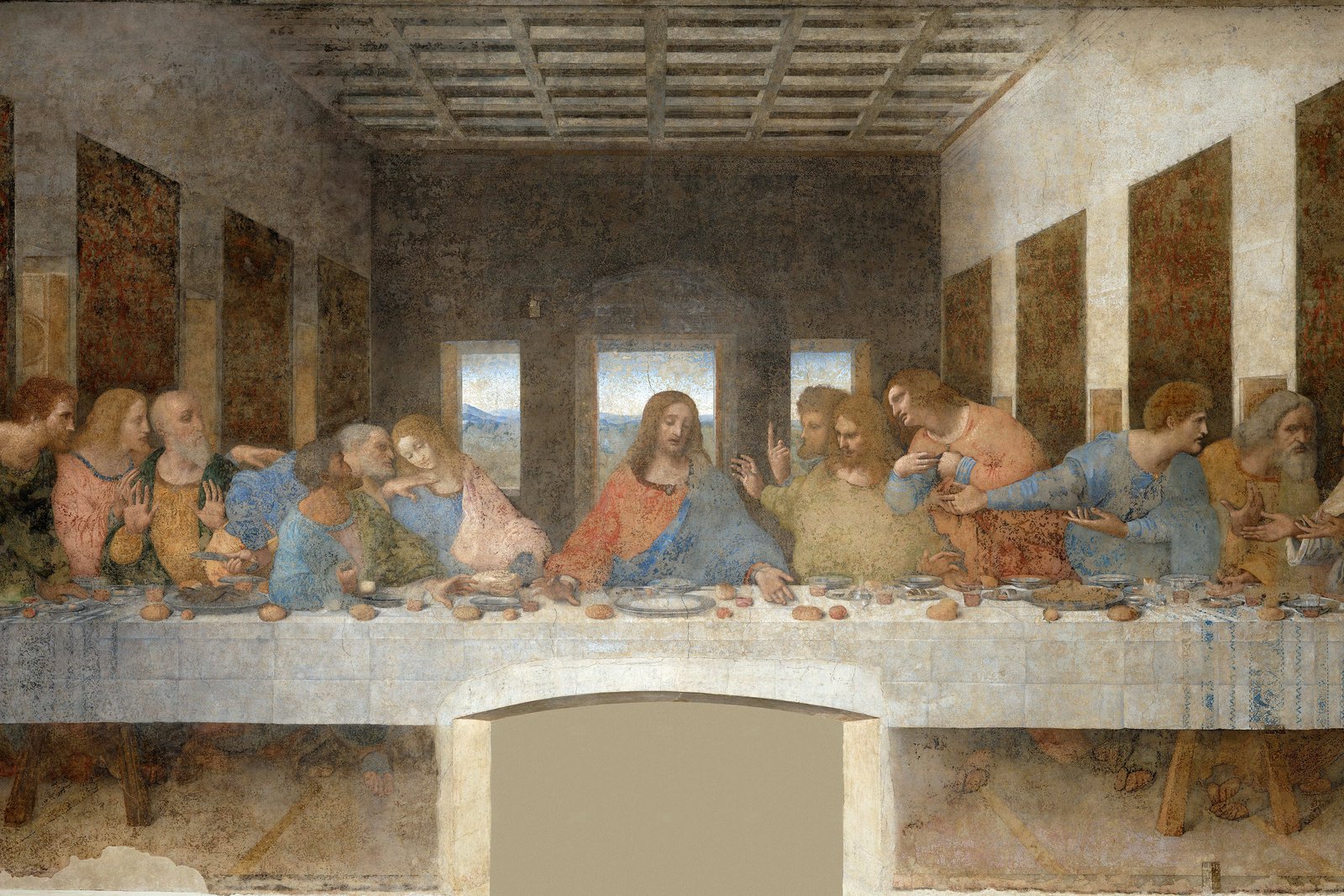
Leonardo da Vinci, "The Last Supper," 1495-98, Santa Maria delle Grazie, Milan — public domain.
Leonardo worked on the mural for roughly three years, an unusually long span for a wall painting of its size, reportedly pausing for long stretches to think through individual faces and gestures before committing brush to plaster. Contemporary accounts, including one from the writer Matteo Bandello who observed Leonardo at work, describe him standing before the wall for hours without painting a single stroke, then suddenly adding a few details and leaving again — a working method that frustrated the prior of the convent but that Leonardo defended as essential to getting each apostle's expression exactly right.
The technical gamble that doomed the original
True fresco painting requires an artist to apply pigment directly into wet plaster, which chemically bonds the color to the wall as it dries — a technique that produces extraordinary durability but demands speed, since the artist must finish each section before the plaster sets. Leonardo, who preferred to work slowly and revise as he went, rejected fresco for The Last Supper and instead experimented with a dry wall technique, applying a mixture of tempera and oil paint onto plaster that had already dried. The approach gave him the flexibility he wanted, but the paint adhered poorly to the wall surface, and the room's humidity — worsened by its use as a dining hall with steam and smoke from meals — accelerated the damage. Reports of flaking and deterioration surfaced within Leonardo's own lifetime; by the mid-1500s, Vasari described the painting as already a "muddle of blots," and by the seventeenth century a doorway was even cut through the bottom of the wall, removing Christ's feet from the composition entirely.
Reading the composition
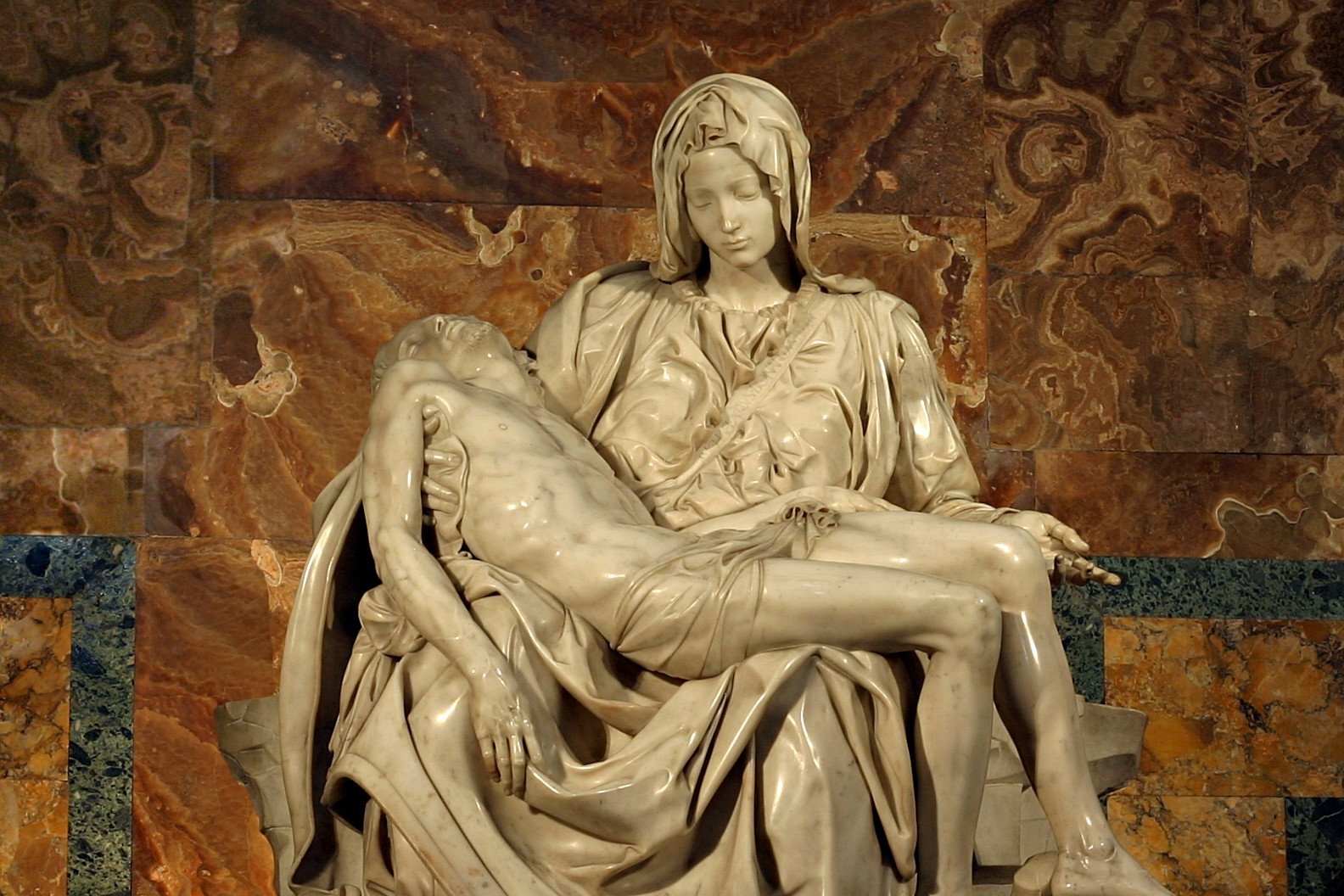
Leonardo organized the thirteen figures into four groups of three apostles each, flanking Christ at the center, who sits calm and isolated amid the visual chaos around him — his figure forms a stable triangle, echoing the same geometric discipline seen a few years earlier in Michelangelo's Pietà, though applied here to an entirely different medium and subject. Each cluster of apostles reacts to Christ's announcement of betrayal with a distinct combination of shock, denial, anger, or quiet withdrawal — Leonardo used hand gestures and body language rather than facial expression alone to individualize each figure, a technique he had studied extensively through preparatory sketches, several of which survive today in museum collections. Judas, rather than being isolated at the opposite end of the table as in most earlier depictions of the scene, sits among the other apostles, leaning back into shadow with his face partly obscured — identifiable mainly by the small bag of coins he clutches and his defensive posture, a subtler form of visual condemnation than the blunt separation older compositions relied on.
The room itself extends the real architecture of the refectory through painted linear perspective, with the vanishing point converging precisely at Christ's head — a device that makes the mural feel like a continuation of the physical dining hall rather than a separate painted scene, reinforcing the sense that the friars eating below were sharing a room with the biblical meal itself.
Centuries of attempted repair
The painting's fragile condition prompted repeated restoration attempts over the centuries, many of which did more harm than good. Restorers in later periods repainted damaged sections entirely, sometimes altering faces and details in ways that drifted from Leonardo's original work, and a 1943 Allied bombing raid during World War II destroyed the refectory's roof, though the wall bearing the painting — protected in advance by sandbags — miraculously survived largely intact. The most significant modern restoration, led by conservator Pinin Brambilla Barcilon, ran from 1978 to 1999, using microscopic analysis and painstaking removal of centuries of overpainting, dirt, and glue applied by earlier restorers to recover as much of Leonardo's authentic surface as could be salvaged. The result, unveiled in 1999, is inevitably a partial painting — entire passages are lost beyond recovery — but it represents the closest look at Leonardo's original intentions available since the work began deteriorating five centuries ago.
A painting that shaped how the scene would be imagined ever after
Despite its damaged state, The Last Supper became the definitive visual template for how the scene would be imagined in Western art and popular culture for the following five centuries, copied, referenced, and reproduced more than almost any other religious painting in history. Its influence extends well beyond fine art, having become instantly recognizable even to viewers with no particular religious background — a testament to how thoroughly Leonardo's specific staging of the moment, apostles reacting in dramatic clusters around a calm central Christ, displaced every earlier version of the same subject in the popular imagination.
Trivia
Where is Leonardo da Vinci's The Last Supper located?
Why did Leonardo's Last Supper start deteriorating so quickly?
How is The Last Supper different from other paintings of the same scene?
How long did the major 20th-century restoration of The Last Supper take?
Can visitors still see The Last Supper today?
Related Reading