Michelangelo's Pietà


A cardinal's tomb, a young sculptor's chance
In 1497, a French cardinal living in Rome named Jean de Bilhères de Lagraulas wanted a striking marble monument for his eventual tomb in Old St. Peter's Basilica. He turned to a sculptor still in his early twenties who had already impressed Roman patrons with smaller commissions — Michelangelo Buonarroti, freshly arrived from Florence. The contract, signed in 1498, specified an unusually ambitious brief: a Pietà (Italian for "pity" or "compassion"), the traditional image of the Virgin Mary cradling the dead body of her son after the Crucifixion, and it demanded that the work be "the most beautiful work in marble which exists today in Rome, one that no living artist could better." Michelangelo delivered on that bravado within about a year, working the marble himself from a single, nearly flawless block quarried at Carrara.
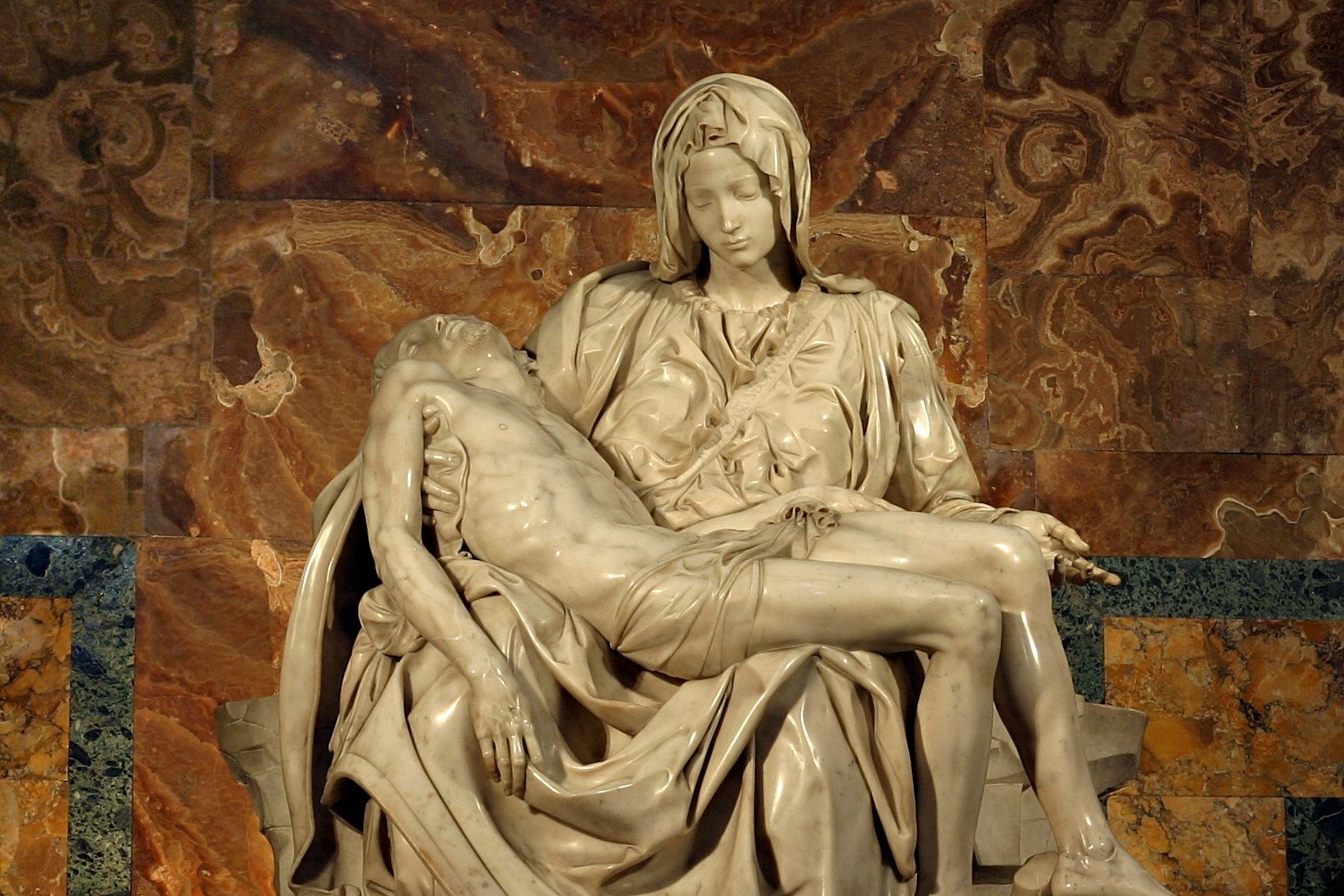
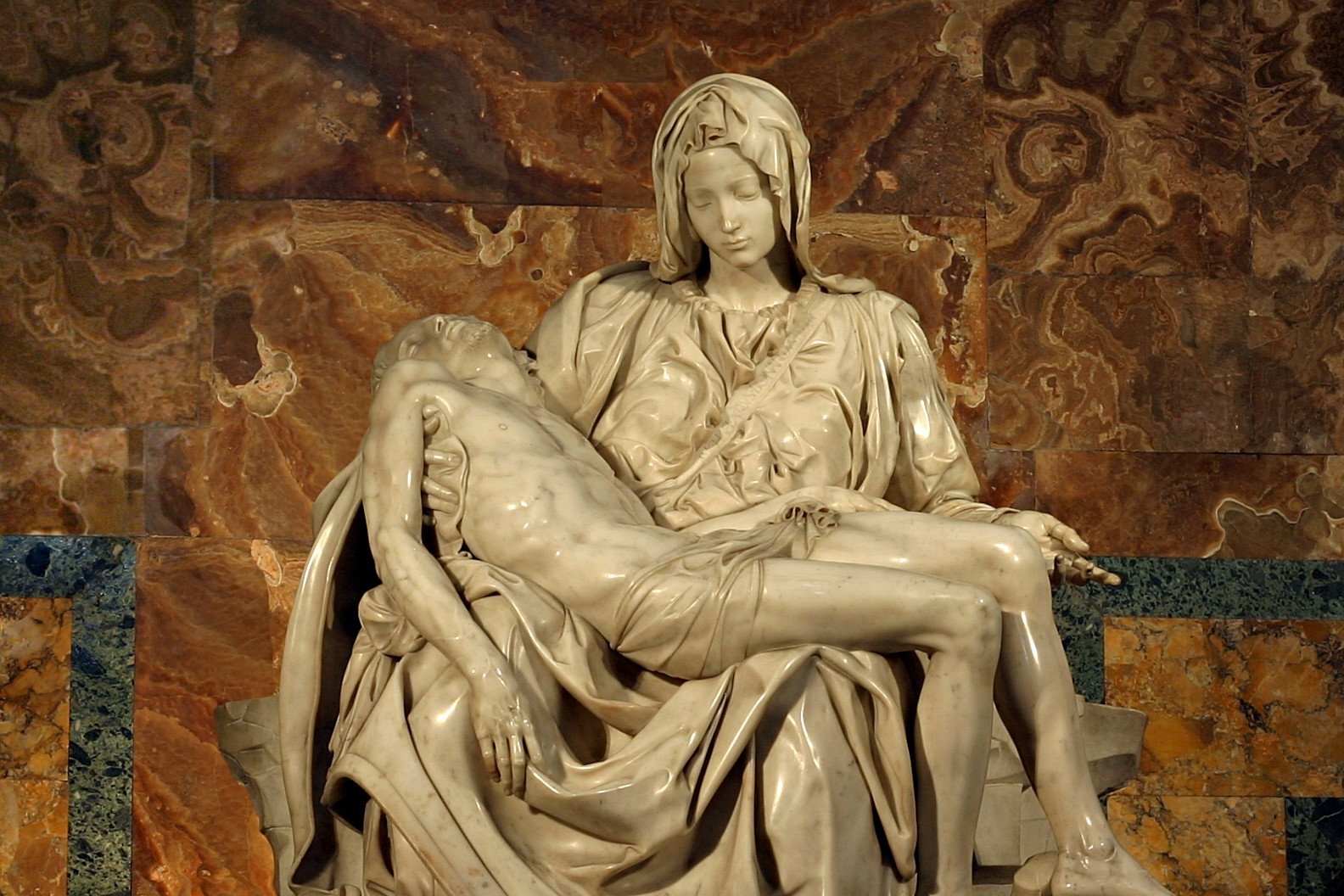
Michelangelo, "Pietà," 1498-99, St. Peter's Basilica, Vatican City. Photo by Stanislav Traykov, CC BY 2.5, via Wikimedia Commons.
The theme of the Pietà had a long tradition in Northern European devotional art before Michelangelo touched it, especially in Germany and France, where such statues were often carved with a stiff, almost geometric sorrow — Mary shown as an old, grieving mother, her son's body rigid and awkwardly proportioned across her knees. Michelangelo, trained in the classical humanism of Florence, discarded that formula entirely. His Mary is youthful, her drapery falls in naturalistic folds that seem to move with real weight, and Christ's body — anatomically studied with a precision Michelangelo had developed through actual dissection — lies across her lap with a relaxed, almost sleeping quality rather than the stiffness of earlier versions. The result reads less like a symbol of grief and more like a captured moment, which is precisely what made it so startling to contemporaries.
Reading the composition
The sculpture solves a genuine engineering and visual problem: how do you seat a full-grown man's body across a seated woman's lap without the composition looking either cramped or absurdly oversized? Michelangelo's solution was to enlarge Mary's frame and drape her in voluminous robes that create a broad, stable base — if she stood up, art historians have noted, she would tower well over Christ's own height, but the seated pyramid of drapery disguises the disproportion completely. That pyramidal structure, wide at the base and narrowing toward Mary's bowed head, was itself a hallmark of the emerging High Renaissance style, echoed a few years later in compositions like Leonardo da Vinci's Last Supper, which similarly used geometric structure to organize a scene of intense emotion.
Mary's face carries almost no visible anguish — no contorted brow, no tears. Her expression is instead a quiet, inward resignation, one hand turned open beneath Christ's arm as if offering him, and by extension her grief, to the viewer directly. This restraint departed sharply from the more theatrical anguish common in earlier Pietà sculptures and became one of the defining qualities critics point to when discussing Michelangelo's particular gift for conveying deep emotion through stillness rather than gesture.
The signature story
According to Giorgio Vasari, whose Lives of the Artists (1550) remains the primary early source for many stories about Renaissance masters, Michelangelo initially left the work unsigned. Sometime after its unveiling, he reportedly overheard a group of visitors from Lombardy attributing the sculpture to a rival sculptor, Cristoforo Solari. Furious at the misattribution, Michelangelo is said to have returned that night with his chisel and carved, across the diagonal sash crossing Mary's chest: "MICHAEL•A[N]GELVS•BONAROTVS•FLORENT[INVS]•FACIEBA[T]" — "Michelangelo Buonarroti of Florence made this." He reportedly regretted the outburst of pride afterward and resolved never to sign another work, which — whether or not the anecdote is recorded with full accuracy — remains consistent with the historical fact that no other surviving Michelangelo sculpture bears his name.
Why Mary looks so young
The most debated detail of the Pietà is Mary's age. Historically, a Pietà shows a mother mourning a 33-year-old son, yet Michelangelo carved her with the smooth, unlined face of a young woman — closer in apparent age to Christ than a realistic mother would be. Condivi's near-contemporary biography records Michelangelo's own explanation: he held that a woman's chastity kept her looking fresh and youthful far longer than ordinary aging would allow, and so Mary's face reflected her spiritual purity rather than her literal years. Whether this was Michelangelo's actual private reasoning or a later polished explanation offered to admirers, it fits a broader Renaissance tendency to treat Mary's appearance as an expression of theological truth — her Immaculate Conception and lifelong sinlessness, in Catholic tradition — rather than strict biological realism. Murillo's later paintings of the Immaculate Conception draw on this same tradition of representing Mary's purity through an idealized, ageless appearance.
Damage, restoration, and the glass barrier
The Pietà survived nearly five centuries largely intact until May 21, 1972, when a Hungarian-Australian geologist named Laszlo Toth climbed the altar rail and struck the sculpture some fifteen times with a hammer while shouting that he was Christ, severely damaging Mary's left arm, which broke off at the elbow, along with parts of her nose, eyelid, and veil. The attack, captured in photographs that circulated worldwide, prompted a months-long restoration effort using recovered marble fragments and powdered marble dust mixed with resin to rebuild the missing pieces. Since the restoration was completed, the sculpture has been displayed behind a bulletproof acrylic glass screen in St. Peter's Basilica, a protective measure that, while necessary, means visitors today view the work from a greater distance than Michelangelo's original contemporaries did.
A youthful masterpiece that set the standard
The Pietà was finished before Michelangelo turned 25, yet it immediately established him as the preeminent sculptor of his generation, years before the David or the Sistine Chapel ceiling. Its influence on how later artists approached scenes of the Virgin's grief was immense, shaping devotional art across Catholic Europe for centuries. For an artist whose long career would range across sculpture, painting, and architecture, the Pietà remains a singular case: a work of total technical control paired with genuine emotional restraint, carved by a young man still years away from the fame that would eventually surround his name.
Trivia
How old was Michelangelo when he carved the Pietà?
Why is Mary shown so young in the Pietà, even though Christ was 33 when he died?
Is the Pietà the only work Michelangelo ever signed?
Has the Pietà ever been damaged?
Where can you see Michelangelo's Pietà today?
Related Reading