Raphael's Sistine Madonna

An altarpiece for a monastery, not a museum
Raphael painted the Sistine Madonna around 1512, near the height of his career in Rome, working under commission from Pope Julius II for the church of the Benedictine monastery of San Sisto in Piacenza, a city in northern Italy that had recently come back under papal control. Unlike many Renaissance altarpieces designed as fixed architectural panels, this one was painted as a large, freestanding canvas meant to be placed directly above the high altar, where the parted green curtains at either side of the composition would have appeared to open dramatically onto the vision within — Mary descending through clouds with the Christ Child in her arms, as if the painting itself were a window opening onto a heavenly apparition rather than a static devotional image.
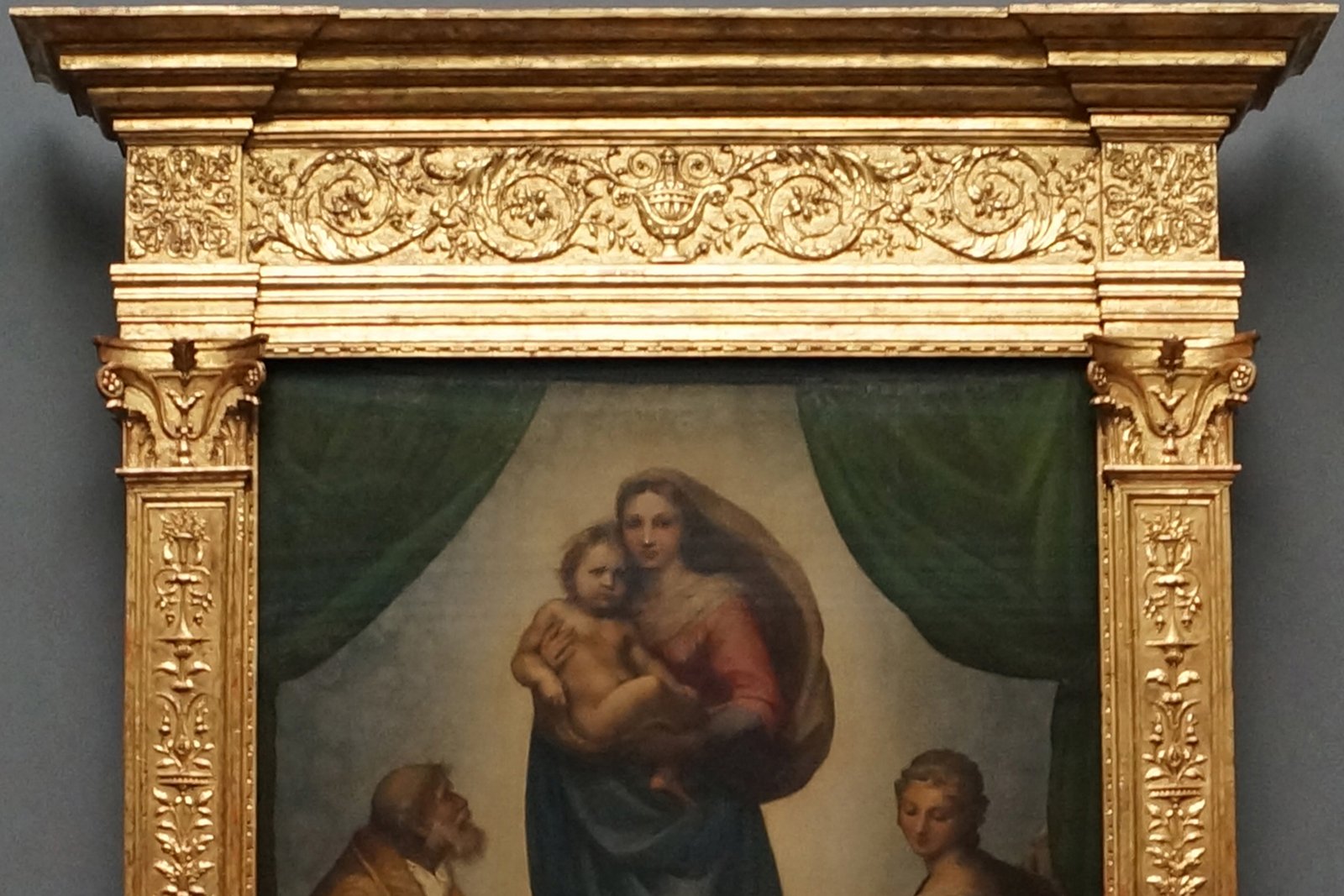
Raphael, "Sistine Madonna," 1512, Gemäldegalerie Alte Meister, Dresden — public domain.
The choice of San Sisto as the destination and Saint Sixtus II as one of the two saints flanking Mary was likely more than coincidental. Julius II's birth name was Giuliano della Rovere, but he had also served as a cardinal under the title connected to Saint Sixtus, and some historians connect the commission to the transfer of Sixtus's relics to the monastery around the same period — giving the altarpiece a specific local and papal significance beyond its general Marian subject.
The composition: parted curtains and a vision descending
The painting's structure is unusual for its period in how directly it stages itself as a vision. Green curtains, drawn back at the top corners as if by an unseen hand, frame the scene and suggest the viewer is being given privileged access to something normally hidden. Mary stands on clouds, barefoot, carrying the Christ Child, her gaze directed outward toward the viewer rather than down at her son — a departure from the more inward, tender mother-and-child compositions common in earlier Madonna paintings. Saint Sixtus kneels to the left in his papal vestments, gesturing with his hand toward the viewer as though presenting the vision or interceding on behalf of the faithful looking up at the altarpiece from below. Saint Barbara, a third-century martyr venerated for her steadfast faith under persecution, kneels opposite him on the right, her gaze cast modestly downward toward the two cherubs at the base of the composition, providing a visual bridge between the heavenly upper register and the earthly lower edge of the canvas.
Beneath a wispy layer of clouds that, on close inspection, resolve into the faces of countless additional cherubim, Mary's descent gives the whole composition a sense of weightless movement rarely achieved in earlier Madonna imagery, which more often depicted Mary enthroned in static majesty. This dynamic quality — a mother in motion, her robes and the child's pose caught mid-gesture — reflects the High Renaissance interest in capturing convincing physical movement within an idealized, harmonious composition, an interest Raphael shared with contemporaries including Leonardo, whose Last Supper similarly organizes intense emotion within a stable geometric framework, even though the two paintings differ completely in subject and mood.
The cherubs that outgrew the painting
At the very bottom edge of the canvas, resting their folded arms on what appears to be a ledge or the frame's lower border, two winged putti gaze upward with an expression somewhere between boredom and wistful curiosity. Within Raphael's original composition, they functioned as a modest transitional device — figures positioned at the literal bottom threshold of the vision, bridging the viewer's earthly vantage point and the heavenly scene above. Nothing about their original placement suggested they would become independently famous.
That independent fame developed almost entirely after Raphael's death, as engravings, prints, and eventually mass-produced reproductions isolated the two cherubs from the rest of the composition, turning a minor compositional detail into one of the most recognized images in Western visual culture — reprinted so widely on postcards, stationery, and decorative objects that many people who instantly recognize the cherubs have never seen, or even heard of, the full altarpiece they originally belonged to. Art historians sometimes cite this split reception as a case study in how detail and whole can travel completely different cultural paths once an image enters mass reproduction.
From an Italian monastery to a German royal collection
The Sistine Madonna remained above the altar at San Sisto for over two centuries before Augustus III, the Elector of Saxony and King of Poland, purchased it from the monks in 1754 for a substantial sum, adding it to his royal art collection in Dresden. The purchase was part of a broader pattern of European royal courts acquiring major Italian Renaissance works during the eighteenth century, and the painting's arrival in Dresden reportedly caused enough excitement that, according to one frequently repeated (though likely embellished) account, Augustus himself moved his throne to make room for the canvas. It has remained in Dresden ever since, surviving the Second World War in a Soviet-controlled evacuation before being returned to what is now the Gemäldegalerie Alte Meister museum, where it remains one of the collection's most visited works — a testament to how thoroughly a painting made for a small Italian monastery church went on to become one of the defining images of the Renaissance in the popular imagination.
Trivia
Why is it called the Sistine Madonna if it's in Germany, not the Vatican's Sistine Chapel?
Who commissioned the Sistine Madonna and why?
Who are the two saints kneeling beside the Virgin Mary in the painting?
Are the two cherubs at the bottom of the painting a later addition?
How did the Sistine Madonna end up in Dresden?
You May Also Like
Related Reading